Minjun's Story : My English Journey in New York
뉴욕에서 시작하는 영어 이야기
PART 1 : Story
Chapter 1 : 꽃 한 송이, 꽃 여러 송이 / One Flower, Some Flowers
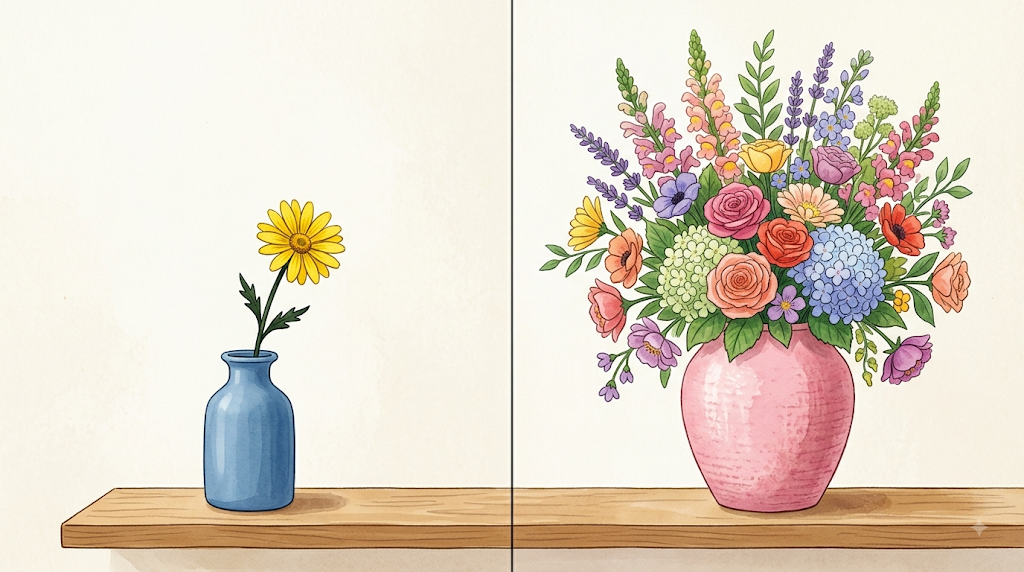
Ms. Williams shows two vases.
윌리엄스 선생님이 화병 두 개를 보여주십니다.
One has a single flower: "a flower."
하나는 꽃 한 송이가 있어요: "꽃 한 송이."
The other has many: "some flowers."
다른 하나는 여러 송이가 있어요: "꽃 몇 송이."
Ms. Williams writes: "The plural of a noun is usually -s."
윌리엄스 선생님이 쓰십니다: "명사의 복수형은 보통 -s입니다."
She writes examples.
선생님이 예문을 쓰십니다.
a flower → some flowers
a train → two trains
one week → a few weeks
a nice place → some nice places
this student → these students
Carlos looks at the pattern.
카를로스가 패턴을 봅니다.
He says: "So most nouns just add s for plural, simple as that?"
그가 말합니다. "그러면 대부분의 명사는 복수형에 그냥 s만 붙이는 거네요, 간단하게?"
Ms. Williams nods: "Exactly right, Carlos. But there are spelling rules for some endings."
선생님이 고개를 끄덕입니다. "정확해요, 카를로스. 하지만 일부 어미에는 철자 규칙이 있어요."
She writes: "-s / -sh / -ch / -x → -es."
선생님이 쓰십니다: "-s / -sh / -ch / -x → -es."
bus → buses / dish → dishes / church → churches / box → boxes
also potato → potatoes / tomato → tomatoes
She writes: "-y → -ies."
선생님이 쓰십니다: "-y → -ies."
baby → babies / dictionary → dictionaries / party → parties
but -ay / -ey / -oy → -ys:
day → days / monkey → monkeys / boy → boys
She writes: "-f / -fe → -ves."
선생님이 쓰십니다: "-f / -fe → -ves."
shelf → shelves / knife → knives / wife → wives
👩🏫 Ms. Williams says:
"The plural of a noun is usually -s."
The plural of a noun is usually -s:
명사의 복수형은 보통 -s입니다:
a flower → some flowers
a train → two trains
one week → a few weeks
a nice place → some nice places
this student → these students
Spelling:
철자 규칙:
-s/-sh/-ch/-x → -es: bus → buses / dish → dishes / church → churches / box → boxes
also: potato → potatoes / tomato → tomatoes
-y → -ies: baby → babies / dictionary → dictionaries / party → parties
but -ay/-ey/-oy → -ys: day → days / monkey → monkeys / boy → boys
-f/-fe → -ves: shelf → shelves / knife → knives / wife → wives
📐 Grammar Point : 복수형 철자 규칙
| -s/-sh/-ch/-x | -es | bus → buses |
| -y (자음+y) | -ies | baby → babies |
| -ay/-ey/-oy | -ys | day → days |
| -f/-fe | -ves | knife → knives |
✅ some flowers, two trains
✅ shelf → shelves
Chapter 2 : 항상 복수인 물건들 / Things That Are Always Plural
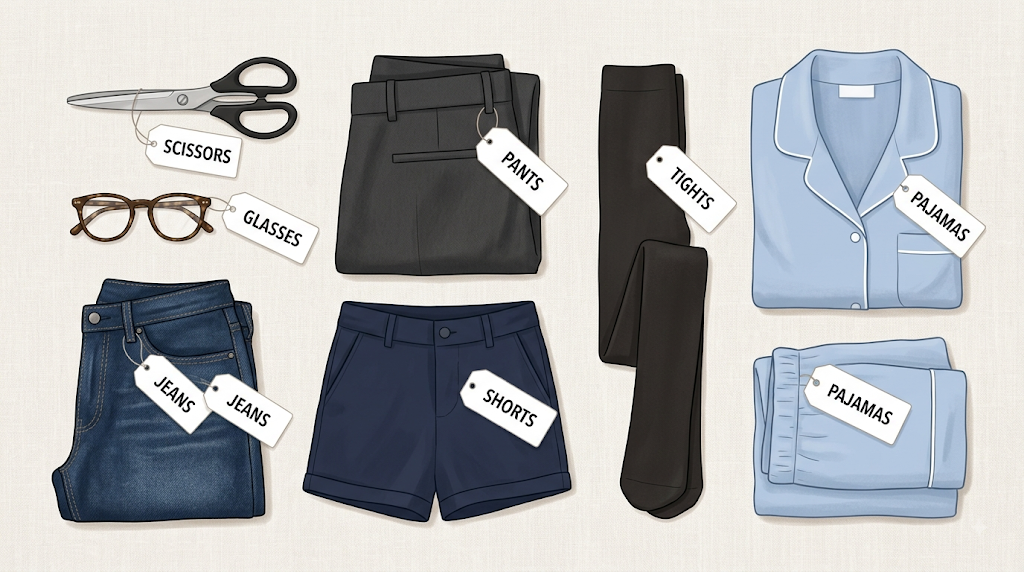
Ms. Williams writes: "These things are plural in English."
윌리엄스 선생님이 쓰십니다: "이것들은 영어에서 복수형입니다."
She shows a row of items: scissors, glasses, pants, jeans, shorts, tights, pajamas.
선생님이 물건 줄을 보여주십니다: scissors, glasses, pants, jeans, shorts, tights, pajamas.
She writes examples.
선생님이 예문을 쓰십니다.
Do you wear glasses?
안경 쓰세요?
Where are the scissors? I need them.
가위 어디 있어요? 필요해요.
Yuki looks confused.
유키가 헷갈린 표정을 짓습니다.
She asks: "So scissors is always plural, even for one pair?"
그녀가 묻습니다. "그러면 scissors는 한 개(한 쌍)여도 항상 복수형이네요?"
Ms. Williams nods: "Exactly right, Yuki. These items have two parts, so English treats them as plural."
선생님이 고개를 끄덕입니다. "정확해요, 유키. 이 물건들은 두 부분으로 되어 있어서 영어는 이것들을 복수로 다뤄요."
She writes: "You can also say a pair of scissors / a pair of pants / a pair of pajamas, etc."
선생님이 쓰십니다: "a pair of scissors / a pair of pants / a pair of pajamas 등이라고도 할 수 있습니다."
I need a new pair of jeans. or I need some new jeans. (not a new jeans)
저는 새 청바지가 필요해요. 또는 저는 새 청바지가 좀 필요해요. (a new jeans가 아님)
Lucas says: "So I can say a pair of jeans, or just some jeans, but never a jeans alone?"
루카스가 말합니다. "그러면 a pair of jeans라고 하거나 그냥 some jeans라고 하지, 절대 a jeans라고 혼자 안 쓰는 거네요?"
Ms. Williams nods: "Exactly right, Lucas."
선생님이 고개를 끄덕입니다. "정확해요, 루카스."
👩🏫 Ms. Williams says:
"These things are plural in English: scissors, glasses, pants, jeans, shorts, tights, pajamas."
These things are plural in English:
이것들은 영어에서 복수형입니다:
scissors, glasses, pants, jeans, shorts, tights, pajamas
Do you wear glasses?
안경 쓰세요?
Where are the scissors? I need them.
가위 어디 있어요? 필요해요.
You can also say a pair of scissors / a pair of pants / a pair of pajamas, etc.:
a pair of scissors / a pair of pants / a pair of pajamas 등이라고도 할 수 있습니다:
I need a new pair of jeans. or I need some new jeans. (not a new jeans)
저는 새 청바지가 필요해요.
📐 Grammar Point : 항상 복수인 명사
| scissors, glasses, pants 등 | Where are the scissors? |
| a pair of + 명사 | I need a new pair of jeans. |
✅ Do you wear glasses?
✅ I need a new pair of jeans. (not a new jeans)
Chapter 3 : -s로 안 끝나는 복수형 / Plurals That Don't End in -s
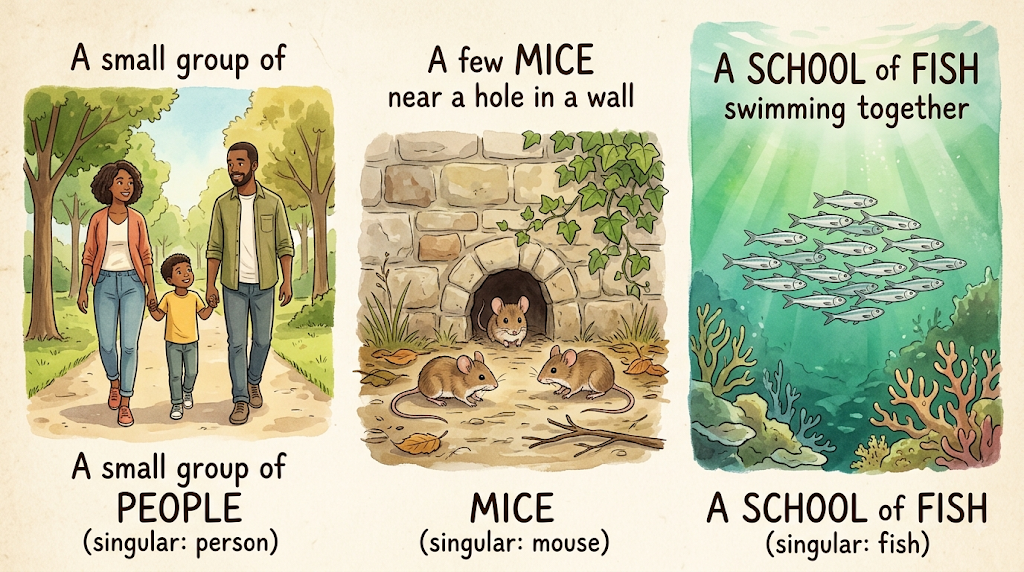
Ms. Williams writes: "Some plurals do not end in -s."
윌리엄스 선생님이 쓰십니다: "일부 복수형은 -s로 끝나지 않습니다."
She draws a box of irregular plurals.
선생님이 불규칙 복수형 상자를 그리십니다.
this man → these men / a woman → some women / a child → many children
이 남자 → 이 남자들 / 여자 한 명 → 여자 몇 명 / 아이 한 명 → 아이 여러 명
one foot → two feet / a tooth → all my teeth / a mouse → some mice
발 한 개 → 발 두 개 / 이 하나 → 제 이 전부 / 쥐 한 마리 → 쥐 몇 마리
that sheep → those sheep / a fish → a lot of fish
저 양 한 마리 → 저 양들 / 물고기 한 마리 → 물고기 많이
Huang Wei looks at sheep and fish.
황웨이가 sheep과 fish를 봅니다.
He says: "Wait, sheep and fish don't change at all, singular and plural look the same?"
그가 말합니다. "잠깐, sheep이랑 fish는 아예 안 변하네요, 단수랑 복수가 똑같아 보여요?"
Ms. Williams nods: "Exactly right, Huang Wei. Some words are the same in both forms."
선생님이 고개를 끄덕입니다. "정확해요, 황웨이. 어떤 단어들은 두 형태가 똑같아요."
She writes: "also a person → two people / some people / a lot of people, etc."
선생님이 쓰십니다: "또한 a person → two people / some people / a lot of people 등."
She's a nice person.
그녀는 좋은 사람이에요.
but They are nice people. (not nice persons)
하지만 그들은 좋은 사람들이에요. (nice persons가 아님)
👩🏫 Ms. Williams says:
"Some plurals do not end in -s."
Some plurals do not end in -s:
일부 복수형은 -s로 끝나지 않습니다:
this man → these men / a woman → some women / a child → many children
이 남자 → 이 남자들 / 여자 한 명 → 여자 몇 명 / 아이 한 명 → 아이 여러 명
one foot → two feet / a tooth → all my teeth / a mouse → some mice
발 한 개 → 발 두 개 / 이 하나 → 제 이 전부 / 쥐 한 마리 → 쥐 몇 마리
that sheep → those sheep / a fish → a lot of fish
저 양 한 마리 → 저 양들 / 물고기 한 마리 → 물고기 많이
also a person → two people / some people / a lot of people, etc.:
또한 a person → two people / some people / a lot of people 등:
She's a nice person.
그녀는 좋은 사람이에요.
but They are nice people. (not nice persons)
하지만 그들은 좋은 사람들이에요.
📐 Grammar Point : 불규칙 복수형
| man | men |
| woman | women |
| child | children |
| foot | feet |
| tooth | teeth |
| mouse | mice |
| sheep/fish | sheep/fish (변화 없음) |
| person | people |
✅ These men are my classmates.
✅ They are nice people. (not nice persons)
Chapter 4 : people과 police는 복수 / People and Police Are

Ms. Williams writes: "People is plural (= they), so we say people are / people have, etc."
윌리엄스 선생님이 쓰십니다: "People은 복수형(= they)이라서 people are / people have 등이라고 합니다."
She writes examples.
선생님이 예문을 쓰십니다.
A lot of people speak English. (not speaks)
많은 사람들이 영어를 해요. (speaks가 아님)
I like the people here. They are very friendly.
저는 여기 사람들이 좋아요. 그들은 아주 친절해요.
Fatima says: "So even though people looks singular, like one word, it acts like a plural, they?"
파티마가 말합니다. "그러면 people이 한 단어처럼 단수로 보여도, they처럼 복수로 행동하는 거네요?"
Ms. Williams nods: "Exactly right, Fatima."
선생님이 고개를 끄덕입니다. "정확해요, 파티마."
She writes: "Police is plural."
선생님이 쓰십니다: "Police는 복수형입니다."
The police want to talk to anybody who saw the accident. (not The police wants)
경찰은 사고를 목격한 사람과 얘기하고 싶어해요. (The police wants가 아님)
Sofia says: "So police follows the same rule as people, plural verb, even though it sounds like one thing?"
소피아가 말합니다. "그러면 police도 people과 같은 규칙을 따르는 거네요, 하나처럼 들려도 복수 동사요?"
Ms. Williams nods: "Exactly right, Sofia."
선생님이 고개를 끄덕입니다. "정확해요, 소피아."
👩🏫 Ms. Williams says:
"People is plural (= they), so we say people are / people have, etc. Police is plural."
People is plural (= they), so we say people are / people have, etc.:
People은 복수형(= they)이라서 people are / people have 등이라고 합니다:
A lot of people speak English. (not speaks)
많은 사람들이 영어를 해요.
I like the people here. They are very friendly.
저는 여기 사람들이 좋아요. 그들은 아주 친절해요.
Police is plural:
Police는 복수형입니다:
The police want to talk to anybody who saw the accident. (not The police wants)
경찰은 사고를 목격한 사람과 얘기하고 싶어해요.
📐 Grammar Point — people/police (항상 복수)
| people | 복수 동사 (are/have) | A lot of people speak English. |
| police | 복수 동사 (want) | The police want to talk to you. |
✅ A lot of people speak English.
✅ The police want to talk to anybody who saw the accident.
Chapter 5 : 저녁, 복수형 정리하기 / Evening, Sorting Out Plurals
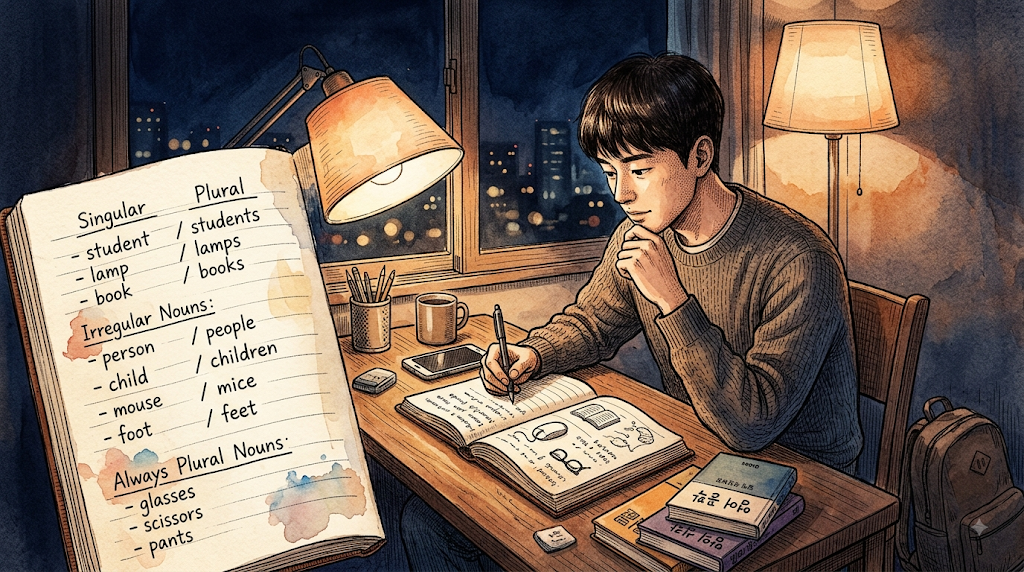
It is evening.
저녁입니다.
I sit at my desk and open my journal.
저는 책상에 앉아 일기를 폅니다.
I write a list of things around my apartment, using both singular and plural.
저는 아파트 주변 물건들의 목록을 단수와 복수 둘 다 사용해서 씁니다.
I have a book on my desk, and many books on my shelf.
저는 책상에 책이 한 권 있고, 책장에는 책이 많이 있어요.
I bought some new jeans yesterday.
저는 어제 새 청바지를 좀 샀어요.
My glasses are always on my desk when I study.
제 안경은 공부할 때 항상 책상에 있어요.
I also think about tricky words.
저는 까다로운 단어들에 대해서도 생각합니다.
Many people in New York speak more than one language.
뉴욕의 많은 사람들이 한 개 이상의 언어를 해요.
I think about how far I've come since Unit 1, when I barely knew how to make a simple sentence plural.
저는 제가 겨우 단순한 문장을 복수형으로 만들 줄 알던 Unit 1부터 얼마나 멀리 왔는지 생각합니다.
I close my journal. Tomorrow, there will be new words to learn, and I'm ready.
저는 일기를 덮습니다. 내일은 배울 새 단어들이 있을 거고, 저는 준비되어 있습니다.
PART 2 : Grammar Focus
Unit 64 : train(s), bus(es) (singular and plural) 완전 정리
A. 복수형 -s 규칙
The plural of a noun is usually -s:
a flower → some flowers / a train → two trains / one week → a few weeks / a nice place → some nice places / this student → these students
Spelling:
-s/-sh/-ch/-x → -es: bus → buses / dish → dishes / church → churches / box → boxes
also: potato → potatoes / tomato → tomatoes
-y → -ies: baby → babies / dictionary → dictionaries / party → parties
but -ay/-ey/-oy → -ys: day → days / monkey → monkeys / boy → boys
-f/-fe → -ves: shelf → shelves / knife → knives / wife → wives
B. 항상 복수인 명사
These things are plural in English: scissors, glasses, pants, jeans, shorts, tights, pajamas
Do you wear glasses?
안경 쓰세요?
Where are the scissors? I need them.
가위 어디 있어요?
You can also say a pair of scissors / a pair of pants / a pair of pajamas, etc.:
I need a new pair of jeans. or I need some new jeans. (not a new jeans)
새 청바지가 필요해요.
C. -s로 안 끝나는 복수형
this man → these men / a woman → some women / a child → many children
one foot → two feet / a tooth → all my teeth / a mouse → some mice
that sheep → those sheep / a fish → a lot of fish
also a person → two people / some people / a lot of people, etc.:
She's a nice person. but They are nice people. (not nice persons)
그녀는 좋은 사람이에요. 그들은 좋은 사람들이에요.
D. people/police는 복수
A lot of people speak English. (not speaks)
많은 사람들이 영어를 해요.
I like the people here. They are very friendly.
저는 여기 사람들이 좋아요.
The police want to talk to anybody who saw the accident. (not The police wants)
경찰은 얘기하고 싶어해요.
Key Summary : 복수형 완전 정리
| 규칙 -s | flower → flowers |
| -es/-ies/-ves | bus → buses, baby → babies, knife → knives |
| 항상 복수 | scissors, glasses, pants |
| 불규칙 | man → men, child → children |
| 변화 없음 | sheep, fish |
| people/police | 항상 복수 동사 |
Key Phrases : Unit 64
| 규칙 복수 -s | ~들 | flowers, trains |
| a pair of + 복수 | ~ 한 벌/쌍 | a pair of jeans |
| 불규칙 복수 | men, women, children | These men are my friends. |
| people are/have | 사람들은 ~이다/~을 가지다 | A lot of people speak English. |
PART 3 : Practice
Mini Quiz
- a flower → some ________. (flowers)
- bus → ________. (buses)
- baby → ________. (babies)
- knife → ________. (knives)
- a child → many ________. (children)
- A lot of people ________ English. (speak, not speaks)
정답
- flowers
- buses
- babies
- knives
- children
- speak
Discussion Questions
- 규칙 복수형(-s)과 불규칙 복수형(man→men)의 차이를 예문 두 개씩 들어 설명해 보세요.
- 다음 문장들을 올바르게 고쳐 쓰세요.
- "They are nice persons."
- "The police wants to talk to you."
- scissors, glasses, pants 중 하나를 사용해서 문장을 써보세요.
- 불규칙 복수형(man/men, child/children 등)을 사용해서 문장 두 개를 만들어 보세요.
- 파트너와 다음 주제로 대화해 보세요: 이 도시 사람들은 어때요? (people are...로 대답해 보세요)
'스토리로 배우는 영문법' 카테고리의 다른 글
| Unit 66 | a cake / some cake / some cakes (count/noncount 2) | (0) | 2026.09.05 |
|---|---|
| Unit 65 | a bottle / some water (count/noncount 1) (0) | 2026.09.04 |
| Unit 63 | a/an... (0) | 2026.09.01 |
| Unit 62 | -'s (Kate's camera / my brother's car, etc.) (0) | 2026.08.31 |
| Unit 61 | myself/yourself/themselves, etc. (0) | 2026.08.30 |