Minjun's Story : My English Journey in New York
뉴욕에서 시작하는 영어 이야기
PART 1 : Story
Chapter 1 : 케이트의 카메라, 제 남동생의 차 / Kate's Camera, My Brother's Car

Ms. Williams shows three pictures.
윌리엄스 선생님이 그림 세 장을 보여주십니다.
Kate holds a camera: "My camera."
케이트가 카메라를 듭니다: "제 카메라예요."
Ms. Williams writes: "Kate's camera (her camera)."
선생님이 쓰십니다: "케이트의 카메라 (그녀의 카메라)."
A man stands by a car: "My car."
한 남자가 차 옆에 섭니다: "제 차예요."
Ms. Williams writes: "my brother's car (his car)."
선생님이 쓰십니다: "제 남동생의 차 (그의 차)."
A door is labeled "MANAGER."
문에 "MANAGER"라고 적혀 있습니다.
Ms. Williams writes: "the manager's office (his or her office)."
선생님이 쓰십니다: "매니저의 사무실 (그의 또는 그녀의 사무실)."
Carlos looks at the pattern.
카를로스가 패턴을 봅니다.
He says: "So 's after a person's name shows ownership, kind of like his or her name plus the object?"
그가 말합니다. "그러면 사람 이름 뒤에 's는 소유를 보여주는 거네요, 그 사람 이름 + 물건 같은 거요?"
Ms. Williams nods: "Exactly right, Carlos. We normally use -'s for people."
선생님이 고개를 끄덕입니다. "정확해요, 카를로스. 사람에게는 보통 -'s를 씁니다."
She writes examples.
선생님이 예문을 쓰십니다.
I stayed at my sister's house. (not the house of my sister)
저는 제 여동생 집에 묵었어요. (the house of my sister가 아님)
Have you met Mr. Black's wife? (not the wife of Mr. Black)
블랙 씨의 아내를 만나셨어요? (the wife of Mr. Black이 아님)
Are you going to James's party?
제임스의 파티에 가세요?
Paul is a man's name. Paula is a woman's name.
폴은 남자 이름이에요. 폴라는 여자 이름이에요.
She writes: "You can use -'s without a noun after it."
선생님이 쓰십니다: "-'s는 뒤에 명사 없이 쓸 수 있습니다."
Amanda's hair is longer than Kate's. (= Kate's hair)
아만다의 머리는 케이트의 것보다 길어요. (= 케이트의 머리)
"Whose umbrella is this?" "It's my mother's." (= my mother's umbrella)
이거 누구 우산이에요? 저희 어머니 거예요. (= 저희 어머니의 우산)
"Where were you last night?" "I was at Eric's." (= Eric's house)
어젯밤 어디 있었어요? 에릭네 집에 있었어요. (= 에릭의 집)
👩🏫 Ms. Williams says:
"Kate's camera (her camera), my brother's car (his car), the manager's office (his or her office)."
Kate's camera (her camera)
케이트의 카메라 (그녀의 카메라)
my brother's car (his car)
제 남동생의 차 (그의 차)
the manager's office (his or her office)
매니저의 사무실 (그의 또는 그녀의 사무실)
We normally use -'s for people:
사람에게는 보통 -'s를 씁니다:
I stayed at my sister's house. (not the house of my sister)
저는 제 여동생 집에 묵었어요.
Have you met Mr. Black's wife? (not the wife of Mr. Black)
블랙 씨의 아내를 만나셨어요?
Are you going to James's party?
제임스의 파티에 가세요?
Paul is a man's name. Paula is a woman's name.
폴은 남자 이름이에요.
You can use -'s without a noun after it:
-'s는 뒤에 명사 없이 쓸 수 있습니다:
Amanda's hair is longer than Kate's. (= Kate's hair)
아만다의 머리는 케이트의 것보다 길어요.
"Whose umbrella is this?" "It's my mother's." (= my mother's umbrella)
이거 누구 우산이에요? 저희 어머니 거예요.
"Where were you last night?" "I was at Eric's." (= Eric's house)
어젯밤 어디 있었어요? 에릭네 집에 있었어요.
📐 Grammar Point : -'s (소유격)
| 사람 + 's + 명사 | my sister's house |
| 사람 + 's (명사 없이) | It's my mother's. |
✅ Have you met Mr. Black's wife?
✅ I was at Eric's.
Chapter 2 : friend's와 friends' / Friend's and Friends'
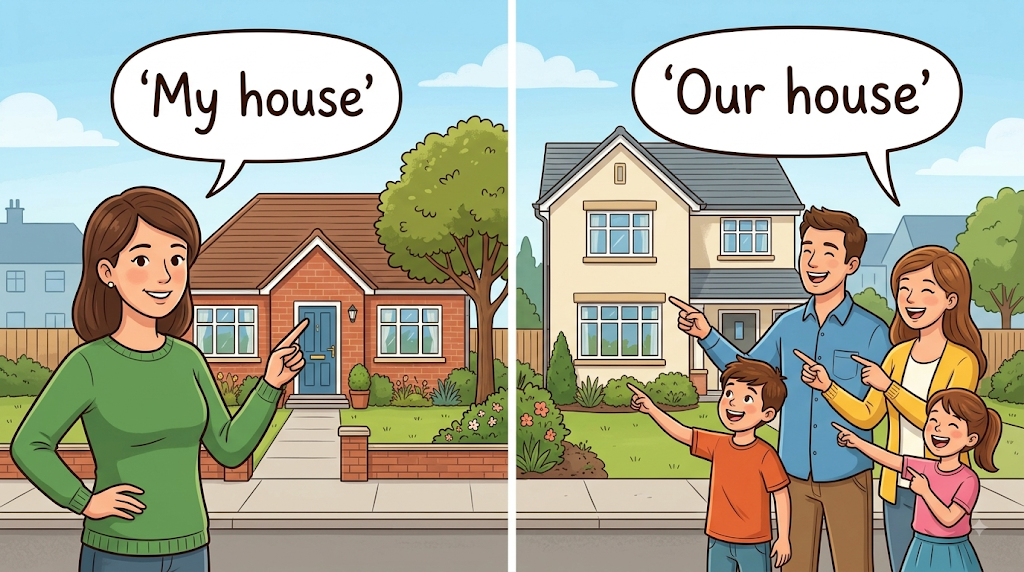
Ms. Williams writes: "friend's and friends'."
윌리엄스 선생님이 쓰십니다: "friend's와 friends'."
She shows a woman pointing at a house: "My house."
선생님이 집을 가리키는 여성을 보여주십니다: "제 집이에요."
Ms. Williams writes: "my friend's house = one friend (= his house or her house)."
선생님이 쓰십니다: "my friend's house = 친구 한 명 (= 그의 집 또는 그녀의 집)."
She shows a family pointing at a house: "Our house."
선생님이 집을 가리키는 가족을 보여주십니다: "저희 집이에요."
Ms. Williams writes: "my friends' house = two or more friends (= their house)."
선생님이 쓰십니다: "my friends' house = 친구 두 명 이상 (= 그들의 집)."
Yuki looks at the difference carefully.
유키가 차이를 주의 깊게 봅니다.
She asks: "So the apostrophe moves depending on whether it's one friend or many friends?"
그녀가 묻습니다. "그러면 친구가 한 명인지 여러 명인지에 따라 아포스트로피 위치가 바뀌는 거네요?"
Ms. Williams nods: "Exactly right, Yuki."
선생님이 고개를 끄덕입니다. "정확해요, 유키."
She writes the rule.
선생님이 규칙을 쓰십니다.
"We write 's after friend/student/mother, etc., (singular):"
"friend/student/mother 등(단수) 뒤에는 's를 씁니다:"
my mother's car (one mother)
저희 어머니의 차 (어머니 한 명)
my father's car (one father)
저희 아버지의 차 (아버지 한 명)
"We write ' after friends/students/parents, etc., (plural):"
"friends/students/parents 등(복수) 뒤에는 '만 씁니다:"
my parents' car (two parents)
저희 부모님의 차 (부모님 두 명)
Lucas says: "So for a plural noun that already ends in s, we just add an apostrophe, no extra s?"
루카스가 말합니다. "그러면 이미 s로 끝나는 복수명사에는 그냥 아포스트로피만 붙이고, s를 추가로 안 붙이는 거네요?"
Ms. Williams nods: "Exactly right, Lucas."
선생님이 고개를 끄덕입니다. "정확해요, 루카스."
👩🏫 Ms. Williams says:
"my friend's house = one friend, my friends' house = two or more friends."
my friend's house = one friend (= his house or her house)
my friend's house = 친구 한 명 (= 그의 집 또는 그녀의 집)
my friends' house = two or more friends (= their house)
my friends' house = 친구 두 명 이상 (= 그들의 집)
We write 's after friend/student/mother, etc., (singular):
단수 명사 뒤에는 's를 씁니다:
my mother's car (one mother)
저희 어머니의 차 (한 명)
my father's car (one father)
저희 아버지의 차 (한 명)
We write ' after friends/students/parents, etc., (plural):
복수 명사 뒤에는 '만 씁니다:
my parents' car (two parents)
저희 부모님의 차 (두 명)
📐 Grammar Point : 's (단수) vs ' (복수)
| 단수 명사 | 명사 + 's | my mother's car |
| 복수 명사 (s로 끝남) | 명사 + ' | my parents' car |
✅ my friend's house (친구 한 명)
✅ my friends' house (친구 두 명 이상)
Chapter 3 : 사물에는 of를 씁니다 / We Use Of for Things

Ms. Williams writes: "We use of... for things, places, etc."
윌리엄스 선생님이 쓰십니다: "사물, 장소 등에는 of...를 씁니다."
She writes examples.
선생님이 예문을 쓰십니다.
Look at the roof of that building. (not that building's roof)
저 건물의 지붕을 보세요. (that building's roof가 아님)
We didn't see the beginning of the movie. (not the movie's beginning)
저희는 영화의 시작 부분을 못 봤어요. (the movie's beginning이 아님)
What's the name of this town?
이 마을의 이름이 뭐예요?
Do you know the cause of the problem?
문제의 원인을 아세요?
You can sit in the back of the car.
차 뒷좌석에 앉아도 돼요.
Madrid is the capital of Spain.
마드리드는 스페인의 수도예요.
Huang Wei says: "So for things, places, buildings, we use of, but for people, we use 's?"
황웨이가 말합니다. "그러면 사물, 장소, 건물에는 of를 쓰고, 사람에게는 's를 쓰는 거네요?"
Ms. Williams nods: "Exactly right, Huang Wei. That's the main rule to remember from this unit."
선생님이 고개를 끄덕입니다. "정확해요, 황웨이. 그게 이 유닛에서 기억해야 할 주요 규칙이에요."
👩🏫 Ms. Williams says:
"We use of... for things, places, etc."
We use of ... for things, places, etc.:
사물, 장소 등에는 of ...를 씁니다:
Look at the roof of that building. (not that building's roof)
저 건물의 지붕을 보세요.
We didn't see the beginning of the movie. (not the movie's beginning)
저희는 영화의 시작 부분을 못 봤어요.
What's the name of this town?
이 마을의 이름이 뭐예요?
Do you know the cause of the problem?
문제의 원인을 아세요?
You can sit in the back of the car.
차 뒷좌석에 앉아도 돼요.
Madrid is the capital of Spain.
마드리드는 스페인의 수도예요.
📐 Grammar Point : of (사물/장소)
| 사람 | 명사 + 's | Kate's camera |
| 사물/장소 | of + 명사 | the roof of that building |
✅ Look at the roof of that building.
✅ Madrid is the capital of Spain.
Chapter 4 : 민준의 소유격 연습 / Minjun's Practice with Possessives
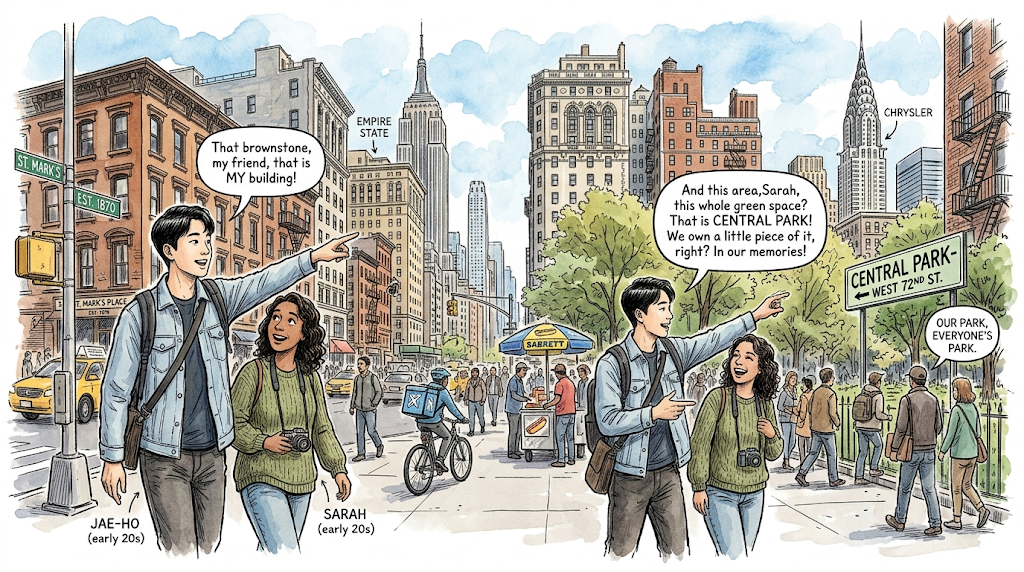
This weekend, I visited my roommate's family.
이번 주말에 저는 제 룸메이트의 가족을 방문했어요.
We went to his parents' house in New Jersey.
저희는 뉴저지에 있는 그의 부모님 집에 갔어요.
I met Sarah's brother and David's wife. Everyone was very kind.
저는 사라의 남동생과 데이비드의 아내를 만났어요. 모두 아주 친절했어요.
On the way back, we passed the top of a tall building and the entrance of Central Park.
돌아오는 길에, 저희는 높은 건물의 꼭대기와 센트럴 파크의 입구를 지나갔어요.
I told my roommate: "New York is the heart of America, isn't it?"
저는 제 룸메이트에게 말했어요. "뉴욕은 미국의 심장이죠, 그렇죠?"
He laughed: "Some people say that. But Washington's role is different, it's the capital."
그가 웃었어요. "그렇게 말하는 사람들도 있어요. 하지만 워싱턴의 역할은 달라요, 그건 수도예요."
I think about how naturally I now switch between 's for people and of for places.
저는 이제 사람에는 's, 장소에는 of를 얼마나 자연스럽게 바꿔 쓰는지 생각해 봅니다.
👩🏫 Ms. Williams says:
"실생활 대화 속 -'s와 of 사용 예문."
I visited my roommate's family. We went to his parents' house in New Jersey.
저는 제 룸메이트의 가족을 방문했어요. 그의 부모님 집에 갔어요.
I met Sarah's brother and David's wife.
사라의 남동생과 데이비드의 아내를 만났어요.
We passed the top of a tall building and the entrance of Central Park.
높은 건물의 꼭대기와 센트럴 파크의 입구를 지나갔어요.
📐 Grammar Point : 's / of 혼합 예문
| my roommate's family |
| his parents' house |
| the top of a tall building |
| the entrance of Central Park |
✅ I met Sarah's brother and David's wife.
✅ We passed the entrance of Central Park.
Chapter 5 : 저녁, 사람과 사물의 소유 정리 / Evening, Sorting Out Possession for People and Things
It is evening.
저녁입니다.
I sit at my desk and open my journal.
저는 책상에 앉아 일기를 폅니다.
I draw two columns.
저는 두 칸을 그립니다.
's (people) / of (things/places)
Under 's (people) I write.
's (사람) 아래에 씁니다.
Carlos's apartment is close to school.
카를로스의 아파트는 학교에서 가까워요.
My classmates' support has helped me a lot this year. (여러 명)
제 반 친구들의 응원이 올해 저에게 많은 도움이 됐어요.
Under of (things/places) I write.
of (사물/장소) 아래에 씁니다.
The name of my street is easy to remember.
제가 사는 거리의 이름은 기억하기 쉬워요.
The end of this book feels close now.
이 책의 끝이 이제 가깝게 느껴져요.
I look at the two columns.
저는 두 칸을 바라봅니다.
For people, 's comes naturally, close and personal. For things and places, of steps in instead.
사람에게는 's가 자연스럽게, 가깝고 개인적으로 와요. 사물과 장소에는 대신 of가 들어와요.
I close my journal, thinking about tomorrow's class, and how close I am now to finishing the whole book's units.
저는 일기를 덮으며, 내일의 수업과 이제 이 책 전체 유닛을 끝내는 게 얼마나 가까워졌는지 생각합니다.
PART 2 : Grammar Focus
Unit 62 : -'s (Kate's camera / my brother's car, etc.) 완전 정리
A. -'s for people
Kate's camera (her camera) / my brother's car (his car) / the manager's office (his or her office)
케이트의 카메라 / 제 남동생의 차 / 매니저의 사무실
We normally use -'s for people:
I stayed at my sister's house. (not the house of my sister)
저는 제 여동생 집에 묵었어요.
Have you met Mr. Black's wife? (not the wife of Mr. Black)
블랙 씨의 아내를 만나셨어요?
Are you going to James's party?
제임스의 파티에 가세요?
Paul is a man's name. Paula is a woman's name.
폴은 남자 이름이에요.
You can use -'s without a noun after it:
Amanda's hair is longer than Kate's. (= Kate's hair)
아만다의 머리는 케이트의 것보다 길어요.
"Whose umbrella is this?" "It's my mother's." (= my mother's umbrella)
어머니 거예요.
"Where were you last night?" "I was at Eric's." (= Eric's house)
에릭네 집에 있었어요.
B. friend's and friends'
my friend's house = one friend (= his house or her house)
my friends' house = two or more friends (= their house)
We write 's after friend/student/mother, etc. (singular): my mother's car, my father's car
We write ' after friends/students/parents, etc. (plural): my parents' car
C. We use of... for things, places, etc.
Look at the roof of that building. (not that building's roof)
저 건물의 지붕을 보세요.
We didn't see the beginning of the movie. (not the movie's beginning)
영화의 시작 부분을 못 봤어요.
What's the name of this town?
이 마을의 이름이 뭐예요?
Do you know the cause of the problem?
문제의 원인을 아세요?
You can sit in the back of the car.
차 뒷좌석에 앉아도 돼요.
Madrid is the capital of Spain.
마드리드는 스페인의 수도예요.
Key Summary : -'s vs of 완전 정리
| -'s (단수) | 사람 1명 | my sister's house |
| -' (복수) | 사람 2명 이상 | my parents' car |
| of | 사물, 장소 | the roof of that building |
Key Phrases : Unit 62
| 사람's + 명사 | ~의 (사람) | my sister's house |
| 사람들' + 명사 | ~의 (사람들, 복수) | my parents' car |
| of + 사물/장소 | ~의 (사물/장소) | the capital of Spain |
| 사람's (명사 없이) | ~의 것 (사람) | It's my mother's. |
PART 3 : Practice
Mini Quiz
- I stayed at my sister's ________. (house)
- Have you met Mr. Black's ________? (wife)
- my ________ house = 친구 한 명 (friend's)
- my ________ house = 친구 두 명 이상 (friends')
- Look at the roof ________ that building. (of)
- Madrid is the capital ________ Spain. (of)
정답
- house
- wife
- friend's
- friends'
- of
- of
Discussion Questions
- 's(사람)와 of(사물/장소)의 차이를 예문 두 개씩 들어 설명해 보세요.
- 다음 문장들을 올바르게 고쳐 쓰세요.
- "the movie's beginning" (of를 사용해서 고치면?)
- "the house of my sister" ('s를 사용해서 고치면?)
- my friend's와 my friends'를 각각 사용한 문장을 하나씩 만들어 보세요.
- of를 사용해서 사물이나 장소에 대한 문장 두 개를 만들어 보세요.
- 파트너와 다음 주제로 대화해 보세요: 가장 친한 친구의 집은 어디 있어요? (친구's house로 대답해 보세요)
'스토리로 배우는 영문법' 카테고리의 다른 글
| Unit 64 | train(s), bus(es) (singular and plural) (0) | 2026.09.04 |
|---|---|
| Unit 63 | a/an... (0) | 2026.09.01 |
| Unit 61 | myself/yourself/themselves, etc. (0) | 2026.08.30 |
| Unit 60 | I/me/my/mine (0) | 2026.08.29 |
| Unit 59 | Whose is this? It's mine/yours/hers, etc. (0) | 2026.08.28 |