Minjun's Story : My English Journey in New York
뉴욕에서 시작하는 영어 이야기
PART 1 : Story
Chapter 1 : 저는 그를 볼 수 있지만, 그는 저를 못 봐요 / I Can See Him, But He Can't See Me
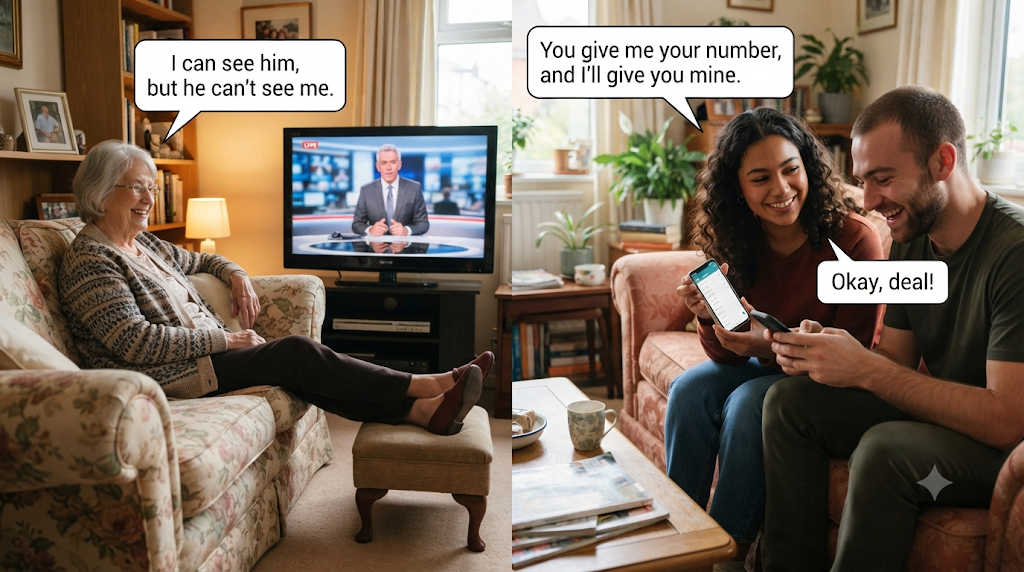
It is a review day.
복습하는 날입니다.
Ms. Williams shows a picture of a woman watching TV.
윌리엄스 선생님이 TV를 보는 여성 그림을 보여주십니다.
She says: "I can see him, but he can't see me."
그녀가 말합니다. "저는 그를 볼 수 있지만, 그는 저를 못 봐요."
Ms. Williams shows a second picture of two friends exchanging numbers.
윌리엄스 선생님이 번호를 교환하는 친구 두 명 그림을 보여주십니다.
One says: "You give me your number, and I'll give you mine."
한 명이 말합니다. "당신 번호를 주면, 제 것도 드릴게요."
Carlos looks at both sentences.
카를로스가 두 문장을 봅니다.
He says: "So this unit puts together everything we learned, I, me, my, mine, all in the same sentences?"
그가 말합니다. "그러면 이 유닛은 저희가 배운 모든 것, I, me, my, mine을 같은 문장 안에 다 합치는 거네요?"
Ms. Williams nods: "Exactly right, Carlos. Today we review Units 57, 58, and 59 together."
선생님이 고개를 끄덕입니다. "정확해요, 카를로스. 오늘은 Unit 57, 58, 59를 함께 복습해요."
She draws a big table with four columns.
선생님이 네 칸이 있는 큰 표를 그리십니다.
I, etc. (→ Unit 57) | me, etc. (→ Unit 57) | my, etc. (→ Unit 58) | mine, etc. (→ Unit 59)
She fills in the rows.
선생님이 행을 채우십니다.
I know Tom. / Tom knows me. / It's my car. / It's mine.
저는 톰을 알아요. / 톰은 저를 알아요. / 그건 제 차예요. / 그건 제 거예요.
We know Tom. / Tom knows us. / It's our car. / It's ours.
저희는 톰을 알아요. / 톰은 저희를 알아요. / 그건 저희 차예요. / 그건 저희 거예요.
You know Tom. / Tom knows you. / It's your car. / It's yours.
당신은 톰을 알아요. / 톰은 당신을 알아요. / 그건 당신 차예요. / 그건 당신 거예요.
He knows Tom. / Tom knows him. / It's his car. / It's his.
그는 톰을 알아요. / 톰은 그를 알아요. / 그건 그의 차예요. / 그건 그의 거예요.
She knows Tom. / Tom knows her. / It's her car. / It's hers.
그녀는 톰을 알아요. / 톰은 그녀를 알아요. / 그건 그녀의 차예요. / 그건 그녀의 거예요.
They know Tom. / Tom knows them. / It's their car. / It's theirs.
그들은 톰을 알아요. / 톰은 그들을 알아요. / 그건 그들의 차예요. / 그건 그들의 거예요.
👩🏫 Ms. Williams says:
"I, me, my, mine, all four forms together."
I know Tom. / Tom knows me. / It's my car. / It's mine.
저는 톰을 알아요. / 톰은 저를 알아요. / 그건 제 차예요. / 그건 제 거예요.
We know Tom. / Tom knows us. / It's our car. / It's ours.
저희는 톰을 알아요. / 톰은 저희를 알아요.
You know Tom. / Tom knows you. / It's your car. / It's yours.
당신은 톰을 알아요. / 톰은 당신을 알아요.
He knows Tom. / Tom knows him. / It's his car. / It's his.
그는 톰을 알아요. / 톰은 그를 알아요.
She knows Tom. / Tom knows her. / It's her car. / It's hers.
그녀는 톰을 알아요. / 톰은 그녀를 알아요.
They know Tom. / Tom knows them. / It's their car. / It's theirs.
그들은 톰을 알아요. / 톰은 그들을 알아요.
📐 Grammar Point : I/me/my/mine 완전 정리
| I | me | my | mine |
| we | us | our | ours |
| you | you | your | yours |
| he | him | his | his |
| she | her | her | hers |
| they | them | their | theirs |
✅ I can see him, but he can't see me.
✅ You give me your number, and I'll give you mine.
Chapter 2 : 이름을 기억 못해요 / I Can't Remember His Name
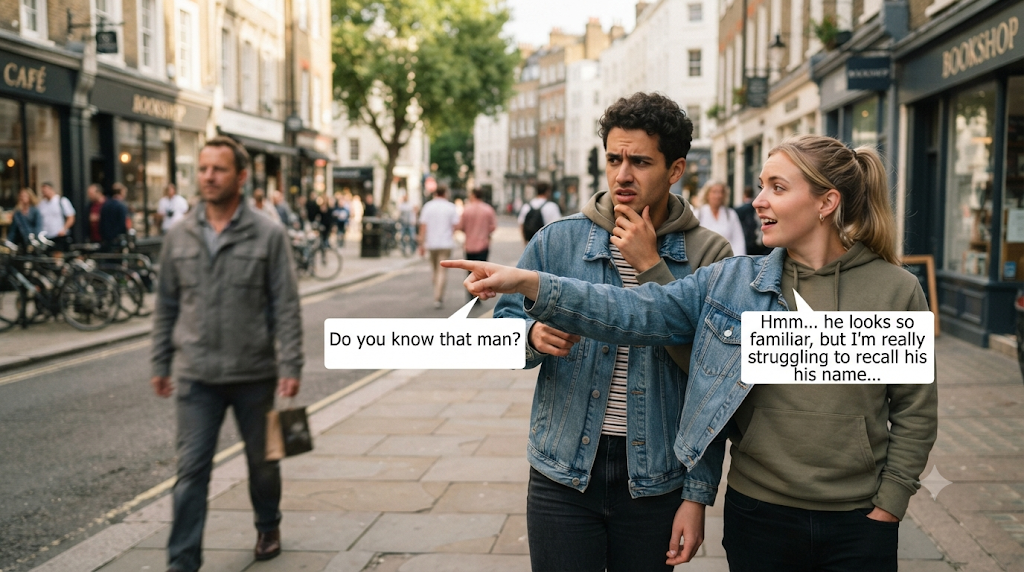
Ms. Williams writes: "Study these examples."
윌리엄스 선생님이 쓰십니다: "이 예문들을 공부해봅시다."
She writes a conversation.
선생님이 대화를 쓰십니다.
"Do you know that man?" "Yes, I know him, but I can't remember his name."
저 남자 아세요? 네, 알아요, 근데 그의 이름이 기억 안 나요.
Carlos reads it carefully.
카를로스가 그것을 주의 깊게 읽습니다.
He says: "So in one sentence, we use you, I, him, I, and his, all different forms?"
그가 말합니다. "그러면 한 문장 안에서 you, I, him, I, his를 다 다른 형태로 쓰는 거네요?"
Ms. Williams nods: "Exactly right, Carlos. Real sentences mix all these forms naturally."
선생님이 고개를 끄덕입니다. "정확해요, 카를로스. 실제 문장들은 이 형태들을 자연스럽게 섞어요."
She writes more examples.
선생님이 예문을 더 쓰십니다.
She was very happy because we invited her to stay with us at our house.
그녀는 저희가 그녀를 저희 집에 초대해서 아주 기뻐했어요.
A: "Where are the children? Have you seen them?"
B: "Yes, they are playing with their friends in the park."
아이들 어디 있어요? 봤어요? 네, 그들은 공원에서 친구들이랑 놀고 있어요.
That's my pen. Can you give it to me, please?
그건 제 펜이에요. 저에게 줄 수 있어요?
"Is this your hat?" "No, it's yours."
이거 당신 모자예요? 아니요, 당신 거예요.
He didn't have an umbrella, so she gave him hers. (= she gave her umbrella to him)
그는 우산이 없어서 그녀가 그에게 자기 것을 줬어요. (= 그녀가 그에게 자기 우산을 줬어요)
I'm going out with a friend of mine tonight. (not a friend of me)
저는 오늘 밤 제 친구 한 명과 나가요. (a friend of me가 아님)
Yuki says: "So each sentence combines several of the forms we've studied, all working together?"
유키가 말합니다. "그러면 각 문장이 저희가 공부한 형태들을 여러 개 조합해서, 다 함께 작동하는 거네요?"
Ms. Williams nods: "Exactly right, Yuki. That's how English really sounds, natural and mixed together."
선생님이 고개를 끄덕입니다. "정확해요, 유키. 그게 진짜 영어가 들리는 방식이에요, 자연스럽고 섞여 있는 거요."
👩🏫 Ms. Williams says:
"실제 문장에서 I/me/my/mine이 섞여 쓰이는 예문들."
"Do you know that man?" "Yes, I know him, but I can't remember his name."
저 남자 아세요? 네, 알아요, 근데 그의 이름이 기억 안 나요.
She was very happy because we invited her to stay with us at our house.
그녀는 저희가 그녀를 저희 집에 초대해서 아주 기뻐했어요.
A: "Where are the children? Have you seen them?" B: "Yes, they are playing with their friends in the park."
아이들 어디 있어요? 봤어요? 네, 공원에서 친구들이랑 놀고 있어요.
That's my pen. Can you give it to me, please?
그건 제 펜이에요. 저에게 줄 수 있어요?
"Is this your hat?" "No, it's yours."
이거 당신 모자예요? 아니요, 당신 거예요.
He didn't have an umbrella, so she gave him hers. (= she gave her umbrella to him)
그는 우산이 없어서 그녀가 그에게 자기 것을 줬어요.
I'm going out with a friend of mine tonight. (not a friend of me)
저는 오늘 밤 제 친구 한 명과 나가요.
📐 Grammar Point : 형태 혼합 예문
| I know him, but I can't remember his name. | 주격, 목적격, 소유격 |
| She gave him hers. | 주격, 목적격, 소유대명사 |
| a friend of mine | 소유대명사 |
✅ Can you give it to me, please?
✅ I'm going out with a friend of mine tonight.
Chapter 3 : 민준의 하루, 모든 형태를 섞어서 / Minjun's Day, Mixing All the Forms
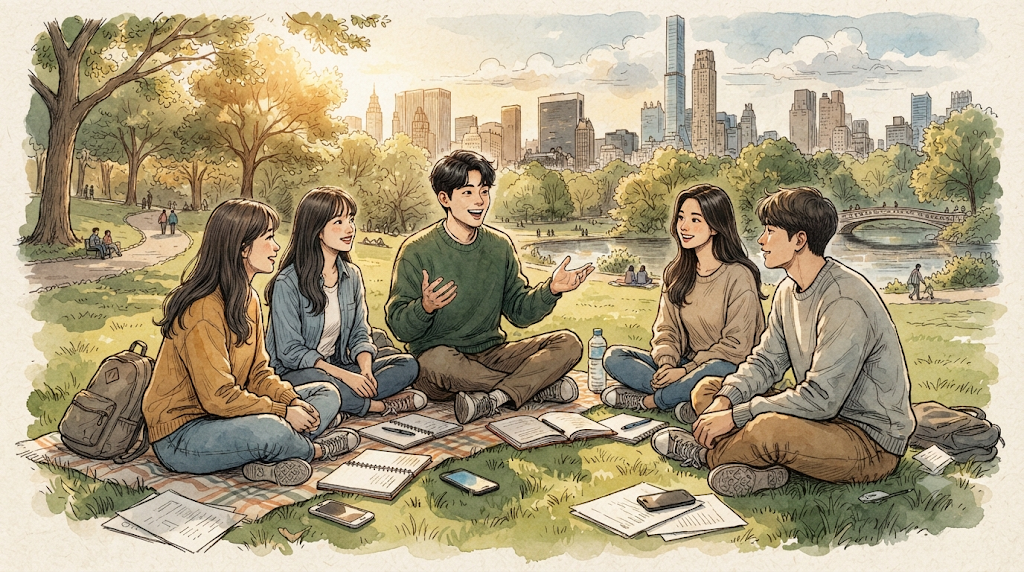
After class, my classmates and I sit in the park.
수업 후 저와 반 친구들은 공원에 앉아요.
Carlos says: "I brought some snacks. Does anyone want them?"
카를로스가 말합니다. "제가 간식을 좀 가져왔어요. 원하는 사람 있어요?"
Yuki says: "I'll take some. Thank you."
유키가 말합니다. "저 좀 가질게요. 고마워요."
Lucas turns to me: "Is this notebook yours?"
루카스가 저에게 돌아섭니다. "이 노트 당신 거예요?"
I check: "No, it's not mine. Maybe it's hers." I point at Yuki.
저는 확인합니다. "아니요, 제 거 아니에요. 아마 그녀의 것일 거예요." 저는 유키를 가리킵니다.
Yuki laughs: "Yes, it's mine. Thank you for finding it."
유키가 웃습니다. "네, 제 거예요. 찾아줘서 고마워요."
Huang Wei says: "We should all meet here again next week"
황웨이가 말합니다. "저희 다음 주에 여기서 다시 만나요."
I say: "That sounds good. I'll tell my roommate about it, and maybe he can join us too."
저는 말합니다. "좋아요. 제 룸메이트한테 얘기할게요, 그러면 그도 저희랑 함께할 수도 있어요."
I notice how naturally all these small words fit together now, without me even thinking about them.
저는 이제 이 작은 단어들이 제가 생각하지 않아도 얼마나 자연스럽게 맞아떨어지는지 알아챕니다.
👩🏫 Ms. Williams says:
"실생활 대화 속 I/me/my/mine."
"I brought some snacks. Does anyone want them?" "I'll take some. Thank you."
간식을 좀 가져왔어요. 원하는 사람 있어요? 좀 가질게요. 고마워요.
"Is this notebook yours?" "No, it's not mine. Maybe it's hers."
이 노트 당신 거예요? 아니요, 제 거 아니에요. 아마 그녀의 것일 거예요.
"I'll tell my roommate about it, and maybe he can join us too."
제 룸메이트한테 얘기할게요, 그러면 그도 저희랑 함께할 수도 있어요.
📐 Grammar Point : 실생활 대화 예문
| Does anyone want them? |
| Is this notebook yours? No, it's not mine. |
| I'll tell my roommate about it. |
✅ Is this notebook yours? No, it's not mine.
✅ Maybe he can join us too.
Chapter 4 : 헷갈리지 않고 말하기 / Speaking Without Getting Confused
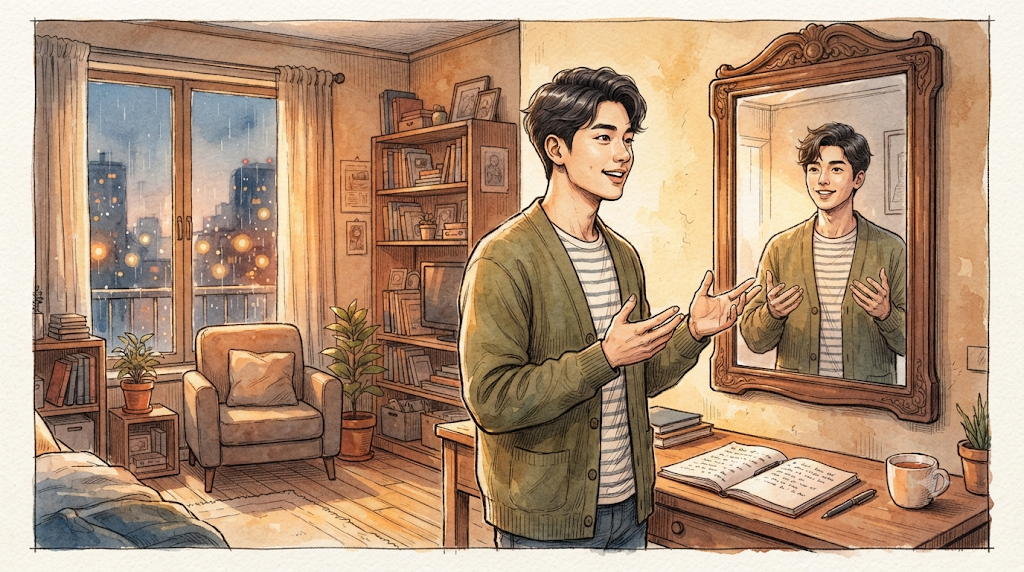
That evening, I practice speaking out loud, alone in my apartment.
그날 저녁, 저는 아파트에서 혼자 소리 내어 말하는 연습을 합니다.
I say: "I met a friend of mine today. She told me about her new job. I was happy for her."
저는 말합니다. "저는 오늘 제 친구 한 명을 만났어요. 그녀는 저에게 새 직장에 대해 얘기했어요. 저는 그녀를 위해 기뻤어요."
I pause and think about each word.
저는 잠깐 멈추고 각 단어에 대해 생각합니다.
I is the subject, doing the action. Me is the object, receiving it. Her is both, object and possessive, depending on its place in the sentence.
I는 주어예요, 행동을 하는 거요. Me는 목적어예요, 그것을 받는 거요. Her는 문장 속 위치에 따라 목적어도, 소유격도 될 수 있어요.
I continue: "It wasn't my job she talked about, it was hers. But I felt like it was ours too, because we're friends."
저는 계속합니다. "제가 말한 건 제 직장이 아니라 그녀의 직장이었어요. 하지만 저는 저희 것처럼 느껴졌어요, 저희가 친구니까요."
I smile at how naturally this all comes out now.
저는 이제 이 모든 것이 얼마나 자연스럽게 나오는지 보고 미소 짓습니다.
👩🏫 Ms. Williams says:
"혼자 말하기 연습에서의 I/me/my/mine 사용."
"I met a friend of mine today. She told me about her new job. I was happy for her."
저는 오늘 제 친구 한 명을 만났어요. 그녀는 저에게 새 직장에 대해 얘기했어요. 저는 그녀를 위해 기뻤어요.
"It wasn't my job she talked about, it was hers. But I felt like it was ours too, because we're friends."
제가 말한 건 제 직장이 아니라 그녀의 직장이었어요. 하지만 저희 것처럼 느껴졌어요.
📐 Grammar Point : 형태별 역할 정리
| I | 주어 (행동을 함) |
| me | 목적어 (행동을 받음) |
| her | 목적어 또는 소유격 (위치에 따라) |
| hers/ours | 소유대명사 |
✅ It wasn't my job, it was hers.
✅ I felt like it was ours too.
Chapter 5 : 저녁, 예순 개의 유닛을 돌아보며 / Evening, Looking Back on Sixty Units
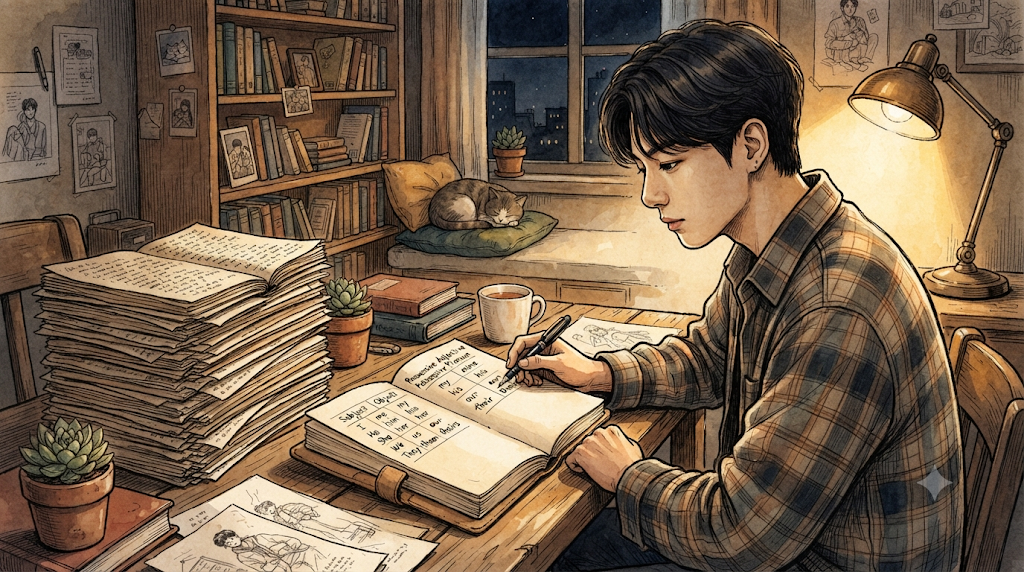
It is evening.
저녁입니다.
I sit at my desk and open my journal.
저는 책상에 앉아 일기를 폅니다.
I draw the same four-column table Ms. Williams showed us today.
저는 오늘 윌리엄스 선생님이 보여주신 것과 같은 네 칸 표를 그립니다.
I, me, my, mine.
I, me, my, mine.
I write one sentence using all four forms about myself.
저는 저 자신에 대해 네 형태를 모두 사용한 문장 하나를 씁니다.
I came to New York a year ago. This city gave me many challenges, but it also gave me my confidence. New York is not mine, but this journey has become mine.
저는 1년 전에 뉴욕에 왔어요. 이 도시는 저에게 많은 도전을 줬지만, 제 자신감도 줬어요. 뉴욕은 제 것이 아니지만, 이 여정은 제 것이 되었어요.
I look back through my journal, sixty units of notes, stories, and small conversations with Ms. Williams, Carlos, Yuki, Lucas, Huang Wei, Sofia, and Fatima.
저는 60개 유닛의 메모, 이야기, 윌리엄스 선생님, 카를로스, 유키, 루카스, 황웨이, 소피아, 파티마와의 작은 대화들이 담긴 일기를 되돌아봅니다.
I, me, my, mine, four small words, but they carry my whole story.
I, me, my, mine, 네 개의 작은 단어지만, 이것들은 제 이야기 전체를 담고 있어요.
I close my journal, ready for whatever comes next in this English journey that has become, truly, mine.
저는 일기를 덮습니다. 진정으로 제 것이 된 이 영어 여정에서 다음에 무엇이 오든 준비되어 있습니다.
PART 2 : Grammar Focus
Unit 60 : I/me/my/mine 완전 정리
A. 네 가지 형태 종합
I know Tom. / Tom knows me. / It's my car. / It's mine.
저는 톰을 알아요. / 톰은 저를 알아요. / 그건 제 차예요. / 그건 제 거예요.
We know Tom. / Tom knows us. / It's our car. / It's ours.
저희는 톰을 알아요. / 톰은 저희를 알아요.
You know Tom. / Tom knows you. / It's your car. / It's yours.
당신은 톰을 알아요. / 톰은 당신을 알아요.
He knows Tom. / Tom knows him. / It's his car. / It's his.
그는 톰을 알아요. / 톰은 그를 알아요.
She knows Tom. / Tom knows her. / It's her car. / It's hers.
그녀는 톰을 알아요. / 톰은 그녀를 알아요.
They know Tom. / Tom knows them. / It's their car. / It's theirs.
그들은 톰을 알아요. / 톰은 그들을 알아요.
B. 실제 문장에서 형태 혼합
"Do you know that man?" "Yes, I know him, but I can't remember his name."
저 남자 아세요? 네, 알아요, 근데 그의 이름이 기억 안 나요.
She was very happy because we invited her to stay with us at our house.
그녀는 저희가 그녀를 저희 집에 초대해서 아주 기뻐했어요.
A: "Where are the children? Have you seen them?" B: "Yes, they are playing with their friends in the park."
아이들 어디 있어요? 봤어요? 네, 공원에서 친구들이랑 놀고 있어요.
That's my pen. Can you give it to me, please?
그건 제 펜이에요. 저에게 줄 수 있어요?
"Is this your hat?" "No, it's yours."
이거 당신 모자예요? 아니요, 당신 거예요.
He didn't have an umbrella, so she gave him hers. (= she gave her umbrella to him)
그는 우산이 없어서 그녀가 그에게 자기 것을 줬어요.
I'm going out with a friend of mine tonight. (not a friend of me)
저는 오늘 밤 제 친구 한 명과 나가요.
Key Summary : I/me/my/mine 최종 정리
| I | me | my | mine |
| we | us | our | ours |
| you | you | your | yours |
| he | him | his | his |
| she | her | her | hers |
| they | them | their | theirs |
Key Phrases : Unit 60
| I know him, his name | 주격+목적격+소유격 혼합 | I know him, but I can't remember his name. |
| give it to me | 저에게 그것을 주다 | Can you give it to me? |
| It's yours / It's mine | ~의 것이다 | "Is this your hat?" "No, it's yours." |
| a friend of mine | 제 친구 한 명 | I'm going out with a friend of mine. |
PART 3 : Practice
Mini Quiz
- ________ know Tom. Tom knows ________. It's ________ car. It's ________. (I / me / my / mine)
- "Do you know that man?" "Yes, I know ________, but I can't remember ________ name." (him / his)
- She was very happy because we invited ________ to stay with ________ at ________ house. (her / us / our)
- That's my pen. Can you give it to ________, please? (me)
- "Is this your hat?" "No, it's ________." (yours)
- I'm going out with a friend of ________ tonight. (mine)
정답
- I / me / my / mine
- him / his
- her / us / our
- me
- yours
- mine
Discussion Questions
- I/me/my/mine이 각각 문장 속에서 어떤 역할을 하는지 예문을 들어 설명해 보세요.
- 다음 문장들을 올바르게 고쳐 쓰세요.
- "Me know Tom."
- "I'm going out with a friend of me tonight."
- I, me, my, mine을 모두 사용한 문장 하나를 만들어 보세요.
- 친구에 대한 이야기를 he/him/his/his 또는 she/her/her/hers를 모두 사용해서 써보세요.
- 파트너와 다음 주제로 대화해 보세요: 최근에 친구와 나눈 대화를 들려주세요. (I, me, my, mine을 자연스럽게 섞어서 말해보세요)
'스토리로 배우는 영문법' 카테고리의 다른 글
| Unit 62 | -'s (Kate's camera / my brother's car, etc.) (0) | 2026.08.31 |
|---|---|
| Unit 61 | myself/yourself/themselves, etc. (0) | 2026.08.30 |
| Unit 59 | Whose is this? It's mine/yours/hers, etc. (0) | 2026.08.28 |
| Unit 58 | my/his/their, etc. (1) | 2026.08.27 |
| Unit 57 | I/me, he/him, they/them, etc. (0) | 2026.08.26 |