Minjun's Story : My English Journey in New York
뉴욕에서 시작하는 영어 이야기
PART 1 : Story
Chapter 1 : 창문 아무거나, 그 창문 / A Window, The Window
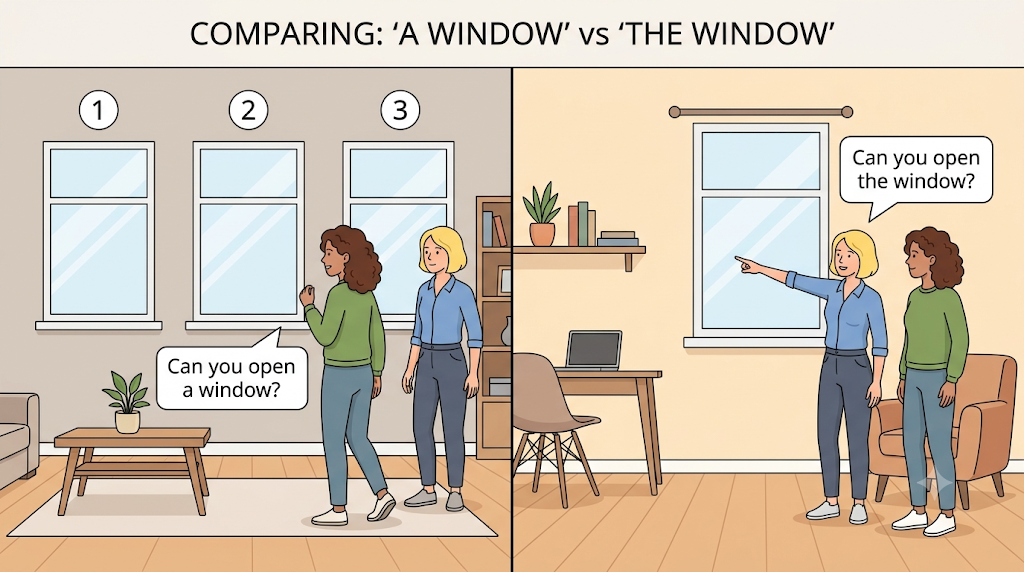
Ms. Williams shows two pictures.
윌리엄스 선생님이 그림 두 장을 보여주십니다.
The first shows a room with three windows. One woman asks: "Can you open a window?"
첫 번째는 창문 세 개가 있는 방입니다. 한 여성이 묻습니다. "창문 좀 열어줄래요?"
Ms. Williams explains: "There are three windows here. a window = window 1 or 2 or 3."
선생님이 설명하십니다. "여기 창문이 세 개 있어요. a window = 1번, 2번, 3번 창문 중 하나예요."
The second shows a room with only one window. A woman points at it: "Can you open the window?"
두 번째는 창문이 하나뿐인 방입니다. 한 여성이 그것을 가리킵니다. "그 창문 좀 열어줄래요?"
Ms. Williams explains: "There is only one window here — the window."
선생님이 설명하십니다. "여기는 창문이 하나뿐이에요, 그 창문이요."
Carlos looks at the difference.
카를로스가 차이를 봅니다.
He says: "So a means any one of several, but the means the specific one everyone knows about?"
그가 말합니다. "그러면 a는 여러 개 중 아무거나 하나를 뜻하고, the는 모두가 아는 그 특정한 하나를 뜻하는 거네요?"
Ms. Williams nods: "Exactly right, Carlos."
선생님이 고개를 끄덕입니다. "정확해요, 카를로스."
She writes examples with a.
선생님이 a를 사용한 예문을 쓰십니다.
I have a car. (there are many cars and I have one)
저는 차가 있어요. (차는 많고, 저는 그중 하나를 가지고 있어요)
Can I ask a question? (there are many questions — can I ask one?)
질문 하나 해도 될까요? (질문은 많고, 그중 하나를 물어봐도 되나요?)
Is there a hotel near here? (there are many hotels — is there one near here?)
이 근처에 호텔이 있나요? (호텔은 많고, 그중 하나가 이 근처에 있나요?)
Paris is an interesting city. (there are many interesting cities and Paris is one)
파리는 흥미로운 도시예요. (흥미로운 도시는 많고, 파리는 그중 하나예요)
Sarah is a student. (there are many students and Lisa is one)
사라는 학생이에요. (학생은 많고, 사라는 그중 한 명이에요)
She writes examples with the.
선생님이 the를 사용한 예문을 쓰십니다.
I'm going to wash the car tomorrow. (= my car)
저는 내일 그 차를 씻을 거예요. (= 제 차)
Can you repeat the question, please? (= the question that you asked)
그 질문을 다시 말씀해 주시겠어요? (= 당신이 물어본 그 질문)
We enjoyed our vacation. The hotel was very nice. (= our hotel)
저희는 휴가를 즐겼어요. 그 호텔은 아주 좋았어요. (= 저희 호텔)
Paris is the capital of France. (there is only one capital of France)
파리는 프랑스의 수도예요. (프랑스의 수도는 하나뿐이에요)
Sarah is the youngest student in her class. (there is only one youngest student in her class)
사라는 그녀의 반에서 가장 어린 학생이에요. (그녀의 반에는 가장 어린 학생이 한 명뿐이에요)
👩🏫 Ms. Williams says:
"a window = window 1 or 2 or 3. the window (there is only one window)."
There are three windows here. a window = window 1 or 2 or 3.
여기 창문이 세 개 있어요. a window = 셋 중 하나.
There is only one window here — the window.
여기는 창문이 하나뿐이에요, 그 창문이요.
I have a car. (there are many cars and I have one)
저는 차가 있어요.
Can I ask a question? (there are many questions — can I ask one?)
질문 하나 해도 될까요?
Paris is an interesting city. (there are many interesting cities and Paris is one)
파리는 흥미로운 도시예요.
I'm going to wash the car tomorrow. (= my car)
저는 내일 그 차를 씻을 거예요.
Can you repeat the question, please? (= the question that you asked)
그 질문을 다시 말씀해 주시겠어요?
Paris is the capital of France. (there is only one capital of France)
파리는 프랑스의 수도예요.
📐 Grammar Point : a vs the
| a/an | 여러 개 중 하나 | I have a car. |
| the | 특정한 하나, 이미 아는 것 | I'm going to wash the car. |
✅ Can I ask a question? / Can you repeat the question?
✅ Paris is an interesting city. / Paris is the capital of France.
Chapter 2 : 재킷과 셔츠 비교 / Comparing the Jacket and the Shirt
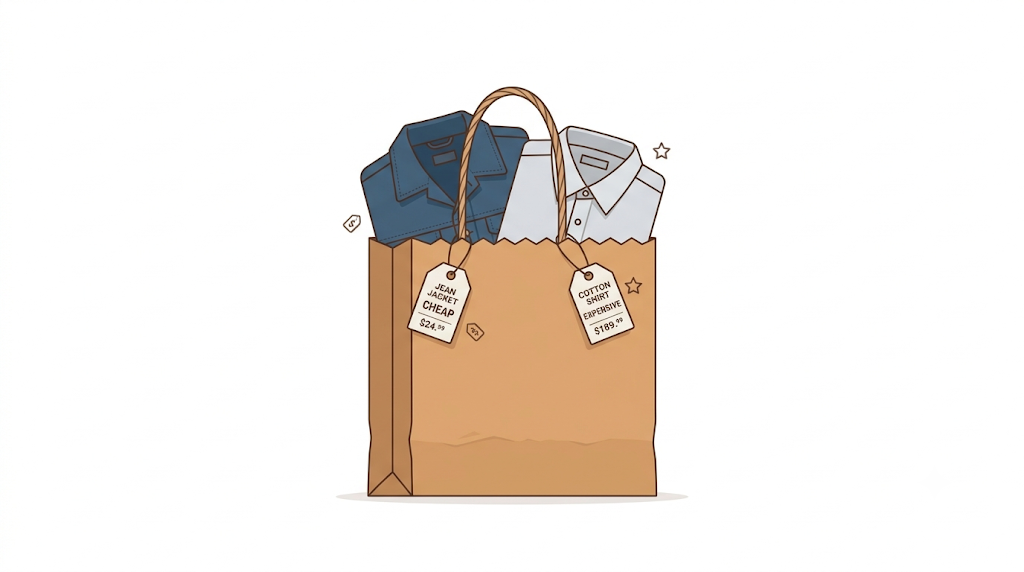
Ms. Williams writes: "Compare a and the."
윌리엄스 선생님이 쓰십니다: "a와 the를 비교해봅시다."
She writes an example.
선생님이 예문을 쓰십니다.
I bought a jacket and a shirt. The jacket was cheap, but the shirt was expensive.
저는 재킷 하나와 셔츠 하나를 샀어요. 그 재킷은 쌌지만, 그 셔츠는 비쌌어요.
She explains: "(= the jacket and the shirt that I bought)"
선생님이 설명하십니다: "(= 제가 산 그 재킷과 그 셔츠)"
Yuki looks at the sentence carefully.
유키가 문장을 주의 깊게 봅니다.
She says: "So the first time I mention something, I use a, but the second time, once we both know what I mean, I use the?"
그녀가 말합니다. "그러면 처음 언급할 때는 a를 쓰고, 두 번째로 언급할 때는, 서로 무엇을 말하는지 알고 나면 the를 쓰는 거네요?"
Ms. Williams nods: "Exactly right, Yuki. That's one of the most common patterns in English."
선생님이 고개를 끄덕입니다. "정확해요, 유키. 그게 영어에서 가장 흔한 패턴 중 하나예요."
👩🏫 Ms. Williams says:
"I bought a jacket and a shirt. The jacket was cheap, but the shirt was expensive."
I bought a jacket and a shirt. The jacket was cheap, but the shirt was expensive.
저는 재킷 하나와 셔츠 하나를 샀어요. 그 재킷은 쌌지만, 그 셔츠는 비쌌어요.
(= the jacket and the shirt that I bought)
(= 제가 산 그 재킷과 그 셔츠)
📐 Grammar Point : 처음 언급 vs 다시 언급
| 처음 언급 | a/an | I bought a jacket and a shirt. |
| 다시 언급 | the | The jacket was cheap. |
✅ I bought a jacket and a shirt. The jacket was cheap, but the shirt was expensive.
Chapter 3 : 명확할 때 the를 씁니다 / We Say The When It's Clear
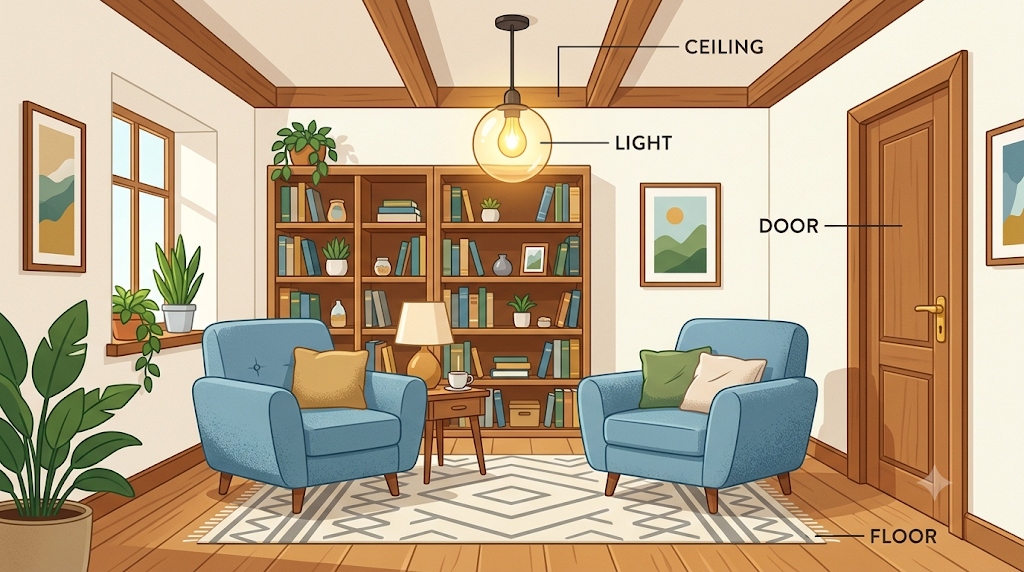
Ms. Williams writes: "We say the... when it is clear which thing or person we mean."
윌리엄스 선생님이 쓰십니다: "어떤 것이나 어떤 사람을 뜻하는지 명확할 때 the...를 씁니다."
She draws a box of examples.
선생님이 예문 상자를 그리십니다.
the door / the ceiling / the floor / the carpet / the light, etc. (of a room)
문 / 천장 / 바닥 / 카펫 / 조명 등 (방의)
the roof / the backyard / the kitchen / the bathroom, etc. (of a house)
지붕 / 뒷마당 / 부엌 / 화장실 등 (집의)
the airport / the police station / the bus station / the mayor's office, etc. (of a city)
공항 / 경찰서 / 버스 정류장 / 시장 사무실 등 (도시의)
Lucas says: "So even without saying whose room, whose house, whose city, the shows we both understand which one?"
루카스가 말합니다. "그러면 누구의 방, 누구의 집, 누구의 도시인지 말 안 해도, the가 저희 둘 다 어느 것을 말하는지 이해한다는 걸 보여주는 거네요?"
Ms. Williams nods: "Exactly right, Lucas."
선생님이 고개를 끄덕입니다. "정확해요, 루카스."
She writes examples.
선생님이 예문을 쓰십니다.
"Where's Tom?" "In the kitchen." (= the kitchen of this house or apartment)
톰은 어디 있어요? 부엌에 있어요. (= 이 집이나 아파트의 부엌)
Turn off the light and close the door. (= the light and the door of the room)
불 끄고 문 닫으세요. (= 그 방의 불과 문)
Do you live far from the airport? (= the airport of your town)
공항에서 멀리 사세요? (= 당신 동네의 공항)
I'd like to speak to the manager, please. (= the manager of this store, etc.)
매니저와 얘기하고 싶어요. (= 이 가게 등의 매니저)
Huang Wei says: "So the always points to something both people already understand from context?"
황웨이가 말합니다. "그러면 the는 항상 문맥에서 두 사람 다 이미 이해하는 것을 가리키는 거네요?"
Ms. Williams nods: "Exactly right, Huang Wei. That's the whole idea behind the."
선생님이 고개를 끄덕입니다. "정확해요, 황웨이. 그게 the의 핵심 아이디어예요."
👩🏫 Ms. Williams says:
"We say the ... when it is clear which thing or person we mean."
We say the ... when it is clear which thing or person we mean:
어떤 것이나 어떤 사람을 뜻하는지 명확할 때 the ...를 씁니다:
the door / the ceiling / the floor / the carpet / the light, etc. (of a room)
문 / 천장 / 바닥 / 카펫 / 조명 등 (방의)
the roof / the backyard / the kitchen / the bathroom, etc. (of a house)
지붕 / 뒷마당 / 부엌 / 화장실 등 (집의)
the airport / the police station / the bus station / the mayor's office, etc. (of a city)
공항 / 경찰서 / 버스 정류장 / 시장 사무실 등 (도시의)
"Where's Tom?" "In the kitchen." (= the kitchen of this house or apartment)
부엌에 있어요.
Turn off the light and close the door. (= the light and the door of the room)
불 끄고 문 닫으세요.
Do you live far from the airport? (= the airport of your town)
공항에서 멀리 사세요?
I'd like to speak to the manager, please. (= the manager of this store, etc.)
매니저와 얘기하고 싶어요.
📐 Grammar Point : the (문맥상 명확한 것)
| 방 | the door, the ceiling, the floor, the light |
| 집 | the roof, the kitchen, the bathroom |
| 도시 | the airport, the police station, the bus station |
✅ "Where's Tom?" "In the kitchen."
✅ Do you live far from the airport?
Chapter 4 : 민준의 새 아파트 / Minjun's New Apartment
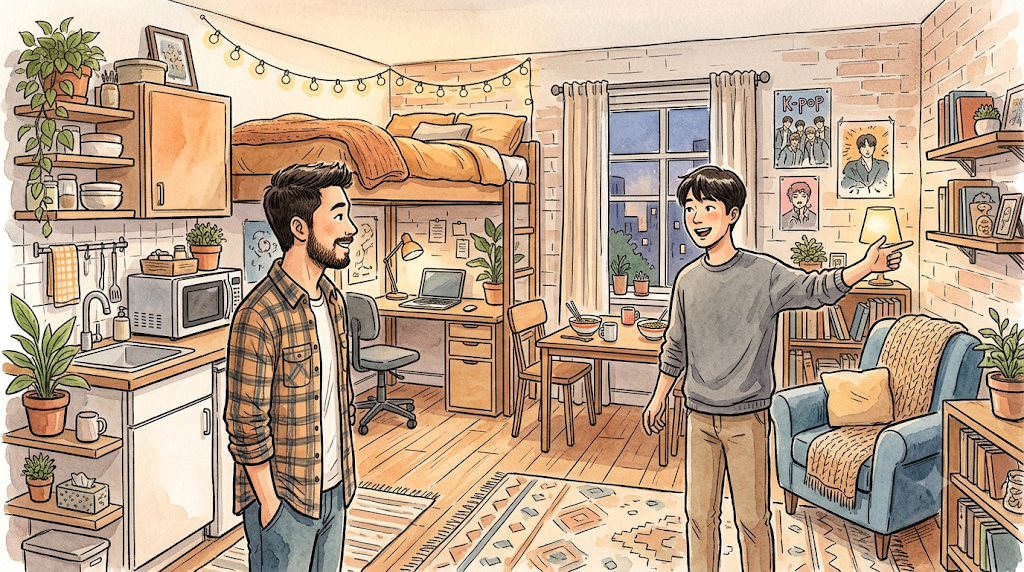
Carlos visited my new apartment today.
카를로스가 오늘 제 새 아파트를 방문했어요.
I said: "Welcome! This is the kitchen, and over there is the bathroom."
저는 말했어요. "환영해요! 여기가 부엌이고, 저쪽이 화장실이에요."
He asked: "Is the ceiling always this low?"
그가 물었어요. "천장이 항상 이렇게 낮아요?"
I laughed: "Yes, it's a small apartment. Can you close the door? It's a little cold."
저는 웃었어요. "네, 작은 아파트예요. 문 좀 닫아줄 수 있어요? 조금 추워요."
Later, he asked: "Is the subway station close to here?"
나중에 그가 물었어요. "지하철역이 여기서 가까워요?"
I said: "Yes, it's just five minutes away. I usually take a taxi when it's raining, though."
저는 말했어요. "네, 5분 거리예요. 하지만 비 올 때는 보통 택시를 타요."
I noticed how naturally I now use the for things Carlos and I both understand, my apartment's rooms, and a for general, unspecified things.
저는 이제 카를로스와 제가 둘 다 이해하는 것들(제 아파트의 방들)에는 the를, 일반적이고 특정되지 않은 것들에는 a를 얼마나 자연스럽게 쓰는지 알아챕니다.
👩🏫 Ms. Williams says:
"실생활 대화 속 a/the 사용."
"This is the kitchen, and over there is the bathroom."
여기가 부엌이고, 저쪽이 화장실이에요.
"Can you close the door? It's a little cold."
문 좀 닫아줄 수 있어요? 조금 추워요.
"I usually take a taxi when it's raining."
저는 비 올 때 보통 택시를 타요.
📐 Grammar Point : 실생활 a/the 예문
| This is the kitchen. |
| Can you close the door? |
| I usually take a taxi. |
✅ Is the subway station close to here?
✅ I usually take a taxi when it's raining.
Chapter 5 : 저녁, 아무거나와 그것 사이 / Evening, Between Anything and That One
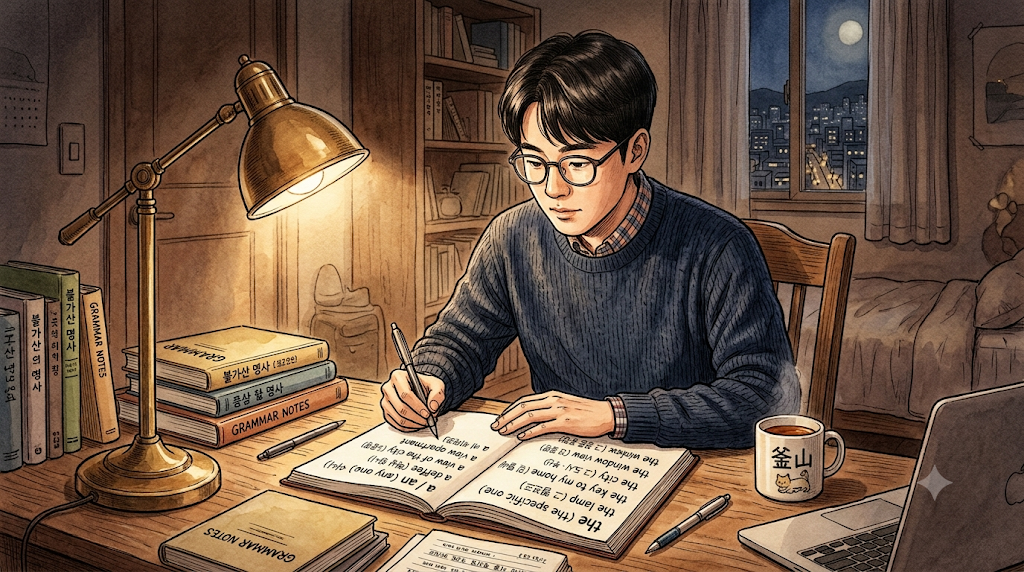
It is evening.
저녁입니다.
I sit at my desk and open my journal.
저는 책상에 앉아 일기를 폅니다.
I draw two columns.
저는 두 칸을 그립니다.
a/an (any one) / the (the specific one)
Under a/an I write things I mention for the first time or in general.
a/an 아래에 처음 언급하거나 일반적으로 말하는 것을 씁니다.
I want to find a good coffee shop near my apartment.
저는 제 아파트 근처에서 좋은 커피숍을 찾고 싶어요.
Under the I write things both my classmates and I understand clearly.
the 아래에 제 반 친구들과 제가 명확히 이해하는 것을 씁니다.
The teacher gave us homework today. (= Ms. Williams, our only teacher)
선생님이 오늘 숙제를 내주셨어요. (= 저희 선생님인 윌리엄스 선생님)
I close the window in my room every night before bed.
저는 매일 밤 자기 전에 제 방 창문을 닫아요.
I look at the two columns.
저는 두 칸을 바라봅니다.
A opens the door to something new, one among many. The points to something we already share, clear and specific.
a는 새로운 것, 여러 개 중 하나에 문을 열어줘요. the는 저희가 이미 공유하는 것, 명확하고 구체적인 것을 가리켜요.
I close my journal, ready to notice this small but powerful difference in tomorrow's conversations.
저는 일기를 덮으며, 내일의 대화에서 이 작지만 강력한 차이를 알아챌 준비를 합니다.
PART 2 : Grammar Focus
Unit 67 : a/an and the 완전 정리
A. a/an vs the
There are three windows here. a window = window 1 or 2 or 3.
여기 창문이 세 개 있어요.
There is only one window here — the window.
여기는 창문이 하나뿐이에요.
I have a car. (there are many cars and I have one)
저는 차가 있어요.
Can I ask a question? (there are many questions — can I ask one?)
질문 하나 해도 될까요?
Is there a hotel near here? (there are many hotels)
호텔이 있나요?
Paris is an interesting city. (there are many interesting cities)
파리는 흥미로운 도시예요.
Sarah is a student. (there are many students)
사라는 학생이에요.
I'm going to wash the car tomorrow. (= my car)
저는 내일 그 차를 씻을 거예요.
Can you repeat the question, please? (= the question that you asked)
그 질문을 다시 말씀해 주시겠어요?
We enjoyed our vacation. The hotel was very nice. (= our hotel)
그 호텔은 아주 좋았어요.
Paris is the capital of France. (there is only one capital)
파리는 프랑스의 수도예요.
Sarah is the youngest student in her class. (there is only one youngest)
사라는 그녀의 반에서 가장 어린 학생이에요.
Compare a and the:
I bought a jacket and a shirt. The jacket was cheap, but the shirt was expensive.
저는 재킷 하나와 셔츠 하나를 샀어요. 그 재킷은 쌌지만, 그 셔츠는 비쌌어요.
(= the jacket and the shirt that I bought)
B. the (문맥상 명확한 것)
We say the ... when it is clear which thing or person we mean:
the door / the ceiling / the floor / the carpet / the light, etc. (of a room)
the roof / the backyard / the kitchen / the bathroom, etc. (of a house)
the airport / the police station / the bus station / the mayor's office, etc. (of a city)
"Where's Tom?" "In the kitchen." (= the kitchen of this house or apartment)
부엌에 있어요.
Turn off the light and close the door. (= the light and the door of the room)
불 끄고 문 닫으세요.
Do you live far from the airport? (= the airport of your town)
공항에서 멀리 사세요?
I'd like to speak to the manager, please. (= the manager of this store, etc.)
매니저와 얘기하고 싶어요.
Key Summary : a/an vs the 완전 정리
| a/an | 여러 개 중 하나 (처음 언급) | I bought a jacket. |
| the | 특정한 하나 (이미 알거나 다시 언급) | The jacket was cheap. |
| the | 문맥상 명확한 것 | Close the door. |
Key Phrases : Unit 67
| a/an + 명사 (처음 언급) | ~ 하나 | I bought a jacket. |
| the + 명사 (다시 언급) | 그 ~ | The jacket was cheap. |
| the + 명사 (문맥상 명확) | 그 ~ (뻔한 것) | Close the door. |
| the capital/youngest | 유일한 것 | Paris is the capital of France. |
PART 3 : Practice
Mini Quiz
- There are three windows here. Can you open ________ window? (a)
- There is only one window here. Can you open ________ window? (the)
- I bought a jacket and a shirt. ________ jacket was cheap. (The)
- Paris is ________ interesting city. (an)
- Paris is ________ capital of France. (the)
- "Where's Tom?" "In ________ kitchen." (the)
정답
- a
- the
- The
- an
- the
- the
Discussion Questions
- a/an과 the의 차이를 예문 두 개씩 들어 설명해 보세요.
- 다음 문장들을 올바르게 고쳐 쓰세요.
- "Paris is a capital of France." (수도는 하나뿐이므로 고치면?)
- "I bought jacket and shirt." (처음 언급이므로 고치면?)
- 처음 언급하는 것에는 a/an, 다시 언급하는 것에는 the를 사용해서 문장 두 개를 이어서 써보세요.
- the를 사용해서 집이나 도시의 특정 장소(부엌, 공항 등)에 대한 문장을 써보세요.
- 파트너와 다음 주제로 대화해 보세요: 당신의 도시에는 공항이 있나요? 공항에서 멀리 사세요? (the airport를 사용해서 대답해 보세요)
'스토리로 배우는 영문법' 카테고리의 다른 글
| Unit 69 | go to work, go home, go to the hospital (0) | 2026.09.08 |
|---|---|
| Unit 68 | the... (0) | 2026.09.07 |
| Unit 66 | a cake / some cake / some cakes (count/noncount 2) | (0) | 2026.09.05 |
| Unit 65 | a bottle / some water (count/noncount 1) (0) | 2026.09.04 |
| Unit 64 | train(s), bus(es) (singular and plural) (0) | 2026.09.04 |