Minjun's Story : My English Journey in New York
뉴욕에서 시작하는 영어 이야기
PART 1 : Story
Chapter 1 : 목요일 아침, 이상한 카를로스 / Thursday Morning, Something Is Wrong with Carlos
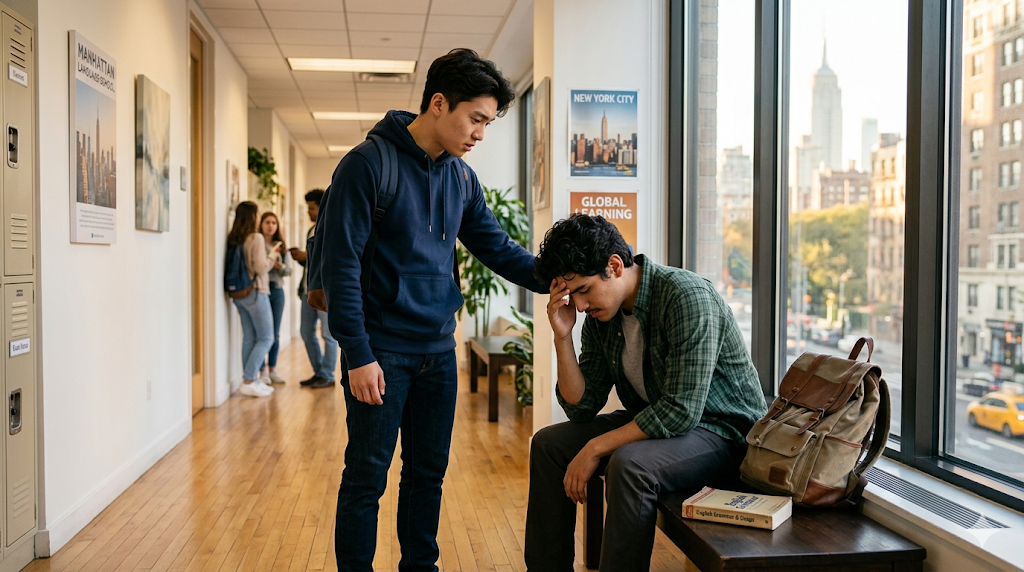
It is Thursday morning.
목요일 아침입니다.
I arrive at school early.
저는 학교에 일찍 도착합니다.
Carlos is sitting in the corridor.
카를로스가 복도에 앉아 있습니다.
He is not laughing today.
그는 오늘 웃지 않고 있습니다.
He is not talking to anyone.
아무에게도 말을 걸지 않고 있습니다.
He is just staring at the floor.
그냥 바닥을 멍하니 바라보고 있습니다.
I walk up to him.
저는 그에게 다가갑니다.
I ask: "Are you feeling OK?"
저는 묻습니다. "괜찮아?"
He looks up slowly.
그가 천천히 고개를 들어 올립니다.
He says: "Not really. I'm not sleeping well."
그가 말합니다. "별로. 잠을 잘 못 자고 있어."
I sit down next to him.
저는 그 옆에 앉습니다.
I ask: "Are you thinking about home?"
저는 묻습니다. "집 생각하고 있어?"
He nods slowly.
그가 천천히 고개를 끄덕입니다.
He says: "Yes. My family is having a big party this weekend."
그가 말합니다. "응. 이번 주말에 우리 가족이 큰 파티를 하거든."
He says: "And I'm sitting here in New York."
그가 말합니다. "근데 나는 여기 뉴욕에 앉아 있고."
I say: "Are you calling them tonight?"
저는 말합니다. "오늘 밤에 전화할 거야?"
He says: "Yes, I am."
그가 말합니다. "응, 그럴 거야."
I say: "Good. That will help."
저는 말합니다. "잘됐다. 그러면 나아질 거야."
He smiles a little.
그가 살짝 미소를 짓습니다.
It is a small smile but it is enough.
작은 미소지만 충분합니다.
👩🏫 Ms. Williams says:
"Today we make questions in the present continuous."
오늘은 현재진행형 의문문을 만들어 봅니다.
Unit 3에서 현재진행형 문장을 배웠습니다.
Unit 2에서 be동사를 앞으로 이동해 의문문을 만들었습니다.
오늘은 이 두 가지를 합칩니다.
공식: be동사 + 주어 + 동사-ing?
평서문: You are feeling OK.
의문문: Are you feeling OK?
평서문: It is raining.
의문문: Is it raining?
평서문: She is going somewhere.
의문문: Where is she going?
📐 Grammar Point — 현재진행형 의문문 패턴
| Yes/No 질문 | be + 주어 + -ing? | Are you feeling OK? |
| Yes/No 질문 | be + 주어 + -ing? | Is it raining? |
| 의문사 질문 | Wh + be + 주어 + -ing? | What are you doing? |
| 의문사 질문 | Wh + be + 주어 + -ing? | Where is she going? |
✅ Are you leaving now? Yes, I am.
✅ Is Ben working today? Yes, he is.
✅ What's Eric doing? He's studying for his exams.
❌ Are you do now? (WRONG — 반드시 -ing를 붙여야 합니다)
❌ You are doing what? (WRONG — be동사가 주어 앞으로 가야 합니다)
Chapter 2 : 어순 연습 / Word Order Practice
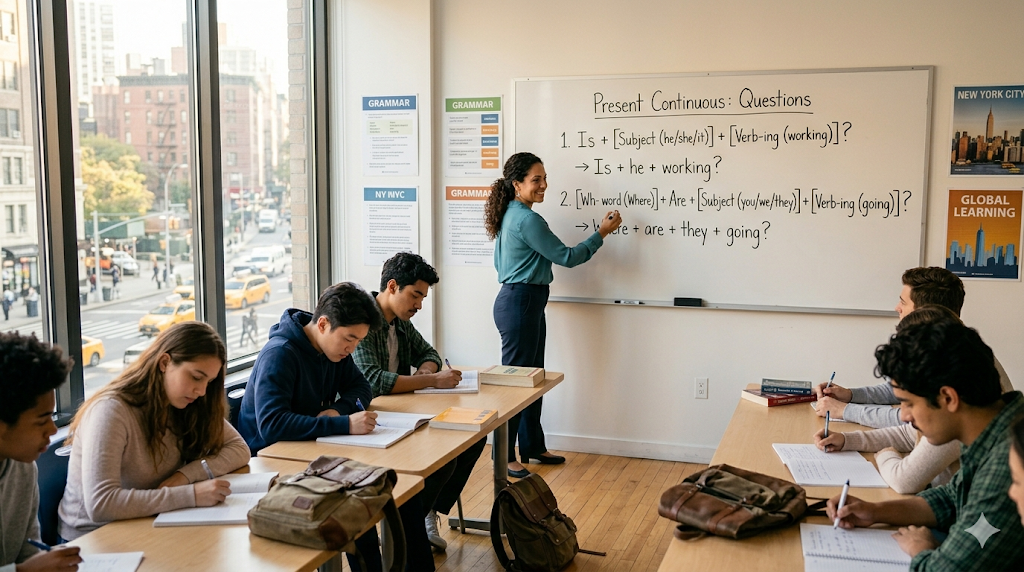
Ms. Williams starts the lesson.
윌리엄스 선생님이 수업을 시작하십니다.
She says: "Today's most important thing is word order."
선생님이 말씀하십니다. "오늘 가장 중요한 것은 어순입니다."
She writes on the board.
선생님이 칠판에 씁니다.
is/are + subject + -ing
She says: "This order never changes."
선생님이 말씀하십니다. "이 순서는 절대 바뀌지 않습니다."
She writes two sentences.
선생님이 문장 두 개를 씁니다.
Is he working today?
Is Ben working today?
She says: "Not: Is working Ben today? That is wrong."
선생님이 말씀하십니다. "Is working Ben today? 이렇게 하면 틀려요."
Then she writes with question words.
그런 다음 의문사가 있는 경우를 씁니다.
Where are they going?
Where are those people going?
She says: "Not: Where are going those people? Wrong again."
선생님이 말씀하십니다. "Where are going those people? 이것도 틀려요."
Anna raises her hand.
안나가 손을 듭니다.
She asks: "So the subject always comes right after the verb?"
그녀가 묻습니다. "그럼 주어는 항상 동사 바로 뒤에 오나요?"
Ms. Williams nods and says: "Exactly. Always."
선생님이 고개를 끄덕이며 말씀하십니다. "정확해요. 항상 그래요."
be동사 + 주어 + -ing
이 순서를 절대 잊지 마세요.
👩🏫 Ms. Williams says:
"Study the word order carefully."
어순을 주의 깊게 공부하세요.
영어 의문문에서 주어는 반드시 be동사 바로 뒤에 옵니다.
주어가 길어져도 규칙은 같습니다.
Is he working today?
Is Ben working today?
Where are they going?
Where are those people going? (not: Where are going those people?)
의문사가 있는 경우 공식:
의문사 + be동사 + 주어 + -ing?
What are you doing?
Where is she going?
Why are you wearing a coat? It's not cold.
Who are you waiting for?
📐 Grammar Point — 어순 정리 (Word Order Summary)
| (없음) | Are | you | leaving | now? |
| (없음) | Is | it | raining? | |
| What | are | the children | doing? | |
| Where | is | she | going? | |
| Why | are | you | wearing | a coat? |
| Who | are | you | waiting | for? |
✅ Where's she going? (= Where is she going?)
✅ What are the children doing? They're watching TV.
✅ Who are you waiting for? Are you waiting for Sue?
❌ Where is going she? (WRONG — 주어가 동사 앞으로 가면 안 됨)
Chapter 3 : 교실 활동: 누가 무엇을 하고 있나? / Classroom Activity: Who Is Doing What?
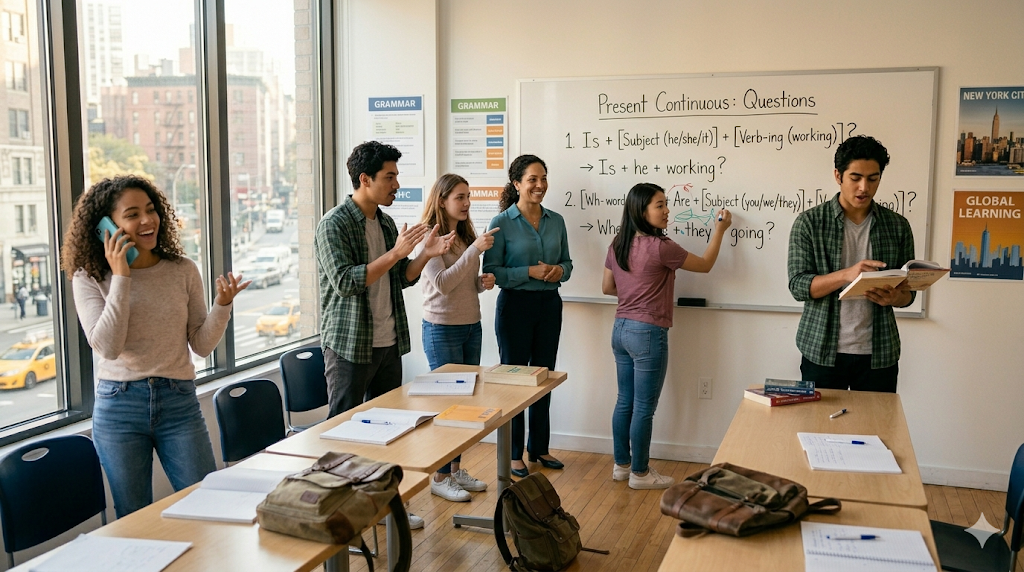
Ms. Williams claps her hands.
윌리엄스 선생님이 손뼉을 칩니다.
She says: "Let's play a game."
선생님이 말씀하십니다. "게임을 해봅시다."
"One student does an action."
"한 학생이 동작을 합니다."
"The others ask questions using -ing."
"나머지 학생들이 -ing를 사용해서 질문합니다."
Sofia stands up first.
소피아가 먼저 일어납니다.
She is drawing in the air with her finger.
그녀가 손가락으로 허공에 그림을 그리고 있습니다.
Fatima asks: "Are you drawing?"
파티마가 묻습니다. "그림 그리고 있어?"
Sofia smiles: "Yes, I am."
소피아가 웃습니다. "응, 맞아."
Lucas asks: "What are you drawing?"
루카스가 묻습니다. "뭘 그리고 있어?"
Sofia says: "I'm drawing the New York skyline."
소피아가 말합니다. "뉴욕 스카이라인을 그리고 있어."
Now it is Carlos's turn.
이제 카를로스의 차례입니다.
He stands up. He looks much better now.
그가 일어납니다. 지금은 훨씬 나아 보입니다.
He is pretending to talk on the phone.
그는 전화 통화하는 척을 하고 있습니다.
I ask: "Are you talking on the phone?"
저는 묻습니다. "전화 통화하고 있어?"
He says: "Yes, I am."
그가 말합니다. "응, 맞아."
I ask: "Who are you talking to?"
저는 묻습니다. "누구랑 통화하고 있어?"
He grins: "My mother. She is asking why I am not eating."
그가 씩 웃습니다. "우리 엄마. 왜 밥을 안 먹느냐고 물어보고 있어."
The whole class laughs.
반 전체가 웃습니다.
Even Carlos laughs properly now.
카를로스도 이제 제대로 웃습니다.
👩🏫 Ms. Williams says:
"Notice how questions and answers connect."
질문과 대답이 어떻게 연결되는지 보세요.
질문할 때 사용한 be동사를 그대로 짧은 대답에 씁니다.
"Are you feeling OK?" → "Yes, I am." / "No, I'm not."
"Is Ben working today?" → "Yes, he is." / "No, he isn't."
"Is it raining?" → "No, it isn't."
"Are your friends staying at a hotel?" → "No, they aren't. They're staying with me."
📐 Grammar Point — 짧은 대답 (Short Answers)
| Are you leaving now? | Yes, I am. | No, I'm not. |
| Is he working? | Yes, he is. | No, he isn't. |
| Is it raining? | Yes, it is. | No, it isn't. |
| Are they staying? | Yes, they are. | No, they aren't. |
✅ "Are you leaving now?" "Yes, I am."
✅ "Is it raining?" "No, it isn't."
✅ "Are your friends staying at a hotel?" "No, they aren't. They're staying with me."
❌ "Are you working?" "Yes, I'm." (WRONG — I am의 단축형은 짧은 대답에 불가)
Chapter 4 : 방과 후 센트럴 파크 / After Class — Central Park

After class we go to Central Park.
수업 후 우리는 센트럴 파크로 갑니다.
Carlos, Yuki and I are sitting on the grass.
카를로스, 유키, 그리고 저는 잔디 위에 앉아 있습니다.
The sun is shining now.
이제 햇빛이 나고 있습니다.
It is not raining anymore.
더 이상 비가 오지 않습니다.
Yuki is reading her notebook.
유키는 노트를 읽고 있습니다.
Carlos is lying on the grass.
카를로스는 잔디 위에 누워 있습니다.
He is staring at the sky.
그는 하늘을 바라보고 있습니다.
I ask: "Carlos, what are you thinking about?"
저는 묻습니다. "카를로스, 무슨 생각 하고 있어?"
He says: "I'm thinking about the game."
그가 말합니다. "게임 생각하고 있어."
I ask: "Are you talking about the classroom game?"
저는 묻습니다. "교실에서 한 게임 말하는 거야?"
He says: "No. Soccer. Mexico is playing tonight."
그가 말합니다. "아니. 축구. 오늘 밤 멕시코 경기가 있어."
Yuki looks up from her notebook.
유키가 노트에서 고개를 듭니다.
She asks: "Are you watching it?"
그녀가 묻습니다. "볼 거야?"
He says: "Yes, I am. Are you coming?"
그가 말합니다. "응. 너도 올래?"
She thinks for a moment.
그녀가 잠깐 생각합니다.
She says: "Yes. What time is it starting?"
그녀가 말합니다. "응. 몇 시에 시작해?"
He says: "Eight o'clock."
그가 말합니다. "8시."
I say: "I'm coming too."
저는 말합니다. "나도 갈게."
Carlos smiles his big smile again.
카를로스가 다시 환하게 웃습니다.
This morning he was sad.
오늘 아침 그는 슬펐습니다.
Now he is laughing and making plans.
지금은 웃으면서 계획을 세우고 있습니다.
That is the power of friends.
그것이 친구의 힘입니다.
👩🏫 Ms. Williams says:
"Look at these natural questions in conversation."
대화 속 자연스러운 질문들을 살펴보세요.
현재진행형 의문문은 일상 대화에서 매우 자주 쓰입니다.
"Look, there's Emily! Where's she going?"
"저기 에밀리 있다! 어디 가고 있지?"
"Why are you wearing a coat? It's not cold."
"왜 코트 입고 있어? 춥지도 않은데."
"Who are you waiting for? Are you waiting for Sue?"
"누구 기다리고 있어? 수 기다리고 있는 거야?"
"What are the children doing?" "They're watching TV."
"애들 지금 뭐 하고 있어?" "TV 보고 있어."
📐 Grammar Point — 의문사 + 현재진행형 자연스러운 표현
what's = what is → What's he doing?
where's = where is → Where's she going?
who's = who is → Who's calling?
how's = how is → How's it going?
✅ What's Eric doing? He's studying for his exams.
✅ Where are those people going?
✅ Is it raining? Yes, take an umbrella.
❌ What he is doing? (WRONG — be동사가 앞으로 가야 합니다)
Chapter 5 : 밤 축구 경기 관람 / Watching the Soccer Game at Night

We are at a sports bar near school.
우리는 학교 근처 스포츠 바에 있습니다.
The match is starting.
경기가 시작되고 있습니다.
Carlos is leaning forward in his seat.
카를로스가 자리에서 앞으로 몸을 기울이고 있습니다.
He is not breathing normally.
그는 정상적으로 숨을 쉬지 않고 있습니다.
Yuki asks: "Are you OK? Are you breathing?"
유키가 묻습니다. "괜찮아? 숨 쉬고 있어?"
He says: "Yes. I'm watching. Please be quiet."
그가 말합니다. "응. 보고 있어. 제발 조용히 해줘."
I ask: "Is Mexico winning?"
저는 묻습니다. "멕시코 이기고 있어?"
He says: "Not yet. But they are attacking now."
그가 말합니다. "아직. 근데 지금 공격하고 있어."
A moment later Mexico scores.
잠시 후 멕시코가 골을 넣습니다.
Carlos jumps up.
카를로스가 자리에서 벌떡 일어납니다.
He is shouting and waving his arms.
그는 소리치며 팔을 흔들고 있습니다.
I ask Yuki: "Is he always like this?"
저는 유키에게 묻습니다. "항상 저래?"
She is laughing too hard to answer.
그녀는 너무 웃느라 대답을 못하고 있습니다.
Later, walking home, I think about today.
나중에 집으로 걸어가면서 저는 오늘을 생각합니다.
This morning Carlos was sitting alone and sad.
오늘 아침 카를로스는 혼자 슬프게 앉아 있었습니다.
Tonight he is laughing and celebrating.
오늘 밤 그는 웃으며 기뻐하고 있습니다.
People change fast when they are with good friends.
좋은 친구들과 함께 있으면 사람은 빨리 바뀝니다.
I am learning English here.
저는 여기서 영어를 배우고 있습니다.
But I am also learning something else.
하지만 다른 무언가도 배우고 있습니다.
How to be a friend far from home.
집에서 멀리 떨어진 곳에서 친구가 되는 법을.
PART 2 : Grammar Focus
Unit 4 : 현재진행형 의문문 완전 정리
핵심 공식 1 (Yes/No 질문): be동사 + 주어 + 동사-ing? 핵심 공식 2 (의문사 질문): 의문사 + be동사 + 주어 + 동사-ing?
평서문 의문문
| You are feeling OK. | Are you feeling OK? |
| It is raining. | Is it raining? |
| She is going somewhere. | Where is she going? |
| They are doing something. | What are they doing? |
| He is working today. | Is he working today? |
어순 주의 (Word Order Warning)
맞는 표현 틀린 표현
| Is Ben working today? | ❌ Is working Ben today? |
| Where are they going? | ❌ Where are going they? |
| What are you doing? | ❌ What you are doing? |
| Why is she crying? | ❌ Why she is crying? |
짧은 대답 완전 정리
질문 Yes No
| Are you leaving now? | Yes, I am. | No, I**'m not**. |
| Is he working? | Yes, he is. | No, he isn't. |
| Is it raining? | Yes, it is. | No, it isn't. |
| Are they staying? | Yes, they are. | No, they aren't. |
Vocabulary : Unit 4
1. Actions & Feelings
Word Meaning Example
| stare | 멍하니 바라보다 | He is staring at the floor. |
| concentrate | 집중하다 | She is concentrating on her work. |
| attack | 공격하다 | Mexico is attacking now. |
| celebrate | 기뻐하다, 축하하다 | He is celebrating the goal. |
| lean | 기울이다 | He is leaning forward in his seat. |
2. Asking About People
Phrase Meaning Example
| Are you feeling OK? | 괜찮아요? | Are you feeling OK? Yes, I'm fine. |
| What are you doing? | 지금 뭐 하고 있어요? | What are you doing right now? |
| Where are you going? | 어디 가고 있어요? | Where are you going so fast? |
| Who are you waiting for? | 누구 기다리고 있어요? | Who are you waiting for? |
| Why are you wearing that? | 왜 그거 입고 있어요? | Why are you wearing a coat? |
Key Phrases : Unit 4
Phrase 한국어 Example
| Are you feeling OK? | 괜찮아? | Are you feeling OK? Not really. |
| Not yet. | 아직 아니야. | Is Mexico winning? Not yet. |
| Please be quiet. | 조용히 해줘. | I'm watching. Please be quiet. |
| That is the power of friends. | 그것이 친구의 힘이야. | People change fast. That is the power of friends. |
| How to be a friend. | 친구가 되는 법. | I am learning how to be a friend. |
Discussion Questions
- 오늘 아침 카를로스의 상태는 어떠했습니까? 현재진행형으로 3문장 묘사하세요.
- "Is working Ben today?" 가 틀린 이유를 설명하고 올바르게 고쳐 쓰세요.
- 의문사(What / Where / Why / Who)를 사용한 현재진행형 질문을 각각 하나씩 만들어 보세요.
- 센트럴 파크 장면을 참고하여 지금 주변 사람들이 하고 있는 것을 5문장으로 묘사하세요.
- 친구에게 지금 무엇을 하고 있는지 묻는 짧은 대화를 6줄로 써보세요. (현재진행형 질문과 짧은 대답 포함)
Minjun's Story | Unit 4: are you doing? (present continuous questions) | Manhattan English Academy | Kalliope Press
'스토리로 배우는 영문법' 카테고리의 다른 글
| Unit 6 : I don't... (simple present negative) (0) | 2026.07.06 |
|---|---|
| Unit 5 : I do/work/like, etc. (simple present) (1) | 2026.07.05 |
| Unit 3 : I am doing (present continuous) (1) | 2026.07.03 |
| Unit 2 : am / is / are (questions) (0) | 2026.07.02 |
| Unit 1 : am / is / are (0) | 2026.07.01 |