Minjun's Story : My English Journey in New York
뉴욕에서 시작하는 영어 이야기
PART 1 : Story
Chapter 1 : 토요일 아침, 차이를 발견하다 / Saturday Morning, Discovering Differences

It is Saturday morning.
토요일 아침입니다.
There is no school today.
오늘은 학교가 없습니다.
I wake up late for the first time this week.
이번 주 처음으로 늦게 일어납니다.
Lucas is already in the kitchen.
루카스는 이미 부엌에 있습니다.
He is making coffee.
그는 커피를 만들고 있습니다.
He asks: "Do you want coffee, Minjun?"
그가 묻습니다. "민준, 커피 마실래?"
I say: "No thanks. I don't drink coffee."
저는 말합니다. "아니, 괜찮아. 나는 커피를 마시지 않아."
He looks surprised.
그가 놀란 표정을 짓습니다.
He says: "You don't drink coffee? How do you wake up?"
그가 말합니다. "커피를 안 마신다고? 그럼 어떻게 일어나?"
I say: "I drink green tea."
저는 말합니다. "녹차를 마셔."
He shakes his head slowly.
그가 천천히 고개를 젓습니다.
He says: "In Brazil, we don't understand life without coffee."
그가 말합니다. "브라질에서는 커피 없는 삶을 이해하지 못해."
I laugh and say: "In Korea, we don't understand life without tea."
저는 웃으며 말합니다. "한국에서는 차 없는 삶을 이해하지 못하지."
We both laugh.
우리 둘 다 웃습니다.
Different countries. Different mornings.
다른 나라. 다른 아침.
But the same small apartment in New York.
하지만 뉴욕의 같은 작은 아파트.
👩🏫 Ms. Williams says:
"Today we learn the simple present negative."
오늘은 단순 현재 부정문을 배웁니다.
부정문을 만들 때 don't 또는 doesn't를 동사 앞에 씁니다.
동사는 반드시 원형을 씁니다. -s/-es를 붙이지 않습니다.
I / we / you / they → don't + 동사원형
he / she / it → doesn't + 동사원형
She doesn't drink coffee. (not: doesn't drinks)
He doesn't like his job. (not: doesn't likes)
I don't drink tea. (not: don't drinks)
📐 Grammar Point — 단순 현재 부정문 공식
| I / we / you / they | don't | 동사원형 | I don't like football. |
| he / she / it | doesn't | 동사원형 | He doesn't like football. |
✅ I don't drink coffee, but I drink tea.
✅ Sue drinks tea, but she doesn't drink coffee.
✅ We don't watch TV very often.
❌ She doesn't drinks coffee. (WRONG — doesn't 뒤는 반드시 동사원형)
❌ He don't like his job. (WRONG — he이므로 doesn't)
Chapter 2 : 서로 다른 취향 / Different Tastes

In the afternoon we meet at a café.
오후에 우리는 카페에서 만납니다.
All eight students are there.
학생 여덟 명 모두 그곳에 있습니다.
Carlos brings Mexican snacks.
카를로스가 멕시코 과자를 가져옵니다.
He offers one to Yuki.
그는 유키에게 하나를 권합니다.
She tries it and makes a face.
그녀가 먹어보고 인상을 씁니다.
She says: "It's very spicy. I don't eat spicy food usually."
그녀가 말합니다. "너무 매워. 나는 보통 매운 음식을 먹지 않아."
Carlos says: "Really? I don't understand that."
카를로스가 말합니다. "진짜? 나는 그게 이해 안 돼."
"In Mexico, we don't cook without chili."
"멕시코에서는 고추 없이는 요리하지 않아."
Fatima smiles and says: "I don't eat pork."
파티마가 미소를 지으며 말합니다. "저는 돼지고기를 먹지 않아."
"It is part of my religion."
"제 종교의 일부거든."
"But I don't mind other people eating it."
"하지만 다른 사람들이 먹는 건 신경 쓰지 않아."
Sofia says: "I don't drink soda."
소피아가 말합니다. "저는 탄산음료를 안 마셔."
"My mother doesn't allow it at home."
"우리 어머니가 집에서 허락하지 않으셔."
"So now I don't even want it."
"그래서 이제 마시고 싶지도 않아."
Anna says: "I don't like sweet things."
안나가 말합니다. "저는 단 것을 좋아하지 않아."
"I don't eat cake or chocolate."
"케이크나 초콜릿을 먹지 않아."
Lucas stares at her.
루카스가 그녀를 빤히 바라봅니다.
He says: "You don't eat chocolate? That doesn't make sense to me."
그가 말합니다. "초콜릿을 안 먹는다고? 나는 그게 말이 안 돼."
Everyone laughs.
모두가 웃습니다.
I say: "I don't like cheese."
저는 말합니다. "저는 치즈를 좋아하지 않아."
Carlos gasps: "No cheese? In America?"
카를로스가 놀랍니다. "치즈가 싫다고? 미국에서?"
Ms. Williams would say: "Different people, different lives."
윌리엄스 선생님이라면 말씀하실 겁니다. "사람마다 다르다."
👩🏫 Ms. Williams says:
"Remember: don't for I/we/you/they. Doesn't for he/she/it."
기억하세요: I/we/you/they → don't. he/she/it → doesn't.
I don't like Josh, and Josh doesn't like me. (not: Josh don't like)
My car doesn't use much gas. (not: My car don't use)
Sometimes he is late, but it doesn't happen very often.
📐 Grammar Point — don't vs. doesn't 선택 규칙
| I | I don't like | ❌ I doesn't like |
| we / you / they | They don't know | ❌ They doesn't know |
| he / she / it | She doesn't drink | ❌ She don't drink |
| he / she / it | My car doesn't use | ❌ My car don't use |
✅ I don't like Josh, and Josh doesn't like me.
✅ My car doesn't use much gas.
✅ It doesn't rain very often here.
❌ He don't like his job. (WRONG — he → doesn't)
❌ She doesn't likes coffee. (WRONG — doesn't 뒤는 동사원형)
Chapter 3 : 수업 시간의 깨달음 / A Realization in Class
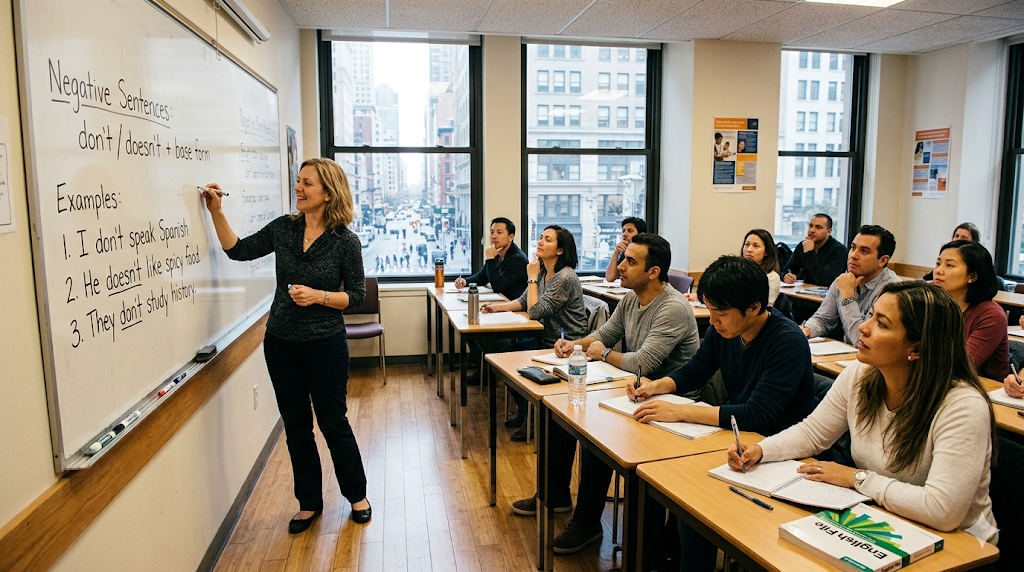
On Monday we are back in class.
월요일에 우리는 다시 수업에 옵니다.
Ms. Williams writes on the board.
윌리엄스 선생님이 칠판에 씁니다.
don't / doesn't + base form
She says: "This is the most important rule today."
선생님이 말씀하십니다. "오늘 가장 중요한 규칙입니다."
"After don't or doesn't, always use the base form."
"don't 또는 doesn't 뒤에는 항상 동사원형을 씁니다."
"Never add -s or -es after doesn't."
"doesn't 뒤에는 절대 -s나 -es를 붙이지 않습니다."
She writes examples.
선생님이 예문을 씁니다.
I don't like to wash the car. I don't do it very often.
저는 세차하는 것을 좋아하지 않습니다. 자주 하지 않습니다.
Sarah speaks Spanish, but she doesn't speak Italian.
사라는 스페인어를 말하지만 이탈리아어는 말하지 않습니다.
Bill doesn't do his job very well.
빌은 자신의 일을 잘 하지 못합니다.
Maria doesn't usually have breakfast.
마리아는 보통 아침을 먹지 않습니다.
She points at the last sentence.
선생님이 마지막 문장을 가리킵니다.
She says: "Notice — doesn't have. Not doesn't has."
선생님이 말씀하십니다. "보세요 — doesn't have입니다. doesn't has가 아닙니다."
Huang Wei raises his hand.
황웨이가 손을 듭니다.
He asks: "So after doesn't, have comes back to normal?"
그가 묻습니다. "그럼 doesn't 뒤에서는 have가 원래대로 돌아오는 건가요?"
Ms. Williams smiles: "Exactly. doesn't does all the work."
선생님이 웃습니다. "정확해요. doesn't가 모든 역할을 합니다."
"The verb rests. It goes back to its base form."
"동사는 쉽니다. 원형으로 돌아갑니다."
I write this down carefully.
저는 이것을 조심스럽게 받아 적습니다.
doesn't does all the work.
doesn't가 모든 역할을 한다.
That is easy to remember.
기억하기 쉽습니다.
👩🏫 Ms. Williams says:
"Don't/doesn't always comes before the BASE FORM of the verb."
don't/doesn't는 항상 동사 원형 앞에 옵니다.
don't/doesn't + base form (동사원형)
don't like / doesn't speak / don't do / doesn't have
❌ doesn't speaks (WRONG)
❌ doesn't has (WRONG)
❌ doesn't doing (WRONG)
📐 Grammar Point — base form 규칙 (Base Form Rule)
doesn't가 부정을 표현하므로 동사는 원형으로 돌아갑니다.
| She speaks Spanish. | She doesn't speak Italian. |
| He does his job well. | He doesn't do it well. |
| Maria has breakfast. | Maria doesn't have breakfast. |
| He watches TV. | He doesn't watch TV. |
| She studies hard. | She doesn't study hard. |
✅ Sarah speaks Spanish, but she doesn't speak Italian.
✅ Bill doesn't do his job very well.
✅ Maria doesn't usually have breakfast.
❌ She doesn't speaks Italian. (WRONG — base form!)
❌ Maria doesn't has breakfast. (WRONG — base form!)
Chapter 4 : 민준이 좋아하지 않는 것들 / Things Minjun Doesn't Like

After class I go to Central Park alone.
수업 후 저는 혼자 센트럴 파크에 갑니다.
I sit on a bench and think.
저는 벤치에 앉아 생각합니다.
I write in my journal in English today.
오늘은 일기를 영어로 씁니다.
"Things I don't like about New York:"
"뉴욕에서 좋아하지 않는 것들:"
"I don't like the noise at night."
"밤의 소음을 좋아하지 않는다."
"I don't sleep well because of the traffic."
"교통 소음 때문에 잘 자지 못한다."
"I don't understand why everything costs so much."
"왜 모든 것이 이렇게 비싼지 이해하지 못한다."
"I don't know many people here yet."
"아직 여기서 아는 사람이 많지 않다."
Then I write: "Things I do like about New York:"
그런 다음 씁니다. "뉴욕에서 좋아하는 것들:"
"I like walking everywhere."
"어디든 걸어 다니는 것을 좋아한다."
"I like the energy of the city."
"도시의 에너지가 좋다."
"I like my classmates."
"반 친구들이 좋다."
"I like Ms. Williams."
"윌리엄스 선생님이 좋다."
"I don't want to go home yet."
"아직 집에 가고 싶지 않다."
I look at what I wrote.
저는 제가 쓴 것을 봅니다.
The don't list is shorter.
don't 목록이 더 짧습니다.
That is a good sign.
그것은 좋은 신호입니다.
👩🏫 Ms. Williams says:
"Notice how 'don't' and 'do' can both appear in one sentence for contrast."
대조를 위해 'don't'와 'do'가 한 문장에 함께 나올 수 있습니다.
I don't like to wash the car. I don't do it very often.
I drink coffee, but I don't drink tea.
Sue drinks tea, but she doesn't drink coffee.
You don't work very hard.
We don't watch TV very often.
The weather is usually nice. It doesn't rain very often.
Matt and Nicole don't know many people.
📐 Grammar Point — 대조 표현 (Contrast with but)
but을 사용하면 긍정과 부정을 자연스럽게 대조할 수 있습니다.
I drink coffee, but I don't drink tea.
She speaks Spanish, but she doesn't speak Italian.
He likes football, but he doesn't play it.
I like New York, but I don't like the noise.
✅ I like walking, but I don't like running.
✅ She reads a lot, but she doesn't watch TV.
✅ We know Carlos, but we don't know his family.
Chapter 5 : 일요일 저녁, 한 주를 돌아보며 / Sunday Evening, Looking Back at the Week

It is Sunday evening.
일요일 저녁입니다.
The week is over.
한 주가 끝났습니다.
I sit by the window and watch the city.
저는 창가에 앉아 도시를 바라봅니다.
Lucas is cooking in the kitchen again.
루카스는 또 부엌에서 요리하고 있습니다.
He doesn't stop cooking on weekends.
그는 주말에 요리를 멈추지 않습니다.
I think about this week.
저는 이번 주에 대해 생각합니다.
I don't speak English perfectly yet.
저는 아직 영어를 완벽하게 말하지 못합니다.
I don't understand everything Ms. Williams says.
윌리엄스 선생님이 하시는 말씀을 모두 이해하지는 못합니다.
I don't always find the right words.
항상 적절한 단어를 찾지는 못합니다.
But I don't give up.
하지만 포기하지 않습니다.
I don't want to.
그러고 싶지 않습니다.
Every day I learn something new.
매일 새로운 것을 배웁니다.
Every day English feels a little less strange.
매일 영어가 조금씩 덜 낯설게 느껴집니다.
Lucas calls from the kitchen.
루카스가 부엌에서 부릅니다.
"Minjun! Do you want dinner?"
"민준! 저녁 먹을래?"
I smile and say: "Yes, I do."
저는 미소 지으며 말합니다. "응, 먹을게."
He says: "Good. Tonight I don't make Brazilian food."
그가 말합니다. "좋아. 오늘 밤은 브라질 음식을 안 만들어."
I ask: "What do you make then?"
저는 묻습니다. "그럼 뭘 만들어?"
He says: "Korean fried rice. I found a recipe online."
그가 말합니다. "한국식 볶음밥. 온라인에서 레시피 찾았어."
I don't know what to say.
저는 뭐라고 해야 할지 모르겠습니다.
But my heart feels warm.
하지만 마음이 따뜻해집니다.
PART 2 : Grammar Focus
Unit 6 : 단순 현재 부정문 완전 정리 (Simple Present Negative)
핵심 공식: don't / doesn't + 동사원형
| I / we / you / they | don't | 동사원형 | I don't drink coffee. |
| he / she / it | doesn't | 동사원형 | She doesn't drink coffee. |
don't vs. doesn't 선택 완전 정리
| I | I don't like | ❌ I doesn't like |
| we / you / they | They don't know | ❌ They doesn't know |
| he / she / it | He doesn't like | ❌ He don't like |
| he / she / it | She doesn't speak | ❌ She doesn't speaks |
| he / she / it | My car doesn't use | ❌ My car don't use |
base form 규칙 완전 정리
doesn't/don't 뒤에는 항상 동사원형을 씁니다.
| She speaks Spanish. | She doesn't speak Italian. |
| He does his job well. | He doesn't do it well. |
| Maria has breakfast. | Maria doesn't have breakfast. |
| He watches TV. | He doesn't watch TV. |
| She studies hard. | She doesn't study hard. |
Vocabulary : Unit 6
1. Negative Expressions (부정 표현 동사)
| don't understand | 이해하지 못하다 | I don't understand why it costs so much. |
| don't mind | 신경 쓰지 않다 | I don't mind other people eating it. |
| don't allow | 허락하지 않다 | My mother doesn't allow soda at home. |
| don't give up | 포기하지 않다 | I don't give up even when it is hard. |
| don't want | 원하지 않다 | I don't want to go home yet. |
2. Contrast Expressions (대조 표현)
| but | 하지만 | I like tea, but I don't like coffee. |
| yet | 아직 | I don't speak perfectly yet. |
| usually | 보통 | She doesn't usually have breakfast. |
| very often | 자주 | We don't watch TV very often. |
| even | ~조차도 | I don't even want soda now. |
Key Phrases : Unit 6
| I don't give up. | 나는 포기하지 않는다. | I don't speak perfectly, but I don't give up. |
| That doesn't make sense. | 그것은 말이 안 된다. | You don't eat chocolate? That doesn't make sense! |
| I don't want to. | 그러고 싶지 않다. | I don't want to go home yet. |
| doesn't stop | 멈추지 않다 | He doesn't stop cooking on weekends. |
| not yet | 아직 ~않다 | I don't know many people here yet. |
Discussion Questions
- 민준이 뉴욕에서 좋아하지 않는 것들을 don't 문장 3개로 써보세요.
- "She doesn't drinks coffee." 가 틀린 이유를 설명하고 올바르게 고쳐 쓰세요.
- don't와 doesn't를 각각 언제 쓰는지 예문 두 개씩 들어 설명하세요.
- but을 사용해 자신이 하는 것과 하지 않는 것을 대조하는 문장 3개를 써보세요.
- 자신에 대해 don't / doesn't 문장 5개를 써보세요. (음식, 습관, 취미 등)
Minjun's Story | Unit 6: I don't... (simple present negative) | Manhattan English Academy | Kalliope Press
'스토리로 배우는 영문법' 카테고리의 다른 글
| Unit 8 : I am doing and I do (present continuous and simple present) (0) | 2026.07.08 |
|---|---|
| Unit 7 : Do you...? (simple present questions) (0) | 2026.07.07 |
| Unit 5 : I do/work/like, etc. (simple present) (1) | 2026.07.05 |
| Unit 4 : are you doing? (present continuous questions) (0) | 2026.07.04 |
| Unit 3 : I am doing (present continuous) (1) | 2026.07.03 |