Minjun's Story : My English Journey in New York
뉴욕에서 시작하는 영어 이야기
PART 1 : Story
Chapter 1 : 월요일, 새로운 짝 활동 / Monday, A New Partner Activity
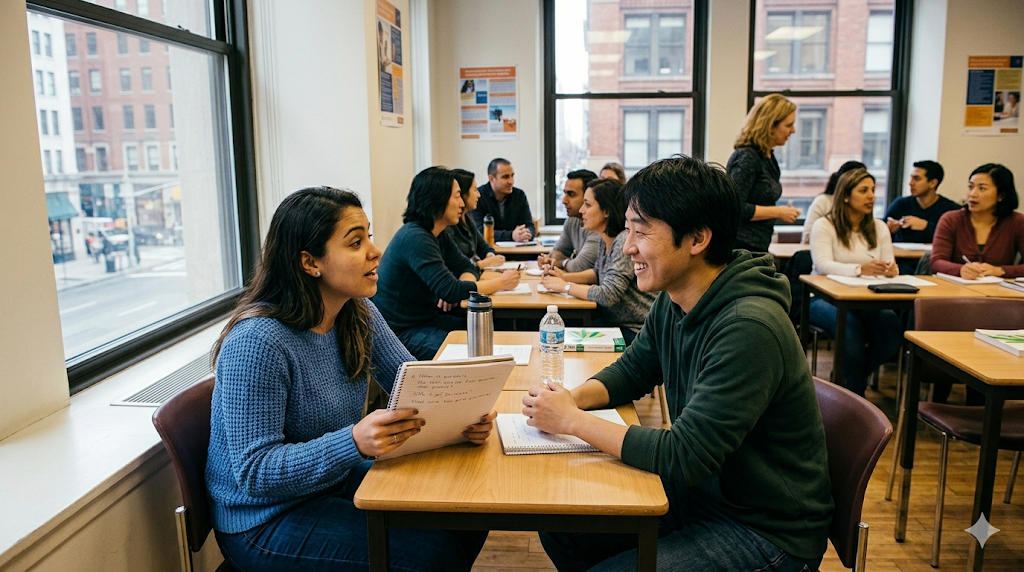
It is Monday morning.
월요일 아침입니다.
We are all in our seats.
우리는 모두 자리에 앉아 있습니다.
Ms. Williams walks in with a big smile.
윌리엄스 선생님이 환한 미소를 지으며 들어오십니다.
She says: "Today we do something different."
선생님이 말씀하십니다. "오늘은 다른 것을 해봅니다."
"You interview your partner."
"파트너를 인터뷰합니다."
"Use do and does to ask questions."
"do와 does를 사용해 질문하세요."
She puts us in pairs.
선생님이 우리를 짝으로 나눕니다.
I am with Fatima.
저는 파티마와 짝입니다.
I feel a little nervous.
저는 조금 긴장됩니다.
I don't know Fatima very well yet.
저는 아직 파티마를 잘 알지 못합니다.
But she smiles at me kindly.
하지만 그녀가 저에게 친절하게 미소를 짓습니다.
She asks: "Do you want to go first?"
그녀가 묻습니다. "먼저 할래요?"
I say: "Yes. OK."
저는 말합니다. "네, 좋아요."
I look at my notepad.
저는 메모지를 봅니다.
I ask: "Do you like living in New York?"
저는 묻습니다. "뉴욕에서 사는 것이 좋으세요?"
She thinks for a moment.
그녀가 잠깐 생각합니다.
She says: "Yes, I do. But I don't like the cold."
그녀가 말합니다. "네, 좋아요. 하지만 추위는 좋아하지 않아요."
I laugh: "Me too. Does it get very cold here in winter?"
저는 웃습니다. "저도요. 여기 겨울에 많이 추워지나요?"
She says: "Yes, it does. Very cold."
그녀가 말합니다. "네, 그래요. 아주 많이 추워요."
I write that down.
저는 그것을 받아 적습니다.
Good to know.
알아두면 좋겠습니다.
👩🏫 Ms. Williams says:
"Today we learn simple present questions with do and does."
오늘은 do와 does를 사용한 단순 현재 의문문을 배웁니다.
Unit 6에서 don't / doesn't로 부정문을 만들었습니다.
오늘은 do / does로 의문문을 만듭니다. 규칙은 같습니다.
공식: do/does + 주어 + 동사원형?
I/we/you/they → Do you work?
he/she/it → Does he work?
동사는 반드시 원형을 씁니다. -s/-es를 붙이지 않습니다.
📐 Grammar Point — 단순 현재 의문문 공식
| Do | I / we / you / they | work / like / do / have | ? |
| Does | he / she / it | work / like / do / have | ? |
✅ Do they like music?
✅ Does he like music?
✅ Do your parents speak English?
❌ Does he likes music? (WRONG — does 뒤는 반드시 동사원형)
❌ Do she work here? (WRONG — she이므로 *Does)
Chapter 2 : 어순 연습 / Word Order Practice

After the partner activity Ms. Williams calls us back.
짝 활동 후 윌리엄스 선생님이 우리를 다시 부르십니다.
She writes on the board.
선생님이 칠판에 씁니다.
do / does + subject + base form
She says: "This order never changes."
선생님이 말씀하십니다. "이 순서는 절대 바뀌지 않습니다."
She writes examples one by one.
선생님이 예문을 하나씩 씁니다.
Do you play the guitar?
기타를 치나요?
Do your friends live near here?
친구들이 근처에 사나요?
Does Chris work on Sundays?
크리스는 일요일에 일하나요?
Does it rain a lot here?
여기 비가 많이 오나요?
Then she adds question words.
그런 다음 선생님이 의문사를 추가하십니다.
Where do your parents live?
부모님은 어디에 사시나요?
How often do you wash your hair?
얼마나 자주 머리를 감나요?
What does this word mean?
이 단어는 무슨 뜻인가요?
How much does it cost to fly to Puerto Rico?
푸에르토리코까지 비행기 값이 얼마나 드나요?
Carlos raises his hand.
카를로스가 손을 듭니다.
He asks: "What do you do? What does that mean?"
그가 묻습니다. "What do you do? 는 무슨 뜻이에요?"
Ms. Williams smiles: "Great question."
선생님이 미소를 짓습니다. "좋은 질문이에요."
"What do you do? = What is your job?"
"What do you do? = 직업이 뭐예요?"
"What do you do?" "I work in a bank."
"직업이 뭐예요?" "은행에서 일해요."
Carlos nods slowly.
카를로스가 천천히 고개를 끄덕입니다.
He says: "So it doesn't mean 'what are you doing right now'?"
그가 말합니다. "그러면 '지금 뭐 하고 있어요?'라는 뜻이 아닌 건가요?"
Ms. Williams says: "Exactly. Context matters."
선생님이 말씀하십니다. "정확해요. 문맥이 중요합니다."
👩🏫 Ms. Williams says:
"Study the word order carefully: do/does + subject + base form."
어순을 주의 깊게 공부하세요: do/does + 주어 + 동사원형.
의문사가 있어도 규칙은 같습니다.
의문사 + do/does + 주어 + 동사원형?
Where do you live?
How often do you wash your hair?
What does this word mean?
How much does it cost to fly to Puerto Rico?
빈도 부사 always / usually는 주어 뒤에 옵니다.
Does Chris always work on Sundays?
What do you usually do on weekends?
📐 Grammar Point — 어순 정리 (Word Order)
| (없음) | Do | you | play | the guitar? | |
| (없음) | Does | Chris | work | on Sundays? | |
| Where | do | your parents | live? | ||
| How often | do | you | wash | your hair? | |
| What | does | this word | mean? | ||
| Does | Chris | always | work | on Sundays? | |
| What | do | you | usually | do | on weekends? |
✅ Does Chris always work on Sundays?
✅ What do you usually do on weekends?
✅ What do you do? = What's your job?
❌ Does it rains here? (WRONG — does 뒤는 동사원형)
❌ Do she live near here? (WRONG — she → Does)
Chapter 3 : 파티마와의 인터뷰 / The Interview with Fatima

After class Fatima and I continue our interview at a café.
수업 후 파티마와 저는 카페에서 인터뷰를 계속합니다.
I ask: "Do you miss your family?"
저는 묻습니다. "가족이 그리우세요?"
She says: "Yes, I do. Every day."
그녀가 말합니다. "네, 그리워요. 매일요."
I ask: "Does your family call you often?"
저는 묻습니다. "가족이 자주 전화하나요?"
She says: "Yes, they do. My mother calls every morning."
그녀가 말합니다. "네, 그래요. 어머니가 매일 아침 전화하세요."
"Does she worry about you?"
"어머니가 걱정을 하시나요?"
She smiles: "Yes, she does. All mothers do."
그녀가 미소를 짓습니다. "네, 하세요. 모든 어머니가 다 그러시죠."
I nod. My mother does too.
저도 고개를 끄덕입니다. 저희 어머니도 그러십니다.
Now it is Fatima's turn to ask.
이제 파티마가 질문할 차례입니다.
She asks: "Do you enjoy studying English?"
그녀가 묻습니다. "영어 공부가 즐거우세요?"
I think for a moment.
저는 잠깐 생각합니다.
I say: "Yes, I do. But does it get easier? I don't know yet."
저는 말합니다. "네, 즐거워요. 하지만 더 쉬워지나요? 아직 모르겠어요."
She laughs: "Does anyone know the answer to that?"
그녀가 웃습니다. "그 질문의 답을 아는 사람이 있을까요?"
We both laugh.
우리 둘 다 웃습니다.
She asks: "Do you play any instruments?"
그녀가 묻습니다. "악기를 연주하나요?"
I say: "No, I don't. Do you?"
저는 말합니다. "아니요, 못 해요. 당신은요?"
She says: "Yes, I do. I play the oud."
그녀가 말합니다. "네, 해요. 우드를 연주해요."
I say: "What is an oud?"
저는 말합니다. "우드가 뭐예요?"
She says: "It is like a guitar. But older. And more beautiful."
그녀가 말합니다. "기타 같은 거예요. 하지만 더 오래됐고, 더 아름다워요."
👩🏫 Ms. Williams says:
"Remember: do for I/we/you/they. Does for he/she/it."
기억하세요: I/we/you/they → do. he/she/it → does.
Do they like music? → Yes, they do. / No, they don't.
Does he like music? → Yes, he does. / No, he doesn't.
📐 Grammar Point — 짧은 대답 (Short Answers)
| Do you play the guitar? | Yes, I do. | No, I don't. |
| Do your parents speak English? | Yes, they do. | No, they don't. |
| Does Ryan work hard? | Yes, he does. | No, he doesn't. |
| Does your sister live in Vancouver? | Yes, she does. | No, she doesn't. |
✅ "Do you play the guitar?" "No, I don't."
✅ "Does Ryan work hard?" "Yes, he does."
✅ "Do your parents speak English?" "Yes, they do."
❌ "Does she live here?" "Yes, she do." (WRONG — she → does)
❌ "Do you like it?" "Yes, I does." (WRONG — I → do)
Chapter 4 : 수업 후 질문 게임 / After Class Question Game
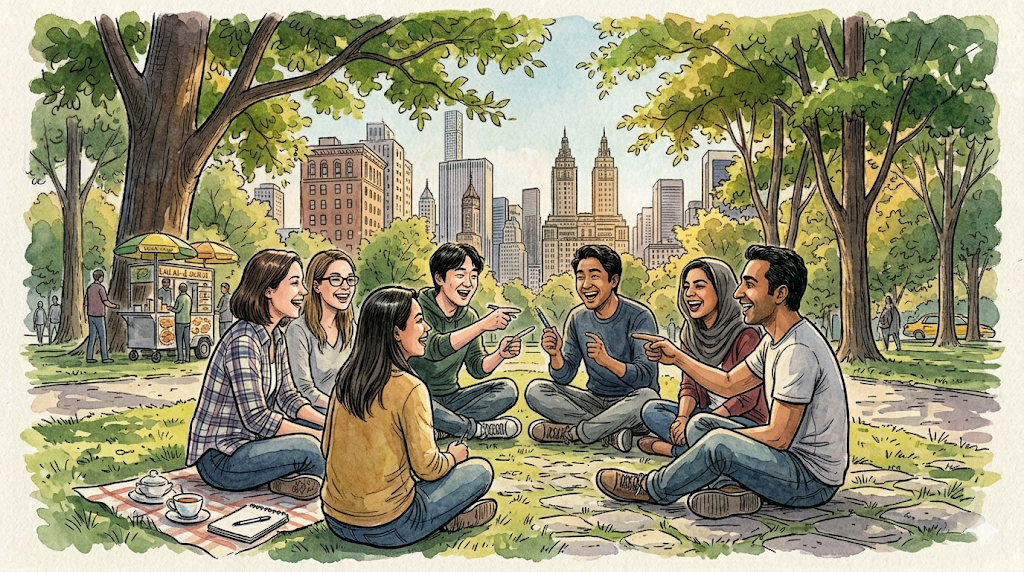
After the café Fatima and I meet the others in the park.
카페 후 파티마와 저는 공원에서 다른 친구들을 만납니다.
Carlos suggests a game.
카를로스가 게임을 제안합니다.
He says: "One person asks a question. The next person answers and asks another."
그가 말합니다. "한 사람이 질문하면 다음 사람이 답하고 또 질문해요."
"Only do and does questions."
"do와 does 질문만 써요."
Lucas starts.
루카스가 시작합니다.
He asks Anna: "Do you cook at home?"
그가 안나에게 묻습니다. "집에서 요리해요?"
Anna says: "Yes, I do. I cook every day."
안나가 말합니다. "네, 해요. 매일 요리해요."
She turns to Sofia: "Does your family live in Rome?"
그녀가 소피아에게 돌아봅니다. "가족이 로마에 사세요?"
Sofia says: "No, they don't. They live in Milan."
소피아가 말합니다. "아니요, 안 살아요. 밀라노에 살아요."
She asks Huang Wei: "Do you speak any language besides Chinese and English?"
그녀가 황웨이에게 묻습니다. "중국어와 영어 외에 다른 언어를 하나요?"
Huang Wei says: "Yes, I do. I speak a little Japanese."
황웨이가 말합니다. "네, 해요. 일본어를 조금 해요."
He asks me: "Does Korean food use a lot of garlic?"
그가 저에게 묻습니다. "한국 음식에 마늘을 많이 쓰나요?"
I say: "Yes, it does. A lot."
저는 말합니다. "네, 써요. 아주 많이요."
I ask Carlos: "Do you watch football every weekend?"
저는 카를로스에게 묻습니다. "매 주말마다 축구를 봐요?"
Carlos says: "Yes, I do. Does anyone here not watch football?"
카를로스가 말합니다. "네, 봐요. 여기서 축구를 안 보는 사람이 있나요?"
We all look at Yuki.
우리 모두 유키를 바라봅니다.
She raises her hand slowly.
그녀가 천천히 손을 듭니다.
She says: "I don't watch football. I don't understand it."
그녀가 말합니다. "저는 축구를 안 봐요. 이해하지 못해요."
Carlos gasps dramatically.
카를로스가 극적으로 놀랍니다.
We all laugh.
우리 모두 웃습니다.
👩🏫 Ms. Williams says:
"What do you do? is one of the most useful questions in English."
"What do you do?"는 영어에서 가장 유용한 질문 중 하나입니다.
What do you do? = What is your job? (직업이 뭐예요?)
"What do you do?" "I work in a bank."
빈도를 물을 때는 How often을 씁니다.
How often do you exercise?
How often does she call you?
📐 Grammar Point — 유용한 do/does 질문 표현
| What do you do? | 직업이 뭐예요? |
| Where do you live? | 어디에 살아요? |
| How often do you go to the gym? | 얼마나 자주 헬스장에 가요? |
| What does this word mean? | 이 단어 무슨 뜻이에요? |
| How much does it cost? | 얼마예요? |
| Does your family call you often? | 가족이 자주 전화해요? |
| Do you enjoy studying English? | 영어 공부가 즐거워요? |
Chapter 5 : 저녁, 민준의 일기 / Evening, Minjun's Journal

I am back in my apartment.
저는 아파트로 돌아왔습니다.
Lucas is watching TV quietly.
루카스가 조용히 TV를 보고 있습니다.
I lie on my bed and open my journal.
저는 침대에 누워 일기를 펼칩니다.
I write questions to myself in English.
저는 영어로 스스로에게 질문을 씁니다.
"Do I enjoy living in New York?"
"나는 뉴욕에서 사는 것이 즐거운가?"
"Yes, I do."
"그렇다."
"Do I miss Korea?"
"나는 한국이 그리운가?"
"Yes, I do. Every day."
"그렇다. 매일."
"Does English get easier every day?"
"영어가 매일 더 쉬워지고 있는가?"
"I think it does."
"그런 것 같다."
"Does Ms. Williams believe in me?"
"윌리엄스 선생님은 나를 믿으시는가?"
"Yes, she does. I can feel it."
"그렇다. 느낄 수 있다."
"Do my new friends like me?"
"새 친구들은 나를 좋아하는가?"
"I think they do."
"그런 것 같다."
I close my journal.
저는 일기를 닫습니다.
I don't have all the answers.
모든 답을 갖고 있지는 않습니다.
But I have the right questions.
하지만 올바른 질문들을 갖고 있습니다.
And in English, that is already something.
그리고 영어로 그렇게 할 수 있다는 것, 그것만으로도 이미 대단한 일입니다.
PART 2 : Grammar Focus
Unit 7 : 단순 현재 의문문 완전 정리 (Simple Present Questions)
핵심 공식: do/does + 주어 + 동사원형?
| Do | I / we / you / they | 동사원형 | Do you like music? |
| Does | he / she / it | 동사원형 | Does he like music? |
어순 완전 정리 (Word Order)
| (없음) | Do | you | play the guitar? | |
| (없음) | Does | Chris | work on Sundays? | |
| Where | do | your parents | live? | |
| How often | do | you | wash your hair? | |
| What | does | this word | mean? | |
| How much | does | it | cost to fly there? |
짧은 대답 완전 정리
| Do you play guitar? | Yes, I do. | No, I don't. |
| Do they like music? | Yes, they do. | No, they don't. |
| Does Ryan work hard? | Yes, he does. | No, he doesn't. |
| Does your sister live here? | Yes, she does. | No, she doesn't. |
Vocabulary : Unit 7
1. Question Verbs (질문에 자주 쓰이는 동사)
| enjoy | 즐기다 | Do you enjoy studying English? |
| miss | 그리워하다 | Do you miss your family? |
| believe | 믿다 | Does she believe in you? |
| suggest | 제안하다 | Carlos suggests a game. |
| interview | 인터뷰하다 | Do you interview your partner today? |
2. Useful Expressions
| How often | 얼마나 자주 | How often do you call home? |
| How much | 얼마나, 얼마에 | How much does it cost? |
| What do you do? | 직업이 뭐예요? | "What do you do?" "I work in a bank." |
| context | 문맥 | Context matters in English. |
| instrument | 악기 | Do you play any instruments? |
Key Phrases : Unit 7
| Do you want to go first? | 먼저 할래요? | Do you want to go first? Yes, OK. |
| What do you do? | 직업이 뭐예요? | "What do you do?" "I work in a bank." |
| Does anyone know? | 아는 사람 있나요? | Does anyone know the answer? |
| I have the right questions. | 나는 올바른 질문들을 갖고 있다. | I don't have all the answers, but I have the right questions. |
| I can feel it. | 느낄 수 있다. | Yes, she does. I can feel it. |
Discussion Questions
- do와 does를 각각 언제 쓰는지 예문 두 개씩 들어 설명하세요.
- "Does he likes football?" 이 틀린 이유를 설명하고 올바르게 고쳐 쓰세요.
- 의문사 Where / How often / What / How much를 사용해 do/does 질문을 각각 하나씩 만들어 보세요.
- 파트너에게 물어볼 질문 5개를 do/does로 만들고 예상 대답도 짧은 대답 형식으로 써보세요.
- 민준처럼 자신에게 do/does 질문 5개를 쓰고 솔직하게 대답해 보세요.
Minjun's Story | Unit 7: Do you...? (simple present questions) | Manhattan English Academy | Kalliope Press
'스토리로 배우는 영문법' 카테고리의 다른 글
| Unit 9 : I have... and I've got... (0) | 2026.07.09 |
|---|---|
| Unit 8 : I am doing and I do (present continuous and simple present) (0) | 2026.07.08 |
| Unit 6 : I don't... (simple present negative) (0) | 2026.07.06 |
| Unit 5 : I do/work/like, etc. (simple present) (1) | 2026.07.05 |
| Unit 4 : are you doing? (present continuous questions) (0) | 2026.07.04 |