Minjun's Story : My English Journey in New York
뉴욕에서 시작하는 영어 이야기
PART 1 : Story
Chapter 1 : 저는 음악이 좋아요, 시험이 싫어요 / I Like Music, I Hate Exams
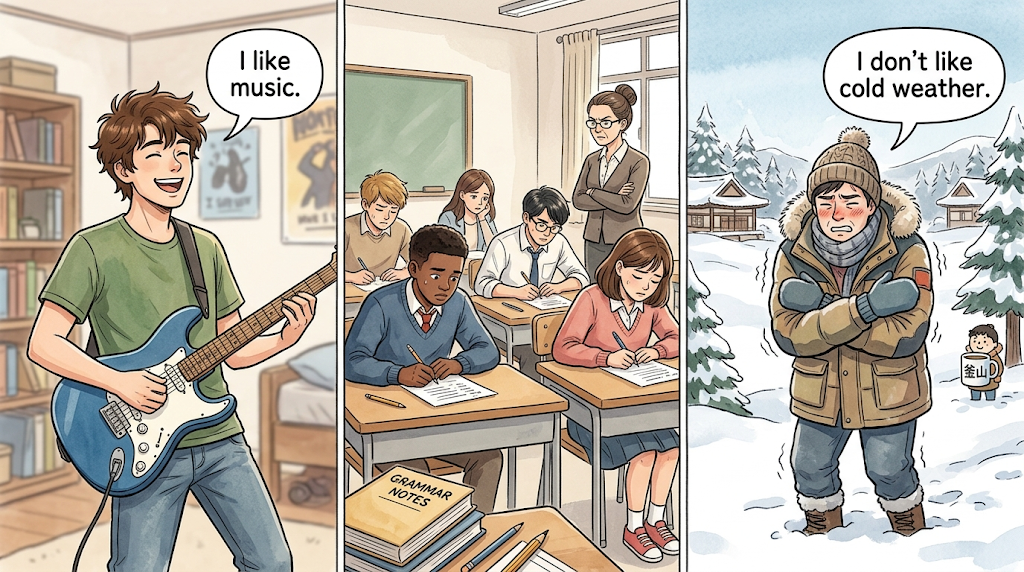
Ms. Williams shows three pictures.
윌리엄스 선생님이 그림 세 장을 보여주십니다.
I like music. / I hate exams. / I don't like cold weather.
저는 음악이 좋아요. / 저는 시험이 싫어요. / 저는 추운 날씨가 싫어요.
Ms. Williams writes: "We do not use the for general ideas."
윌리엄스 선생님이 쓰십니다: "일반적인 개념에는 the를 쓰지 않습니다."
She writes examples.
선생님이 예문을 쓰십니다.
I like music, especially classical music. (not the music... the classical music)
저는 음악, 특히 클래식 음악을 좋아해요. (the music... the classical music이 아님)
We don't eat meat very often. (not the meat)
저희는 고기를 자주 안 먹어요. (the meat이 아님)
Life is not possible without water. (not The life... the water)
생명은 물 없이는 불가능해요. (The life... the water가 아님)
I hate exams. (not the exams)
저는 시험이 싫어요. (the exams가 아님)
Is there a store near here that sells newspapers?
이 근처에 신문 파는 가게가 있나요?
Carlos looks at the examples.
카를로스가 예문을 봅니다.
He says: "So when I'm talking about something in general, not a specific one, I don't use the?"
그가 말합니다. "그러면 일반적인 것에 대해 말할 때는, 특정한 하나가 아니라, the를 안 쓰는 거네요?"
Ms. Williams nods: "Exactly right, Carlos."
선생님이 고개를 끄덕입니다. "정확해요, 카를로스."
She writes: "We do not use the for games and sports."
선생님이 쓰십니다: "게임과 스포츠에는 the를 쓰지 않습니다."
My favorite sports are tennis and skiing. (not the tennis... the skiing)
제가 가장 좋아하는 스포츠는 테니스와 스키예요. (the tennis... the skiing이 아님)
She writes: "We do not use the for languages or school subjects (history/geography/physics/biology, etc.)."
선생님이 쓰십니다: "언어나 학교 과목(history/geography/physics/biology 등)에는 the를 쓰지 않습니다."
Do you think English is difficult? (not the English)
영어가 어렵다고 생각하세요? (the English가 아님)
Tom's brother is studying physics and chemistry.
톰의 남동생은 물리와 화학을 공부하고 있어요.
👩🏫 Ms. Williams says:
"We do not use the for general ideas, games and sports, or languages/school subjects."
We do not use the for general ideas:
일반적인 개념에는 the를 쓰지 않습니다:
I like music, especially classical music. (not the music ... the classical music)
저는 음악, 특히 클래식 음악을 좋아해요.
We don't eat meat very often. (not the meat)
저희는 고기를 자주 안 먹어요.
Life is not possible without water. (not The life ... the water)
생명은 물 없이는 불가능해요.
I hate exams. (not the exams)
저는 시험이 싫어요.
Is there a store near here that sells newspapers?
이 근처에 신문 파는 가게가 있나요?
We do not use the for games and sports:
게임과 스포츠에는 the를 쓰지 않습니다:
My favorite sports are tennis and skiing. (not the tennis ... the skiing)
제가 가장 좋아하는 스포츠는 테니스와 스키예요.
We do not use the for languages or school subjects (history/geography/physics/biology, etc.):
언어나 학교 과목에는 the를 쓰지 않습니다:
Do you think English is difficult? (not the English)
영어가 어렵다고 생각하세요?
Tom's brother is studying physics and chemistry.
톰의 남동생은 물리와 화학을 공부하고 있어요.
📐 Grammar Point : the를 안 쓰는 일반적인 개념
| 일반적인 것 | I like music. I hate exams. |
| 게임/스포츠 | My favorite sports are tennis and skiing. |
| 언어/과목 | Do you think English is difficult? |
✅ I like music, especially classical music.
✅ My favorite sports are tennis and skiing.
Chapter 2 : 꽃일까요, 그 꽃일까요? / Flowers or The Flowers?
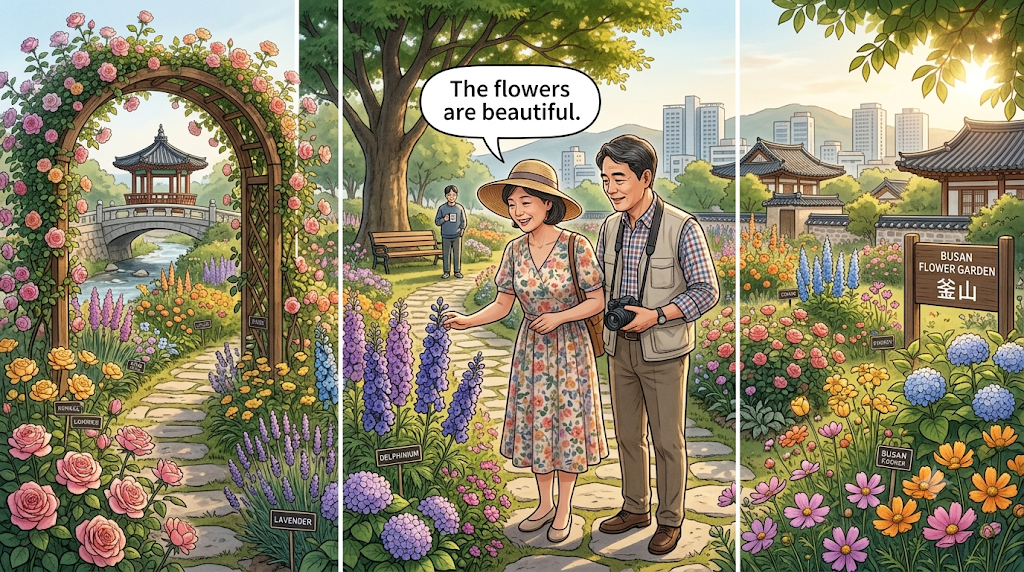
Ms. Williams writes: "flowers or the flowers?"
윌리엄스 선생님이 쓰십니다: "flowers일까요, the flowers일까요?"
She writes: "Compare."
선생님이 쓰십니다: "비교해봅시다."
She writes general statements on the left.
선생님이 왼쪽에 일반적인 문장을 쓰십니다.
Flowers are beautiful. (= flowers in general)
꽃은 아름다워요. (= 일반적인 꽃)
I don't like cold weather. (= cold weather in general)
저는 추운 날씨가 싫어요. (= 일반적인 추운 날씨)
We don't eat fish very often. (= fish in general)
저희는 생선을 자주 안 먹어요. (= 일반적인 생선)
Are you interested in history? (= history in general)
역사에 관심 있으세요? (= 일반적인 역사)
She writes specific statements on the right.
선생님이 오른쪽에 특정한 문장을 쓰십니다.
I love your garden. The flowers are beautiful. (= the flowers in your garden)
당신 정원이 좋아요. 그 꽃들이 아름다워요. (= 당신 정원의 그 꽃들)
The weather isn't very good today. (= the weather today)
오늘 날씨가 별로 안 좋네요. (= 오늘의 그 날씨)
We had a great meal last night. The fish was excellent. (= the fish we ate last night)
저희는 어젯밤 훌륭한 식사를 했어요. 그 생선이 아주 좋았어요. (= 저희가 어젯밤 먹은 그 생선)
Do you know much about the history of your country? (= the specific history of your country)
당신 나라의 역사에 대해 많이 아세요? (= 당신 나라의 그 특정한 역사)
Yuki looks at both sides.
유키가 양쪽을 봅니다.
She says: "So the same word, flowers or fish or history, can be general or specific depending on the?"
그녀가 말합니다. "그러면 flowers, fish, history 같은 같은 단어가 the에 따라 일반적이거나 특정할 수 있는 거네요?"
Ms. Williams nods: "Exactly right, Yuki. That's the key idea of this whole unit."
선생님이 고개를 끄덕입니다. "정확해요, 유키. 그게 이 유닛 전체의 핵심 아이디어예요."
👩🏫 Ms. Williams says:
"Compare: Flowers are beautiful (general) vs The flowers are beautiful (specific)."
Flowers are beautiful. (= flowers in general)
꽃은 아름다워요.
I love your garden. The flowers are beautiful. (= the flowers in your garden)
그 꽃들이 아름다워요.
I don't like cold weather. (= cold weather in general)
저는 추운 날씨가 싫어요.
The weather isn't very good today. (= the weather today)
오늘 날씨가 별로 안 좋네요.
We don't eat fish very often. (= fish in general)
저희는 생선을 자주 안 먹어요.
We had a great meal last night. The fish was excellent. (= the fish we ate last night)
그 생선이 아주 좋았어요.
Are you interested in history? (= history in general)
역사에 관심 있으세요?
Do you know much about the history of your country? (= the specific history of your country)
당신 나라의 역사에 대해 많이 아세요?
📐 Grammar Point : 일반적인 것 vs 특정한 것
| 일반적 | 명사만 (the 없음) | Flowers are beautiful. |
| 특정 | the + 명사 | The flowers are beautiful. (내 정원의) |
✅ Flowers are beautiful. (일반적)
✅ The flowers in your garden are beautiful. (특정)
Chapter 3 : 민준의 취향과 특정한 것들 / Minjun's Tastes and Specific Things
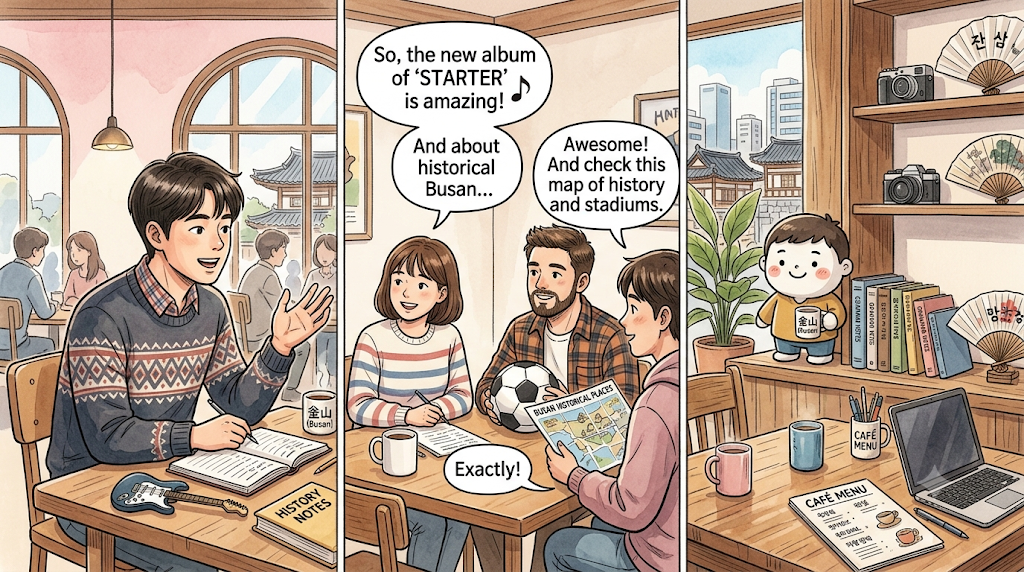
Carlos asked me today: "Do you like sports?"
카를로스가 오늘 저에게 물었어요. "스포츠 좋아하세요?"
I said: "Yes, I like soccer and tennis. But I don't watch the news much, except the news about sports."
저는 말했어요. "네, 저는 축구와 테니스를 좋아해요. 하지만 뉴스는 별로 안 보는데, 스포츠 관련 뉴스는 봐요."
Yuki asked: "Are you interested in history?"
유키가 물었어요. "역사에 관심 있으세요?"
I answered: "Yes, especially the history of Korea. I studied it a lot in school."
저는 대답했어요. "네, 특히 한국의 역사요. 학교에서 많이 공부했어요."
Lucas said: "I don't like cold weather, but the weather in New York this week has been nice."
루카스가 말했어요. "저는 추운 날씨가 싫은데, 이번 주 뉴욕 날씨는 좋았어요."
I noticed how the small word the changes whether we're talking about something general, or something specific we all know about.
저는 the라는 작은 단어가 어떻게 일반적인 것인지, 저희 모두가 아는 특정한 것인지를 바꾸는지 알아챕니다.
👩🏫 Ms. Williams says:
"실생활 대화 속 the 있음/없음 비교."
"Do you like sports?" "Yes, I like soccer and tennis."
스포츠 좋아하세요? 네, 축구랑 테니스를 좋아해요.
"I don't watch the news much, except the news about sports."
뉴스는 별로 안 보는데, 스포츠 뉴스는 봐요.
"Are you interested in history?" "Yes, especially the history of Korea."
역사에 관심 있으세요? 네, 특히 한국 역사요.
"I don't like cold weather, but the weather in New York this week has been nice."
저는 추운 날씨가 싫은데, 이번 주 뉴욕 날씨는 좋았어요.
📐 Grammar Point : 실생활 예문
| Do you like sports? | the news about sports |
| Are you interested in history? | the history of Korea |
| I don't like cold weather. | the weather in New York this week |
✅ I don't like cold weather, but the weather this week has been nice.
✅ Are you interested in history? Especially the history of Korea.
Chapter 4 : 저녁, 일반적인 것과 특정한 것 구분하기 / Evening, Separating General from Specific
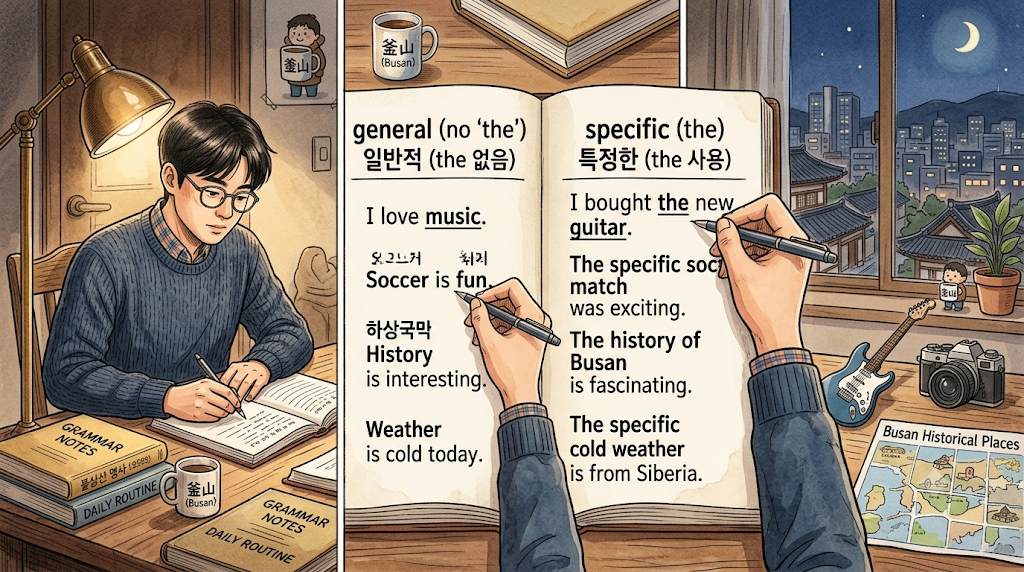
It is evening.
저녁입니다.
I sit at my desk and open my journal.
저는 책상에 앉아 일기를 폅니다.
I draw two columns.
저는 두 칸을 그립니다.
general (no the) / specific (the)
Under general I write things I feel or believe broadly.
general 아래에 제가 넓게 느끼거나 믿는 것들을 씁니다.
I like music a lot, especially jazz music.
저는 음악을 아주 좋아해요, 특히 재즈 음악을요.
I don't really enjoy exams, but I understand why they're necessary.
저는 시험을 정말 좋아하지 않지만, 왜 필요한지는 이해해요.
Under specific I write things tied to a particular moment or place.
specific 아래에 특정한 순간이나 장소와 연결된 것들을 씁니다.
The music at the concert last night was amazing.
어젯밤 콘서트에서의 그 음악은 놀라웠어요.
The exam I took today was harder than I expected.
오늘 본 그 시험은 예상보다 어려웠어요.
I look at the two columns.
저는 두 칸을 바라봅니다.
Without the, I'm talking about the whole category, music itself, exams themselves. With the, I'm pointing to one specific moment, the music from last night, the exam from today.
the가 없으면 저는 전체 범주에 대해 말하는 거예요, 음악 자체, 시험 자체에 대해서요. the가 있으면 특정한 순간을 가리키는 거예요, 어젯밤의 그 음악, 오늘의 그 시험에 대해서요.
I close my journal, feeling like this small word carries a big meaning, whether something is everywhere and general, or right here and specific.
저는 일기를 덮으며, 이 작은 단어가 큰 의미를 담고 있다고 느낍니다, 무언가가 어디에나 있고 일반적인지, 아니면 바로 여기 있고 특정한지를요.
PART 2 : Grammar Focus
Unit 70 : I like music, I hate exams 완전 정리
A. 일반적인 개념에는 the를 쓰지 않음
We do not use the for general ideas:
I like music, especially classical music. (not the music ... the classical music)
저는 음악, 특히 클래식 음악을 좋아해요.
We don't eat meat very often. (not the meat)
저희는 고기를 자주 안 먹어요.
Life is not possible without water. (not The life ... the water)
생명은 물 없이는 불가능해요.
I hate exams. (not the exams)
저는 시험이 싫어요.
Is there a store near here that sells newspapers?
이 근처에 신문 파는 가게가 있나요?
We do not use the for games and sports:
My favorite sports are tennis and skiing. (not the tennis ... the skiing)
제가 가장 좋아하는 스포츠는 테니스와 스키예요.
We do not use the for languages or school subjects (history/geography/physics/biology, etc.):
Do you think English is difficult? (not the English)
영어가 어렵다고 생각하세요?
Tom's brother is studying physics and chemistry.
톰의 남동생은 물리와 화학을 공부하고 있어요.
B. flowers or the flowers?
Compare:
Flowers are beautiful. (= flowers in general) / I love your garden. The flowers are beautiful. (= the flowers in your garden)
꽃은 아름다워요. / 그 꽃들이 아름다워요.
I don't like cold weather. (general) / The weather isn't very good today. (specific)
추운 날씨가 싫어요. / 오늘 날씨가 별로 안 좋네요.
We don't eat fish very often. (general) / The fish was excellent. (specific, last night)
생선을 자주 안 먹어요. / 그 생선이 아주 좋았어요.
Are you interested in history? (general) / Do you know much about the history of your country? (specific)
역사에 관심 있으세요? / 당신 나라의 역사에 대해 많이 아세요?
Key Summary : 일반적인 것 vs 특정한 것
| 일반적 | 명사만 | I like music. I hate exams. |
| 특정 | the + 명사 | The music at the concert was amazing. |
Key Phrases : Unit 70
| I like/hate + 명사 (일반) | ~을 좋아하다/싫어하다 | I hate exams. |
| the + 명사 (특정) | 그 ~ | The exam I took today was hard. |
| 스포츠/언어/과목 (the 없음) | ~ | Do you think English is difficult? |
PART 3 : Practice
Mini Quiz
- I like ________, especially classical music. (music, not the music)
- I hate ________. (exams, not the exams)
- My favorite sports are ________ and skiing. (tennis, not the tennis)
- Do you think ________ is difficult? (English, not the English)
- Flowers are beautiful. I love your garden. ________ are beautiful. (The flowers)
- Are you interested in history? Do you know much about ________ history of your country? (the)
정답
- music
- exams
- tennis
- English
- The flowers
- the
Discussion Questions
- 일반적인 개념(the 없음)과 특정한 것(the 있음)의 차이를 예문 두 개씩 들어 설명해 보세요.
- 다음 문장들을 올바르게 고쳐 쓰세요.
- "I like the music."
- "Do you think the English is difficult?"
- 여러분이 좋아하거나 싫어하는 것을 일반적인 개념(the 없음)으로 두 문장 써보세요.
- 특정한 것(the 있음)을 사용해서 문장 두 개를 만들어 보세요.
- 파트너와 다음 주제로 대화해 보세요: 어떤 스포츠나 과목을 좋아하세요? (the 없이 대답해 보세요)
'스토리로 배우는 영문법' 카테고리의 다른 글
| Unit 72 | this/that/these/those (0) | 2026.09.11 |
|---|---|
| Unit 71 | the... (names of places) (0) | 2026.09.10 |
| Unit 69 | go to work, go home, go to the hospital (0) | 2026.09.08 |
| Unit 68 | the... (0) | 2026.09.07 |
| Unit 67 | a/an and the (1) | 2026.09.06 |