Minjun's Story : My English Journey in New York
뉴욕에서 시작하는 영어 이야기
PART 1 : Story
Chapter 1 : 여기 이것, 저기 저것 / This Here, That There
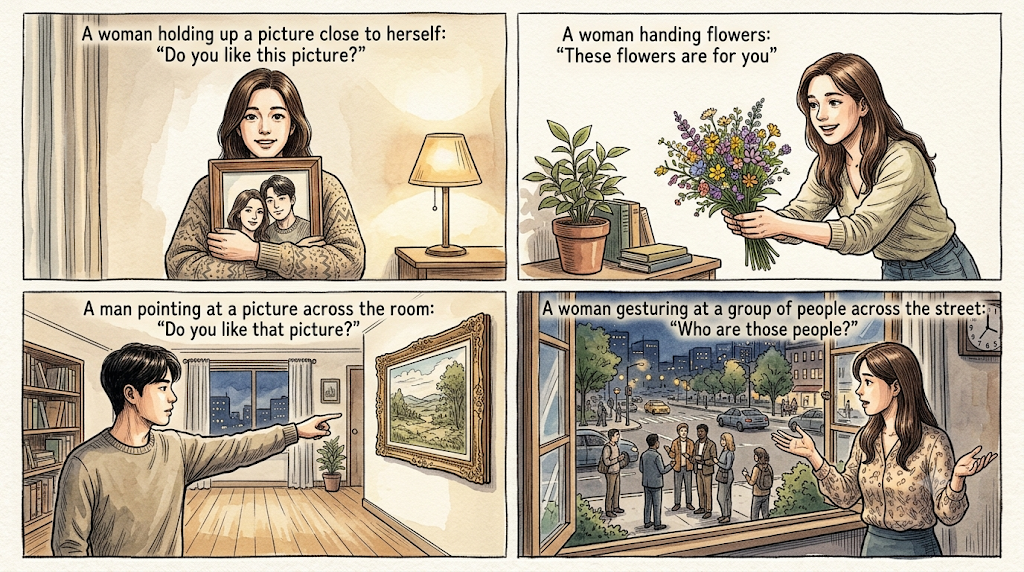
Ms. Williams shows four small scenes.
윌리엄스 선생님이 작은 장면 네 개를 보여주십니다.
A woman holds a picture close to herself: "Do you like this picture?"
한 여성이 그림을 자기 가까이 들고 있습니다. "이 그림 좋아하세요?"
Another hands over flowers: "These flowers are for you."
다른 여성이 꽃을 건넵니다. "이 꽃들은 당신 거예요."
A man points at a picture across the room: "Do you like that picture?"
한 남자가 방 건너편의 그림을 가리킵니다. "저 그림 좋아하세요?"
A woman gestures toward people far away: "Who are those people?"
한 여성이 멀리 있는 사람들을 가리킵니다. "저 사람들은 누구예요?"
Carlos looks at the four panels.
카를로스가 네 장면을 봅니다.
He says: "So this and these are for things close to me, and that and those are for things far away?"
그가 말합니다. "그러면 this와 these는 저에게 가까운 것을 위한 거고, that과 those는 멀리 있는 것을 위한 거네요?"
Ms. Williams nods: "Exactly right, Carlos. And this/that are singular, these/those are plural."
선생님이 고개를 끄덕입니다. "정확해요, 카를로스. 그리고 this/that은 단수고, these/those는 복수예요."
She draws the full chart.
선생님이 전체 표를 그리십니다.
this (singular, near) / these (plural, near)
that (singular, far) / those (plural, far)
She writes: "this picture (= this picture here), these flowers (= these flowers here)."
선생님이 쓰십니다: "this picture (= 여기 이 그림), these flowers (= 여기 이 꽃들)."
She writes: "that picture (= that picture there), those people (= those people there)."
선생님이 쓰십니다: "that picture (= 저기 저 그림), those people (= 저기 저 사람들)."
👩🏫 Ms. Williams says:
"this (singular, near), these (plural, near), that (singular, far), those (plural, far)."
this (singular) / these (plural) — near
this (단수) / these (복수) — 가까운 것
that (singular) / those (plural) — far
that (단수) / those (복수) — 먼 것
Do you like this picture? / These flowers are for you.
이 그림 좋아하세요? / 이 꽃들은 당신 거예요.
Do you like that picture? / Who are those people?
저 그림 좋아하세요? / 저 사람들은 누구예요?
this picture (= this picture here) / these flowers (= these flowers here)
저 그림 (= 여기 이 그림) / 이 꽃들 (= 여기 이 꽃들)
that picture (= that picture there) / those people (= those people there)
저 그림 (= 저기 저 그림) / 저 사람들 (= 저기 저 사람들)
📐 Grammar Point : this/that/these/those
| 가까움 | this | these |
| 멂 | that | those |
✅ Do you like this picture?
✅ Who are those people?
Chapter 2 : 명사와 함께, 명사 없이 / With a Noun, Without a Noun
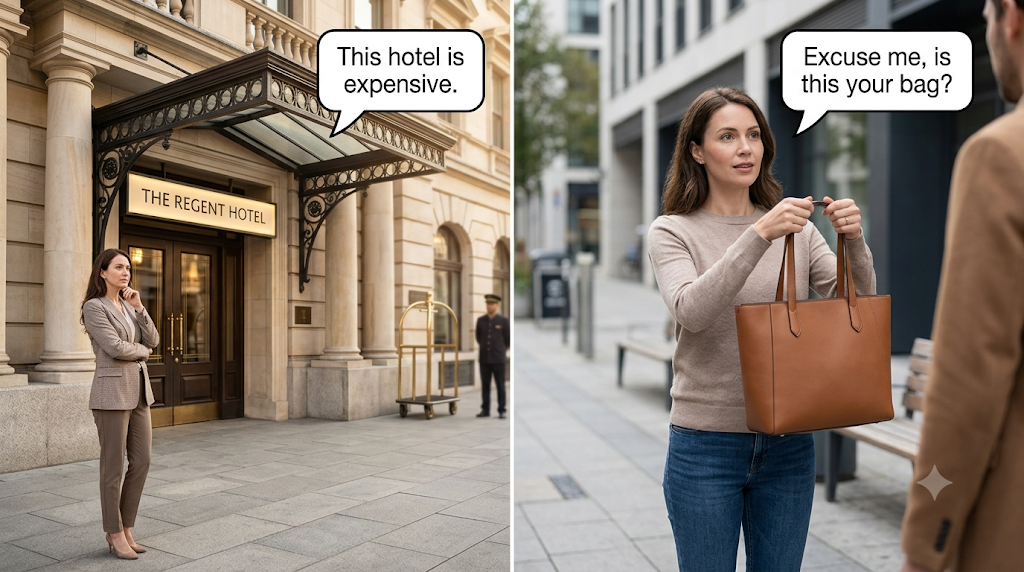
Ms. Williams writes: "We use this/that/these/those with a noun (this picture / those girls, etc.) or without a noun."
윌리엄스 선생님이 쓰십니다: "this/that/these/those는 명사와 함께(this picture / those girls 등) 또는 명사 없이 씁니다."
She writes examples with a noun.
선생님이 명사와 함께 쓰는 예문을 씁니다.
This hotel is expensive, but it's very nice.
이 호텔은 비싸지만 아주 좋아요.
"Who's that girl?" "I don't know."
저 여자는 누구예요? 몰라요.
Do you like these shoes? I bought them last week.
이 신발 마음에 드세요? 저는 지난주에 샀어요.
Those apples look nice. Can I have one?
저 사과들 맛있어 보여요. 하나 먹어도 될까요?
Yuki says: "So all these have a noun right after them, hotel, girl, shoes, apples?"
유키가 말합니다. "그러면 이것들은 모두 바로 뒤에 명사가 오는 거네요, hotel, girl, shoes, apples요?"
Ms. Williams nods: "Exactly right, Yuki. Now let's see them without a noun."
선생님이 고개를 끄덕입니다. "정확해요, 유키. 이제 명사 없이 쓰이는 걸 봅시다."
She writes examples without a noun.
선생님이 명사 없이 쓰는 예문을 씁니다.
This is a nice hotel, but it's very expensive.
이건 좋은 호텔이지만 아주 비싸요.
"Excuse me, is this your bag?" "Oh yes, thank you."
실례합니다, 이거 당신 가방이에요? 오, 네, 고마워요.
Who's that? (= Who is that person?)
저 사람은 누구예요? (= 저 사람은 누구예요?)
Which shoes do you like better — these or those?
어느 신발이 더 좋으세요, 이거 아니면 저거요?
Lucas says: "So without a noun, this/that/these/those can stand alone, replacing the whole thing?"
루카스가 말합니다. "그러면 명사 없이는, this/that/these/those가 혼자 서서 전체를 대신하는 거네요?"
Ms. Williams nods: "Exactly right, Lucas."
선생님이 고개를 끄덕입니다. "정확해요, 루카스."
👩🏫 Ms. Williams says:
"We use this/that/these/those with a noun or without a noun."
We use this/that/these/those with a noun (this picture / those girls, etc.) or without a noun:
this/that/these/those는 명사와 함께 또는 명사 없이 씁니다:
With a noun:
This hotel is expensive, but it's very nice.
이 호텔은 비싸지만 아주 좋아요.
"Who's that girl?" "I don't know."
저 여자는 누구예요?
Do you like these shoes? I bought them last week.
이 신발 마음에 드세요?
Those apples look nice. Can I have one?
저 사과들 맛있어 보여요.
Without a noun:
This is a nice hotel, but it's very expensive.
이건 좋은 호텔이지만 아주 비싸요.
"Excuse me, is this your bag?" "Oh yes, thank you."
이거 당신 가방이에요?
Who's that? (= Who is that person?)
저 사람은 누구예요?
Which shoes do you like better — these or those?
어느 신발이 더 좋으세요?
📐 Grammar Point : 명사 있음/없음
| 명사 있음 | this/that/these/those + 명사 | This hotel is expensive. |
| 명사 없음 | this/that/these/those (단독) | This is a nice hotel. |
✅ Do you like these shoes?
✅ Which shoes do you like better — these or those?
Chapter 3 : 이미 일어난 일에는 that / That for What Has Happened
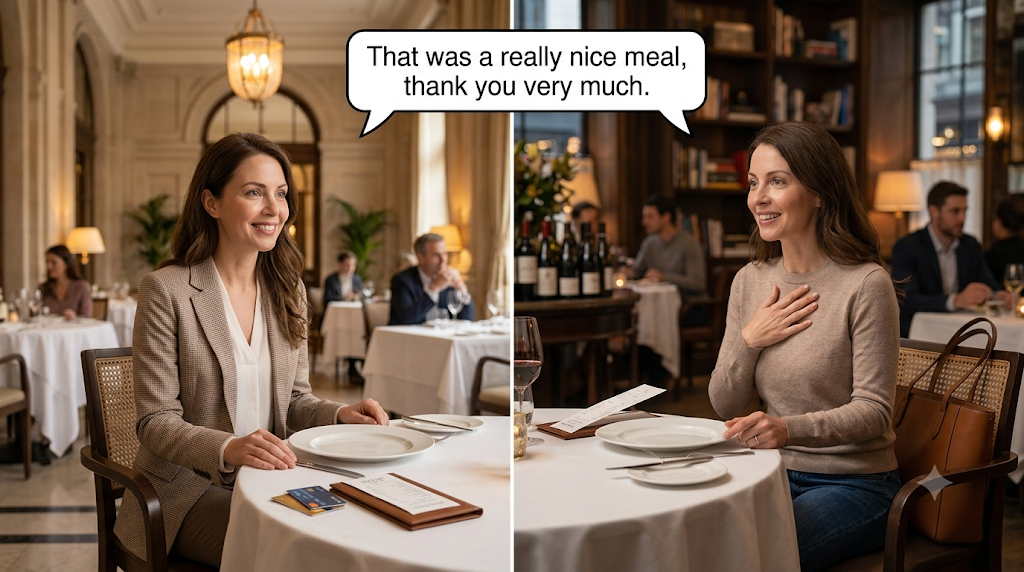
Ms. Williams writes: "that = something that has happened."
윌리엄스 선생님이 쓰십니다: "that = 이미 일어난 일."
She writes examples.
선생님이 예문을 쓰십니다.
"I'm sorry I forgot to call you." "That's all right."
전화하는 걸 깜빡해서 죄송해요. 괜찮아요.
That was a really nice meal. Thank you very much.
정말 좋은 식사였어요. 정말 감사합니다.
Huang Wei says: "So that can refer back to something that just happened, not a physical object?"
황웨이가 말합니다. "그러면 that은 물리적인 물건이 아니라 방금 일어난 일을 가리킬 수도 있는 거네요?"
Ms. Williams nods: "Exactly right, Huang Wei."
선생님이 고개를 끄덕입니다. "정확해요, 황웨이."
She writes: "that = what somebody has just said."
선생님이 쓰십니다: "that = 누군가 방금 말한 것."
She writes examples.
선생님이 예문을 쓰십니다.
"You're a teacher, aren't you?" "Yes, that's right."
당신은 선생님이시죠, 그렇죠? 네, 맞아요.
"Mark has a new job." "He does? I didn't know that."
마크가 새 직업이 생겼어요. 그래요? 몰랐어요.
"I'm going on vacation next week." "Oh, that's nice."
저 다음 주에 휴가 가요. 오, 좋네요.
Fatima says: "So that can also mean the whole idea someone just said, not an object at all?"
파티마가 말합니다. "그러면 that은 물건이 전혀 아니라 누군가 방금 말한 아이디어 전체를 뜻할 수도 있는 거네요?"
Ms. Williams nods: "Exactly right, Fatima. That's a very common and useful way to use that."
선생님이 고개를 끄덕입니다. "정확해요, 파티마. 그게 that을 아주 흔하고 유용하게 쓰는 방법이에요."
👩🏫 Ms. Williams says:
"that = something that has happened. that = what somebody has just said."
that = something that has happened:
that = 이미 일어난 일:
"I'm sorry I forgot to call you." "That's all right."
전화하는 걸 깜빡해서 죄송해요. 괜찮아요.
That was a really nice meal. Thank you very much.
정말 좋은 식사였어요.
that = what somebody has just said:
that = 누군가 방금 말한 것:
"You're a teacher, aren't you?" "Yes, that's right."
당신은 선생님이시죠? 네, 맞아요.
"Mark has a new job." "He does? I didn't know that."
그래요? 몰랐어요.
"I'm going on vacation next week." "Oh, that's nice."
좋네요.
📐 Grammar Point : that (일어난 일/방금 한 말)
| 일어난 일 | That was a really nice meal. |
| 방금 한 말 | I didn't know that. |
✅ That's all right.
✅ Oh, that's nice.
Chapter 4 : 전화에서 this is, 소개할 때 this is / This Is on the Phone, This Is for Introducing

Ms. Williams writes: "We use this is... and is this...? on the telephone."
윌리엄스 선생님이 쓰십니다: "전화에서는 this is...와 is this...?를 씁니다."
She shows a picture of a man on the phone.
선생님이 전화하는 남자 그림을 보여주십니다.
He says: "Hi Sarah, this is David."
그가 말합니다. "안녕하세요 사라, 저 데이비드예요."
Ms. Williams explains: "(this = the speaker)"
선생님이 설명하십니다: "(this = 말하는 사람)"
She writes: "Is this Sarah?"
선생님이 쓰십니다: "이분이 사라예요?"
She explains: "(this = the other person)"
선생님이 설명하십니다: "(this = 상대방)"
Sofia says: "So on the phone, this always means a person, not an object, and it changes meaning depending on who's talking?"
소피아가 말합니다. "그러면 전화에서는 this가 항상 물건이 아니라 사람을 뜻하고, 누가 말하는지에 따라 의미가 바뀌는 거네요?"
Ms. Williams nods: "Exactly right, Sofia."
선생님이 고개를 끄덕입니다. "정확해요, 소피아."
She writes: "We use this is... to introduce people."
선생님이 쓰십니다: "사람을 소개할 때 this is...를 씁니다."
She shows a picture of three people meeting.
선생님이 세 사람이 만나는 그림을 보여주십니다.
A: "Bill, this is Chris."
B: "Hello, Chris. Nice to meet you."
C: "Hi."
빌, 이쪽은 크리스예요. 안녕하세요, 크리스. 만나서 반가워요. 안녕하세요.
Lucas says: "So this is is also how we introduce people in person, not just on the phone?"
루카스가 말합니다. "그러면 this is는 전화뿐만 아니라 직접 만날 때도 사람을 소개하는 방법이네요?"
Ms. Williams nods: "Exactly right, Lucas. Both uses are very common in everyday English."
선생님이 고개를 끄덕입니다. "정확해요, 루카스. 둘 다 일상 영어에서 아주 흔해요."
👩🏫 Ms. Williams says:
"We use this is ... and is this ...? on the telephone. We use this is ... to introduce people."
We use this is ... and is this ...? on the telephone:
전화에서는 this is ...와 is this ...?를 씁니다:
Hi Sarah, this is David. (this = the speaker)
안녕하세요 사라, 저 데이비드예요.
Is this Sarah? (this = the other person)
이분이 사라예요?
We use this is ... to introduce people:
사람을 소개할 때 this is ...를 씁니다:
A: "Bill, this is Chris." B: "Hello, Chris. Nice to meet you." C: "Hi."
빌, 이쪽은 크리스예요. 안녕하세요, 크리스. 만나서 반가워요.
📐 Grammar Point : this is (전화/소개)
| 전화 (나) | Hi Sarah, this is David. |
| 전화 (상대방 확인) | Is this Sarah? |
| 소개 | Bill, this is Chris. |
✅ Hi Sarah, this is David.
✅ Kevin, this is Chris.
Chapter 5 : 저녁, 가까운 것과 먼 것 정리하기 / Evening, Sorting Near from Far
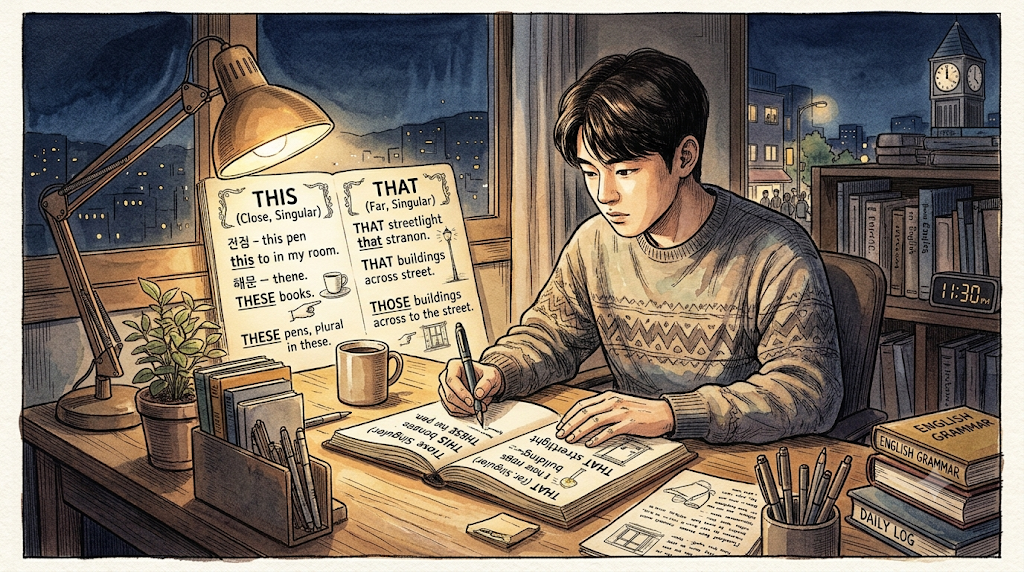
It is evening.
저녁입니다.
I sit at my desk and open my journal.
저는 책상에 앉아 일기를 폅니다.
I draw four columns.
저는 네 칸을 그립니다.
this / these / that / those
Under this I write something on my desk.
this 아래에 제 책상 위에 있는 것을 씁니다.
This notebook is where I write every night.
이 노트는 제가 매일 밤 쓰는 곳이에요.
Under these I write several things near me.
these 아래에 제 근처에 있는 여러 개를 씁니다.
These pens are my favorite ones for studying.
이 펜들은 제가 공부할 때 가장 좋아하는 거예요.
Under that I write something across the room.
that 아래에 방 건너편에 있는 것을 씁니다.
That lamp by the window needs a new bulb.
창가에 있는 저 램프는 전구를 새로 갈아야 해요.
Under those I write several things far away.
those 아래에 멀리 있는 여러 개를 씁니다.
Those books on the shelf are ones I haven't read yet.
저 책장에 있는 저 책들은 아직 안 읽은 것들이에요.
I also think about today's phone call with my mother.
저는 오늘 어머니와의 전화통화도 생각합니다.
I said: "Hi Mom, this is Minjun."
저는 말했어요. "엄마, 저 민준이에요."
She laughed and said: "That's funny, I already know your voice!"
어머니가 웃으며 말했어요. "그거 재밌네, 이미 네 목소리 아는데!"
I close my journal, smiling at how naturally this small system of near and far, singular and plural, now fits into my everyday English.
저는 일기를 덮으며, 가까움과 멂, 단수와 복수의 이 작은 체계가 이제 제 일상 영어에 얼마나 자연스럽게 맞아떨어지는지에 미소 짓습니다.
PART 2 : Grammar Focus
Unit 72 : this/that/these/those 완전 정리
A. this/these (가까움) vs that/those (멂)
this (singular) / these (plural) — near
that (singular) / those (plural) — far
Do you like this picture? / These flowers are for you.
이 그림 좋아하세요? / 이 꽃들은 당신 거예요.
Do you like that picture? / Who are those people?
저 그림 좋아하세요? / 저 사람들은 누구예요?
this picture (= this picture here) / these flowers (= these flowers here)
that picture (= that picture there) / those people (= those people there)
B. 명사와 함께 / 명사 없이
With a noun:
This hotel is expensive, but it's very nice.
이 호텔은 비싸지만 아주 좋아요.
"Who's that girl?" "I don't know."
저 여자는 누구예요?
Do you like these shoes? I bought them last week.
이 신발 마음에 드세요?
Those apples look nice. Can I have one?
저 사과들 맛있어 보여요.
Without a noun:
This is a nice hotel, but it's very expensive.
이건 좋은 호텔이지만 아주 비싸요.
Who's that? (= Who is that person?)
저 사람은 누구예요?
Which shoes do you like better — these or those?
어느 신발이 더 좋으세요?
C. that = 이미 일어난 일 / 방금 한 말
"I'm sorry I forgot to call you." "That's all right."
전화하는 걸 깜빡해서 죄송해요. 괜찮아요.
That was a really nice meal.
정말 좋은 식사였어요.
"You're a teacher, aren't you?" "Yes, that's right."
당신은 선생님이시죠? 네, 맞아요.
"Mark has a new job." "He does? I didn't know that."
몰랐어요.
D. this is (전화 / 소개)
Hi Sarah, this is David. (this = the speaker)
안녕하세요 사라, 저 데이비드예요.
Is this Sarah? (this = the other person)
이분이 사라예요?
A: "Bill, this is Chris." B: "Hello, Chris. Nice to meet you."
빌, 이쪽은 크리스예요.
Key Summary : this/that/these/those 완전 정리
| 가까움 | this | these |
| 멂 | that | those |
| 이미 일어난 일 | That was a nice meal. |
| 방금 한 말 | I didn't know that. |
Key Phrases : Unit 72
| this/these + 명사 | 이 ~ | This hotel is expensive. |
| that/those + 명사 | 저 ~ | Those apples look nice. |
| That's all right / That's nice | 괜찮아요 / 좋네요 | "I'm sorry." "That's all right." |
| this is (전화/소개) | 저는 ~예요 / 이쪽은 ~예요 | Hi Sarah, this is David. |
PART 3 : Practice
Mini Quiz
- Do you like ________ picture? (가까운 그림 하나) (this)
- ________ flowers are for you. (가까운 꽃들, 여러 개) (These)
- Who are ________ people? (먼 사람들, 여러 명) (those)
- "I'm sorry I forgot to call you." "________ all right." (That's)
- Hi Sarah, ________ David. (this is)
- Bill, ________ Chris. (this is)
정답
- this
- These
- those
- That's
- this is
- this is
Discussion Questions
- this/these(가까움)와 that/those(멂)의 차이를 예문 두 개씩 들어 설명해 보세요.
- 다음 문장들을 올바르게 고쳐 쓰세요.
- "Who are that people?" (복수형으로 고치면?)
- "This is a nice hotel" (전화 상황에서 상대방을 확인하는 문장으로 바꾸면?)
- this/that/these/those를 명사와 함께 쓴 문장 두 개를 만들어 보세요.
- that를 사용해서 방금 일어난 일이나 누군가 한 말에 반응하는 문장을 써보세요.
- 파트너와 다음 주제로 대화해 보세요: 전화로 자기소개하는 연습을 해보세요. (Hi, this is...로 시작해 보세요)
'스토리로 배우는 영문법' 카테고리의 다른 글
| Unit 74 | some and any (0) | 2026.09.12 |
|---|---|
| Unit 73 | one/ones (0) | 2026.09.11 |
| Unit 71 | the... (names of places) (0) | 2026.09.10 |
| Unit 70 | I like music, I hate exams (0) | 2026.09.09 |
| Unit 69 | go to work, go home, go to the hospital (0) | 2026.09.08 |