Minjun's Story : My English Journey in New York
뉴욕에서 시작하는 영어 이야기
PART 1 : Story
Chapter 1 : 목요일 아침, 지난달을 돌아보며 / Thursday Morning, Looking Back

It is Thursday morning.
목요일 아침입니다.
I am at the café near school.
저는 학교 근처 카페에 있습니다.
I am looking at photos on my phone.
저는 전화기로 사진들을 보고 있습니다.
Photos from Korea. Photos from last month.
한국에서 찍은 사진들. 지난달 사진들.
Last month I was in Busan.
지난달 저는 부산에 있었습니다.
I was at home with my family.
저는 가족과 함께 집에 있었습니다.
The weather was warm and humid.
날씨는 따뜻하고 습했습니다.
My mother was in the kitchen every morning.
어머니는 매일 아침 부엌에 계셨습니다.
My father was in his study every evening.
아버지는 매일 저녁 서재에 계셨습니다.
Life was simple and familiar.
삶은 단순하고 익숙했습니다.
Now I am in New York.
지금 저는 뉴욕에 있습니다.
The weather is cold and sharp.
날씨는 차갑고 쌀쌀합니다.
But I am happy here too.
하지만 여기서도 행복합니다.
Then was then. Now is now.
그때는 그때였습니다. 지금은 지금입니다.
And both are good.
그리고 둘 다 좋습니다.
👩🏫 Ms. Williams says:
"Today we learn was and were. These are the past tense of am, is, and are."
오늘은 was와 were를 배웁니다. 이것들은 am, is, are의 과거형입니다.
am / is → was (과거)
are → were (과거)
I am tired. (now) → I was tired last night.
Where is Kate? (now) → Where was Kate yesterday?
The weather is nice today. → The weather was nice last week.
You are late. (now) → You were late yesterday.
They aren't here. (now) → They weren't here last Sunday.
📐 Grammar Point — am/is/are의 과거형
| I am | I was |
| he / she / it is | he / she / it was |
| we / you / they are | we / you / they were |
✅ I am tired now. → I was tired last night.
✅ Where is Kate now? → Where was Kate yesterday?
✅ They aren't here now. → They weren't here last Sunday.
❌ I were late. (WRONG — I/he/she/it은 반드시 was)
❌ They was hungry. (WRONG — we/you/they는 반드시 were)
Chapter 2 : 지난 첫날을 기억하며 / Remembering the First Day
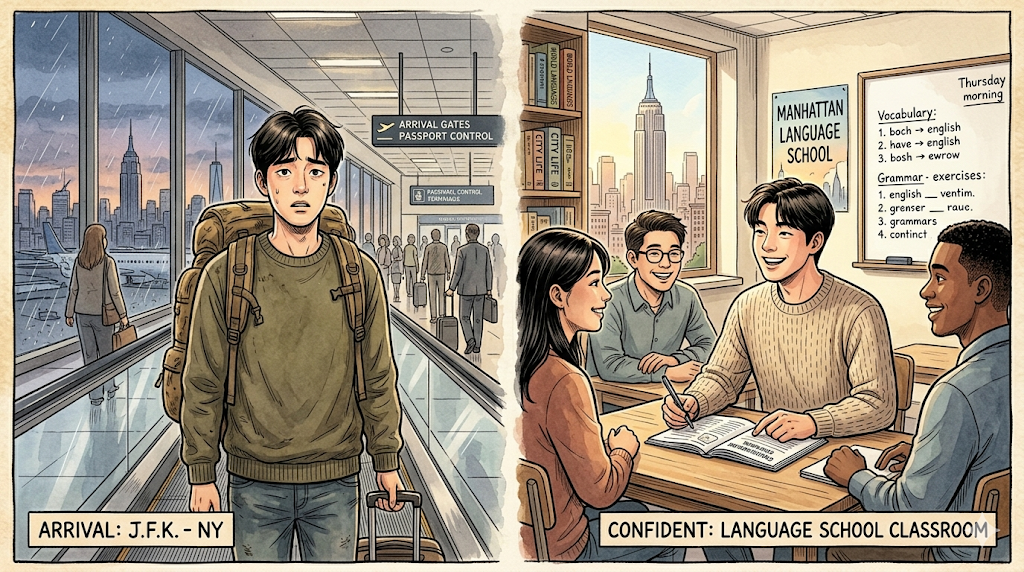
In class Ms. Williams asks us a question.
수업에서 윌리엄스 선생님이 우리에게 질문을 하십니다.
She says: "Think about your first day in New York."
선생님이 말씀하십니다. "뉴욕에서의 첫날을 떠올려 보세요."
"Where were you? How were you feeling?"
"어디에 있었나요? 기분이 어떠했나요?"
"Use was and were."
"was와 were를 사용하세요."
Carlos goes first.
카를로스가 먼저 말합니다.
He says: "My first day was crazy."
그가 말합니다. "첫날은 정신이 없었어요."
"I was at JFK airport."
"JFK 공항에 있었어요."
"My bag was too heavy."
"가방이 너무 무거웠어요."
"The taxi driver was very fast."
"택시 기사님이 매우 빠르셨어요."
"I was scared but excited."
"겁났지만 설레었어요."
Now it is my turn.
이제 제 차례입니다.
I say: "My first day was long."
저는 말합니다. "첫날은 길었어요."
"I was on the plane for fourteen hours."
"비행기에 열네 시간 있었어요."
"The woman next to me was Yuki."
"옆자리 여자가 유키였어요."
"We were both nervous."
"우리 둘 다 긴장했었어요."
"New York was overwhelming at first."
"처음에 뉴욕은 압도적이었어요."
"But Ms. Williams was kind on the first day."
"하지만 선생님이 첫날에 친절하셨어요."
"And that was enough."
"그것으로 충분했어요."
Ms. Williams smiles.
선생님이 미소를 짓습니다.
She says: "Thank you, Minjun. That was lovely."
선생님이 말씀하십니다. "고마워요, 민준. 정말 좋았어요."
👩🏫 Ms. Williams says:
"Now let's look at negatives and questions with was and were."
이제 was와 were의 부정문과 의문문을 살펴봅시다.
부정문: was not = wasn't / were not = weren't
Robert is at work now.
At midnight last night he wasn't at work.
He was in bed. He was asleep.
We were hungry after the trip, but we weren't tired.
The hotel was comfortable, but it wasn't expensive.
Last year Rachel was 22, so she is 23 now.
When I was a child, I was scared of dogs.
📐 Grammar Point — 부정문 (Negatives)
| I/he/she/it was | I/he/she/it was not | wasn't |
| we/you/they were | we/you/they were not | weren't |
✅ The hotel was comfortable but it wasn't expensive.
✅ We were hungry but we weren't tired.
✅ He was in bed. He wasn't at work.
❌ He were not at work. (WRONG — he → wasn't)
❌ They wasn't here. (WRONG — they → weren't)
Chapter 3 : 의문문으로 과거 묻기 / Asking About the Past

Ms. Williams writes on the board.
윌리엄스 선생님이 칠판에 씁니다.
Was the weather nice when you were on vacation?
휴가 때 날씨가 좋았나요?
Your shoes are nice. Were they expensive?
신발이 멋지네요. 비쌌나요?
Why were you late this morning?
오늘 아침 왜 늦었나요?
She says: "To make a question with was or were, move the verb before the subject."
선생님이 말씀하십니다. "was 또는 were로 의문문을 만들 때는 동사를 주어 앞으로 이동합니다."
"It is the same rule as am, is, are. Just in the past."
"am, is, are와 같은 규칙입니다. 그냥 과거입니다."
She puts us in pairs.
선생님이 우리를 짝으로 나눕니다.
I am with Lucas.
저는 루카스와 짝입니다.
I ask: "Were you happy as a child?"
저는 묻습니다. "어렸을 때 행복했어요?"
He smiles: "Yes, I was. Very happy."
그가 웃습니다. "네, 그랬어요. 아주 행복했어요."
He asks: "Was your school far from your house?"
그가 묻습니다. "학교가 집에서 멀었어요?"
I say: "No, it wasn't. It was very close."
저는 말합니다. "아니요, 멀지 않았어요. 아주 가까웠어요."
He asks: "Were you a good student?"
그가 묻습니다. "모범생이었어요?"
I think for a moment.
저는 잠깐 생각합니다.
I say: "I was a quiet student. Not always good."
저는 말합니다. "조용한 학생이었어요. 항상 모범생은 아니었어요."
He laughs: "Me too."
그가 웃습니다. "저도요."
👩🏫 Ms. Williams says:
"To make questions with was and were, move the verb before the subject."
was와 were로 의문문을 만들 때는 동사를 주어 앞으로 이동합니다.
평서문: He was at work.
의문문: Was he at work?
평서문: They were at the party.
의문문: Were they at the party?
의문사 포함:
Why were you late this morning?
Where was Kate yesterday?
Was the weather nice when you were on vacation?
📐 Grammar Point — 의문문 패턴 (Question Pattern)
| (없음) | Was | he | at work? |
| (없음) | Were | they | at the party? |
| Why | were | you | late? |
| Where | was | Kate | yesterday? |
| How | was | the hotel? |
✅ Was Tom at work yesterday? Yes, he was.
✅ Were Sue and Jim at the party? No, they weren't.
✅ Why were you late this morning?
❌ Were he at work? (WRONG — he → Was)
❌ Was they tired? (WRONG — they → Were)
Chapter 4 : 짧은 대답 연습 / Short Answer Practice

Ms. Williams starts a speaking game.
윌리엄스 선생님이 말하기 게임을 시작하십니다.
She says: "I ask a question. You give a short answer."
선생님이 말씀하십니다. "제가 질문하면 짧은 대답을 하세요."
"Yes, I was. Or no, I wasn't. That's it."
"Yes, I was. 또는 No, I wasn't. 그것으로 충분합니다."
She points at Fatima.
선생님이 파티마를 가리키십니다.
"Were you late today, Fatima?"
"파티마, 오늘 늦었나요?"
Fatima says: "No, I wasn't."
파티마가 말합니다. "아니요, 늦지 않았어요."
She points at Huang Wei.
선생님이 황웨이를 가리키십니다.
"Was the food good at lunch yesterday?"
"어제 점심 음식이 좋았나요?"
He says: "Yes, it was. Very good."
그가 말합니다. "네, 좋았어요. 아주 좋았어요."
She looks at me.
선생님이 저를 바라보십니다.
"Minjun, were you nervous on your first day of school here?"
"민준, 여기서 첫날 학교에 올 때 긴장됐었나요?"
I smile and say: "Yes, I was. Very nervous."
저는 웃으며 말합니다. "네, 긴장됐었어요. 많이 긴장됐었어요."
She asks: "And was I scary?"
선생님이 묻습니다. "그리고 제가 무서웠나요?"
The class holds its breath.
반 전체가 숨을 죽입니다.
I say carefully: "No, you weren't."
저는 조심스럽게 말합니다. "아니요, 무섭지 않으셨어요."
"You were kind. That was the most important thing."
"친절하셨어요. 그것이 가장 중요한 것이었어요."
She nods and says: "Good answer, Minjun."
선생님이 고개를 끄덕이며 말씀하십니다. "잘 대답했어요, 민준."
Everyone laughs.
모두가 웃습니다.
👩🏫 Ms. Williams says:
"Short answers with was and were are simple."
was와 were의 짧은 대답은 간단합니다.
"Were you late?" → "No, I wasn't."
"Was Tom at work yesterday?" → "Yes, he was."
"Were Sue and Jim at the party?" → "No, they weren't."
📐 Grammar Point — 짧은 대답 (Short Answers)
| Was I ...? | Yes, you were. | No, you weren't. |
| Was he/she/it ...? | Yes, he/she/it was. | No, he/she/it wasn't. |
| Were we/you/they ...? | Yes, we/you/they were. | No, we/you/they weren't. |
✅ "Were you late?" "No, I wasn't."
✅ "Was Tom at work yesterday?" "Yes, he was."
✅ "Were Sue and Jim at the party?" "No, they weren't."
❌ "Was she tired?" "Yes, she were." (WRONG — she → was)
❌ "Were they there?" "No, they wasn't." (WRONG — they → weren't)
Chapter 5 : 저녁, 과거와 현재 / Evening, Past and Present

It is evening.
저녁입니다.
I am at my desk.
저는 책상 앞에 앉아 있습니다.
I open my journal and write two columns.
저는 일기를 펼치고 두 칸을 씁니다.
THEN / NOW
A month ago I was in Korea.
한 달 전 저는 한국에 있었습니다.
Now I am in New York.
지금 저는 뉴욕에 있습니다.
A month ago my English was weak.
한 달 전 제 영어는 약했습니다.
Now it is stronger.
지금은 더 강해졌습니다.
A month ago I was alone.
한 달 전 저는 혼자였습니다.
Now I am not alone.
지금은 혼자가 아닙니다.
A month ago New York was just a dream.
한 달 전 뉴욕은 그저 꿈이었습니다.
Now it is my home.
지금은 제 집입니다.
A month ago Ms. Williams was a stranger.
한 달 전 윌리엄스 선생님은 낯선 분이었습니다.
Now she is my teacher. My guide.
지금은 제 선생님입니다. 제 안내자입니다.
A month ago Carlos, Yuki, Lucas, Fatima, Sofia, Anna and Huang Wei were strangers.
한 달 전 카를로스, 유키, 루카스, 파티마, 소피아, 안나, 황웨이는 모두 낯선 사람들이었습니다.
Now they are my friends.
지금은 제 친구들입니다.
I close my journal.
저는 일기를 닫습니다.
Was is a powerful word.
Was는 강력한 단어입니다.
It tells you where you came from.
그것은 당신이 어디서 왔는지 알려줍니다.
So you can see how far you have come.
그래서 당신이 얼마나 멀리 왔는지 알 수 있습니다.
PART 2 : Grammar Focus
Unit 10 : was/were 완전 정리
핵심: am/is → was (과거) / are → were (과거)
| I am | I was | I was not | I wasn't |
| he/she/it is | he/she/it was | he/she/it was not | he/she/it wasn't |
| we/you/they are | we/you/they were | we/you/they were not | we/you/they weren't |
의문문 완전 정리
| (없음) | Was | he | at work? |
| (없음) | Were | they | at the party? |
| Why | were | you | late? |
| Where | was | Kate | yesterday? |
| How | was | the hotel? | |
| Was | the weather | nice | when you were on vacation? |
짧은 대답 완전 정리
| Was he/she/it ...? | Yes, he/she/it was. | No, he/she/it wasn't. |
| Were we/you/they ...? | Yes, we/you/they were. | No, we/you/they weren't. |
Vocabulary : Unit 10
- Time Expressions (과거 시간 표현)
| last night | 어젯밤 | I was tired last night. |
| last week | 지난주 | The weather was nice last week. |
| yesterday | 어제 | Where was Kate yesterday? |
| last Sunday | 지난 일요일 | They weren't here last Sunday. |
| a month ago | 한 달 전 | A month ago I was in Korea. |
| as a child | 어렸을 때 | When I was a child, I was scared of dogs. |
| on vacation | 휴가 중 | Was the weather nice when you were on vacation? |
| at the time | 그때 | The hotel was comfortable at the time. |
- Describing Past States (과거 상태 표현)
| scared | 겁먹은 | When I was a child, I was scared of dogs. |
| overwhelming | 압도적인 | New York was overwhelming at first. |
| familiar | 익숙한 | Life was simple and familiar. |
| asleep | 잠든 | He was in bed. He was asleep. |
| expensive | 비싼 | The hotel was comfortable, but it wasn't expensive. |
Key Phrases : Unit 10
| Then was then. Now is now. | 그때는 그때였다. 지금은 지금이다. | Then was then. Now is now. And both are good. |
| Was is a powerful word. | was는 강력한 단어다. | Was tells you where you came from. |
| at first | 처음에 | New York was overwhelming at first. |
| how far you have come | 얼마나 멀리 왔는지 | Was shows you how far you have come. |
| Last year Rachel was 22. | 작년에 레이첼은 22살이었다. | Last year Rachel was 22, so she is 23 now. |
Discussion Questions
- 한 달 전 자신의 상황을 was/were로 5문장 묘사해 보세요.
- "They wasn't here." 가 틀린 이유를 설명하고 올바르게 고쳐 쓰세요.
- 의문사 Where / Why / How를 사용해 was/were 질문을 각각 하나씩 만들어 보세요.
- 민준처럼 THEN / NOW 두 칸을 만들어 과거와 현재를 비교하는 문장을 5쌍 써보세요.
- 파트너에게 어린 시절에 대한 was/were 질문 5개를 만들고 짧은 대답 형식으로 대화를 써보세요.
Minjun's Story | Unit 10: was/were | Manhattan English Academy | Kalliope Press
'스토리로 배우는 영문법' 카테고리의 다른 글
| Unit 12 | I didn't... Did you...? (simple past negative and questions) (0) | 2026.07.12 |
|---|---|
| Unit 11 | worked/got/went, etc. (simple past) (0) | 2026.07.11 |
| Unit 9 : I have... and I've got... (0) | 2026.07.09 |
| Unit 8 : I am doing and I do (present continuous and simple present) (0) | 2026.07.08 |
| Unit 7 : Do you...? (simple present questions) (0) | 2026.07.07 |