Minjun's Story : My English Journey in New York
뉴욕에서 시작하는 영어 이야기
PART 1 : Story
Chapter 1 : 텅 빈 주차장, 차가 하나도 없어요 / The Empty Parking Lot, No Cars
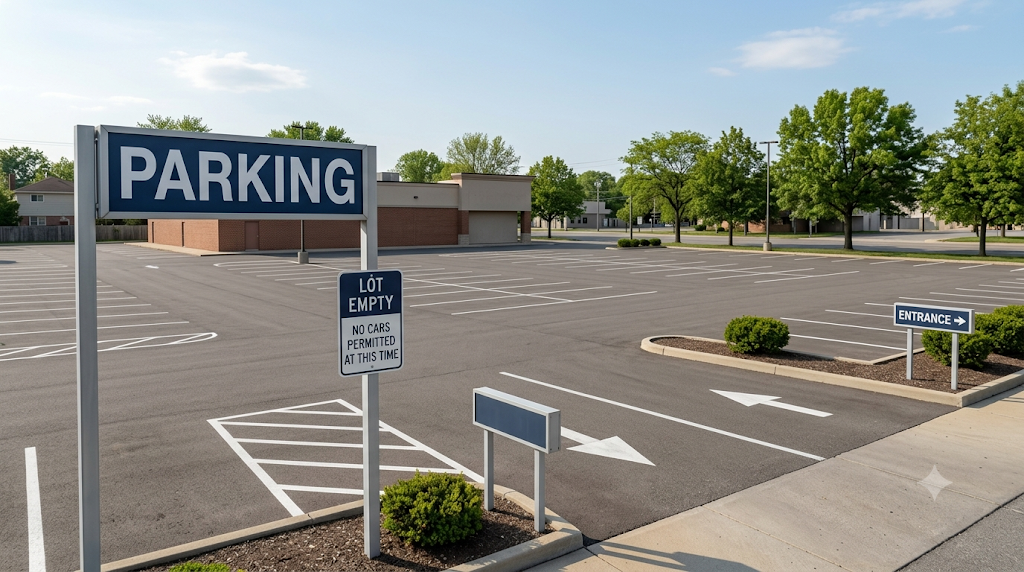
Ms. Williams shows a picture of an empty parking lot.
윌리엄스 선생님이 텅 빈 주차장 그림을 보여주십니다.
She says: "The parking lot is empty."
선생님이 말씀하십니다. "주차장이 비어 있어요."
She writes: "There aren't any cars / There are no cars in the parking lot."
선생님이 쓰십니다: "There aren't any cars / There are no cars in the parking lot."
She asks: "How many cars are there in the parking lot? None."
선생님이 물으십니다. "주차장에 차가 몇 대 있나요? 없어요."
Carlos looks at the two ways to say the same thing.
카를로스가 같은 것을 말하는 두 가지 방법을 봅니다.
He says: "So aren't any and no cars mean exactly the same thing?"
그가 말합니다. "그러면 aren't any랑 no cars는 완전히 같은 뜻이네요?"
Ms. Williams nods: "Exactly right, Carlos."
선생님이 고개를 끄덕입니다. "정확해요, 카를로스."
She writes: "not (-n't) + any."
선생님이 쓰십니다: "not (-n't) + any."
There aren't any cars in the parking lot.
주차장에 차가 하나도 없어요.
Tracey and Jeff don't have any children.
트레이시와 제프는 아이가 없어요.
You can have some coffee, but I don't want any.
당신은 커피를 마셔도 되지만 저는 필요 없어요.
She writes: "no + noun (no cars / no garage, etc.) = not any... or not a..."
선생님이 쓰십니다: "no + 명사 (no cars / no garage 등) = not any... 또는 not a..."
There are no cars in the parking lot. (= there aren't any cars)
주차장에 차가 없어요. (= 차가 하나도 없어요)
We have no coffee. (= we don't have any coffee)
저희는 커피가 없어요. (= 커피가 하나도 없어요)
It's a nice house, but there's no garage. (= there isn't a garage)
좋은 집이지만 차고가 없어요. (= 차고가 없어요)
She writes: "We use no... especially after have/has and there is/are."
선생님이 쓰십니다: "no...는 특히 have/has와 there is/are 뒤에 씁니다."
She writes: "negative verb + any = affirmative verb + no."
선생님이 쓰십니다: "부정 동사 + any = 긍정 동사 + no."
They don't have any children. or They have no children. (not They don't have no children)
그들은 아이가 없어요. (They don't have no children이 아님)
There isn't any sugar in your coffee. or There's no sugar in your coffee.
당신 커피에 설탕이 없어요.
👩🏫 Ms. Williams says:
"not (-n't) + any. no + noun = not any... or not a..."
There aren't any cars / There are no cars in the parking lot.
주차장에 차가 없어요.
How many cars are there in the parking lot? None.
주차장에 차가 몇 대 있나요? 없어요.
not (-n't) + any:
There aren't any cars in the parking lot.
주차장에 차가 하나도 없어요.
Tracey and Jeff don't have any children.
트레이시와 제프는 아이가 없어요.
You can have some coffee, but I don't want any.
저는 필요 없어요.
no + noun (no cars / no garage, etc.) = not any ... or not a ...:
There are no cars in the parking lot. (= there aren't any cars)
주차장에 차가 없어요.
We have no coffee. (= we don't have any coffee)
저희는 커피가 없어요.
It's a nice house, but there's no garage. (= there isn't a garage)
차고가 없어요.
We use no ... especially after have/has and there is/are.
no ...는 특히 have/has와 there is/are 뒤에 씁니다.
negative verb + any = affirmative verb + no:
They don't have any children. or They have no children. (not They don't have no children)
그들은 아이가 없어요.
There isn't any sugar in your coffee. or There's no sugar in your coffee.
당신 커피에 설탕이 없어요.
📐 Grammar Point : not any vs no
| not + any | 부정 동사 + any | There aren't any cars. |
| no + 명사 | 긍정 동사 + no | There are no cars. |
✅ We have no coffee. (= We don't have any coffee.)
❌ They don't have no children. (WRONG — 이중부정, don't have any 또는 have no)
Chapter 2 : no와 none 비교하기 / Comparing No and None
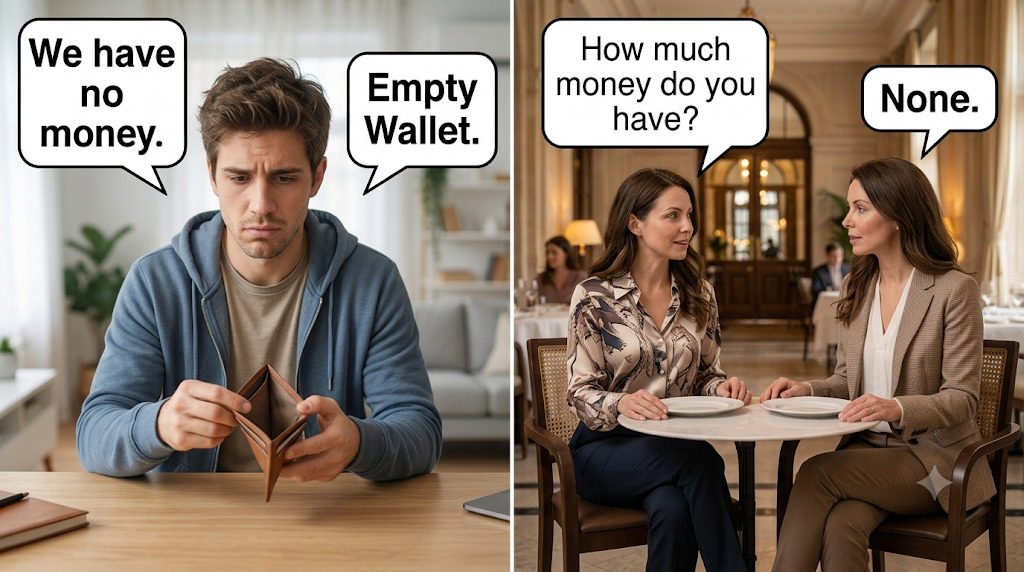
Ms. Williams writes: "no and none."
윌리엄스 선생님이 쓰십니다: "no와 none."
She writes: "Use no + noun (no money / no children, etc.)."
선생님이 쓰십니다: "no + 명사 (no money / no children 등)를 씁니다."
She writes examples.
선생님이 예문을 쓰십니다.
We have no money.
저희는 돈이 없어요.
Everything was OK. There were no problems.
다 괜찮았어요. 문제가 없었어요.
She writes: "Use none alone (without a noun)."
선생님이 쓰십니다: "none은 명사 없이 혼자 씁니다."
She writes examples.
선생님이 예문을 쓰십니다.
"How much money do you have?" "None." (= no money)
돈이 얼마나 있어요? 없어요. (= 돈이 없음)
"Were there any problems?" "No, none." (= no problems)
문제가 있었어요? 아니요, 없었어요. (= 문제가 없음)
Yuki says: "So no needs a noun right after it, but none stands completely alone?"
유키가 말합니다. "그러면 no는 바로 뒤에 명사가 필요한데, none은 완전히 혼자 서는 거네요?"
Ms. Williams nods: "Exactly right, Yuki. That's exactly like one and ones, or some and any without a noun."
선생님이 고개를 끄덕입니다. "정확해요, 유키. one이랑 ones, 또는 명사 없는 some이랑 any랑 정확히 똑같아요."
👩🏫 Ms. Williams says:
"Use no + noun. Use none alone (without a noun)."
Use no + noun (no money / no children, etc.):
no + 명사를 씁니다:
We have no money.
저희는 돈이 없어요.
Everything was OK. There were no problems.
문제가 없었어요.
Use none alone (without a noun):
none은 명사 없이 혼자 씁니다:
"How much money do you have?" "None." (= no money)
돈이 얼마나 있어요? 없어요.
"Were there any problems?" "No, none." (= no problems)
문제가 있었어요? 아니요, 없었어요.
📐 Grammar Point : no vs none
| no | no + 명사 | We have no money. |
| none | 혼자 (명사 없음) | "How much money?" "None." |
✅ We have no money.
✅ "How much money do you have?" "None."
Chapter 3 : none은 0, no one은 아무도 / None Is 0, No One Is Nobody
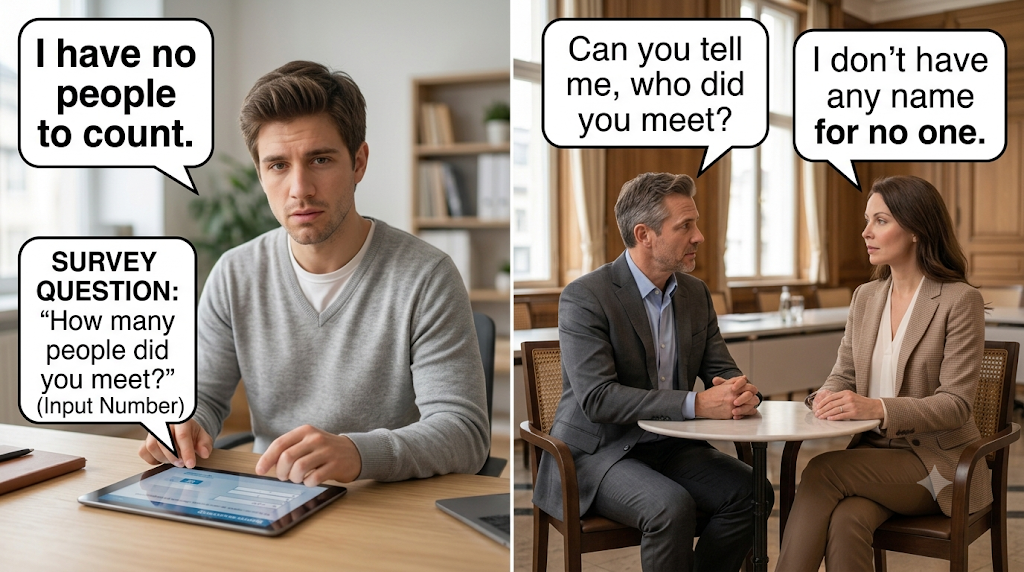
Ms. Williams writes: "none and no one."
윌리엄스 선생님이 쓰십니다: "none과 no one."
She draws a box: "none = 0 (zero). no one = nobody."
선생님이 상자를 그리십니다: "none = 0 (제로). no one = nobody."
She writes: "None is an answer for How much? / How many? (things or people)."
선생님이 쓰십니다: "None은 How much? / How many?(사물이나 사람)에 대한 대답입니다."
She writes examples.
선생님이 예문을 쓰십니다.
A: "How much money do you have?" B: "None." (= no money)
돈이 얼마나 있어요? 없어요. (= 돈이 없음)
A: "How many people did you meet?" B: "None." (= no people)
사람을 몇 명 만났어요? 안 만났어요. (= 사람이 없음)
Lucas says: "So none works for both amounts and counts, money or people?"
루카스가 말합니다. "그러면 none은 양이랑 수 둘 다에 쓰이는 거네요, 돈이랑 사람이요?"
Ms. Williams nods: "Exactly right, Lucas."
선생님이 고개를 끄덕입니다. "정확해요, 루카스."
She writes: "No one is an answer for Who?"
선생님이 쓰십니다: "No one은 Who?에 대한 대답입니다."
She writes examples.
선생님이 예문을 쓰십니다.
A: "Who did you meet?" B: "No one." (or Nobody.)
누구를 만났어요? 아무도요. (또는 Nobody.)
Huang Wei says: "So none answers how much or how many, but no one answers who?"
황웨이가 말합니다. "그러면 none은 how much나 how many에 대답하고, no one은 who에 대답하는 거네요?"
Ms. Williams nods: "Exactly right, Huang Wei. None is for amounts, no one is specifically for people."
선생님이 고개를 끄덕입니다. "정확해요, 황웨이. none은 양을 위한 거고, no one은 특별히 사람을 위한 거예요."
👩🏫 Ms. Williams says:
"none = 0 (zero). no one = nobody. None is an answer for How much?/How many? No one is an answer for Who?"
none = 0 (zero)
none = 0 (제로)
no one = nobody
no one = nobody
None is an answer for How much? / How many? (things or people):
None은 How much? / How many?에 대한 대답입니다:
A: "How much money do you have?" B: "None." (= no money)
돈이 얼마나 있어요? 없어요.
A: "How many people did you meet?" B: "None." (= no people)
사람을 몇 명 만났어요? 안 만났어요.
No one is an answer for Who?:
No one은 Who?에 대한 대답입니다:
A: "Who did you meet?" B: "No one." (or Nobody.)
누구를 만났어요? 아무도요.
📐 Grammar Point : none vs no one
| none | How much? / How many? | None. |
| no one | Who? | No one. (또는 Nobody) |
✅ "How much money do you have?" "None."
✅ "Who did you meet?" "No one."
Chapter 4 : 민준의 텅 빈 하루 / Minjun's Empty Day
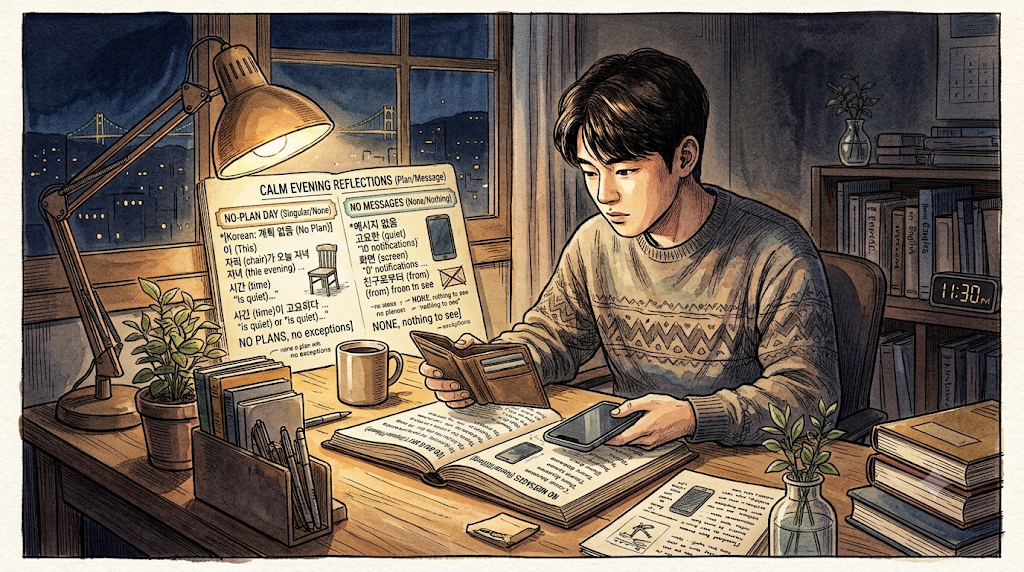
Today was a quiet day.
오늘은 조용한 하루였어요.
Carlos asked me: "How many classes do you have today?" I said: "None. It's a holiday."
카를로스가 저에게 물었어요. "오늘 수업이 몇 개 있어요?" 저는 말했어요. "없어요. 오늘은 휴일이에요."
He asked: "Who did you talk to today?" I said: "No one, actually. I just stayed home and studied."
그가 물었어요. "오늘 누구랑 얘기했어요?" 저는 말했어요. "사실 아무도요. 그냥 집에서 공부했어요."
I checked my wallet. There was no cash inside. I had none left after buying groceries yesterday.
저는 지갑을 확인했어요. 안에 현금이 없었어요. 어제 장을 본 후 하나도 안 남았어요.
I texted Yuki: "There aren't any good coffee shops open near me today, unfortunately."
저는 유키에게 문자를 보냈어요. "안타깝게도 오늘 제 근처에 문 연 좋은 커피숍이 없어요."
I noticed how naturally not any, no, and none all came out today, describing this quiet, empty day.
저는 오늘 이 조용하고 텅 빈 하루를 묘사하며 not any, no, none이 얼마나 자연스럽게 나왔는지 알아챕니다.
👩🏫 Ms. Williams says:
"실생활 대화 속 not any, no, none 사용."
"How many classes do you have today?" "None. It's a holiday."
오늘 수업이 몇 개 있어요? 없어요. 오늘은 휴일이에요.
"Who did you talk to today?" "No one, actually."
오늘 누구랑 얘기했어요? 사실 아무도요.
There was no cash inside. I had none left.
안에 현금이 없었어요. 하나도 안 남았어요.
There aren't any good coffee shops open near me today.
오늘 제 근처에 문 연 좋은 커피숍이 없어요.
📐 Grammar Point : 실생활 예문
| "How many classes?" "None." |
| "Who did you talk to?" "No one." |
| There aren't any good coffee shops. |
✅ There was no cash inside.
✅ There aren't any good coffee shops open near me.
Chapter 5 : 저녁, 없음을 말하는 다양한 방법 / Evening, Many Ways to Say Nothing
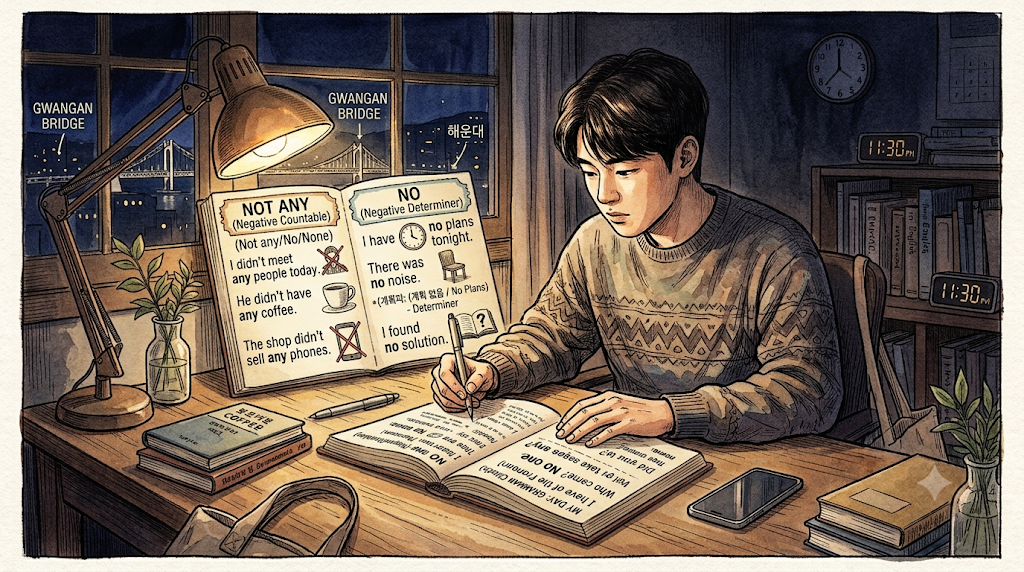
It is evening.
저녁입니다.
I sit at my desk and open my journal.
저는 책상에 앉아 일기를 폅니다.
I draw three columns.
저는 세 칸을 그립니다.
not any / no / none-no one
Under not any I write.
not any 아래에 씁니다.
I don't have any plans for tomorrow yet.
저는 아직 내일 계획이 없어요.
Under no I write.
no 아래에 씁니다.
I have no classes this weekend.
저는 이번 주말에 수업이 없어요.
Under none/no one I write.
none/no one 아래에 씁니다.
"How many messages do you have?" "None."
메시지가 몇 개 있어요? 없어요.
"Who called you today?" "No one."
오늘 누가 전화했어요? 아무도요.
I look at the three columns.
저는 세 칸을 바라봅니다.
Not any needs a negative verb. No sits with a positive verb but still means nothing. None and no one stand completely alone, answering questions directly.
not any는 부정 동사가 필요해요. no는 긍정 동사와 함께 있지만 여전히 없음을 뜻해요. none과 no one은 완전히 혼자 서서 질문에 직접 대답해요.
I close my journal, appreciating how English has so many small, precise ways to describe emptiness, no cars, no money, no one, none at all.
저는 일기를 덮으며, 영어가 텅 빔을 묘사하는 작고 정확한 방법을 얼마나 많이 가지고 있는지에 감사합니다, no cars, no money, no one, none at all처럼요.
PART 2 : Grammar Focus
Unit 75 : not + any, no, none 완전 정리
A. not (-n't) + any / no + 명사
There aren't any cars / There are no cars in the parking lot.
주차장에 차가 없어요.
How many cars are there in the parking lot? None.
주차장에 차가 몇 대 있나요? 없어요.
not (-n't) + any:
There aren't any cars in the parking lot. / Tracey and Jeff don't have any children. / You can have some coffee, but I don't want any.
주차장에 차가 없어요. / 트레이시와 제프는 아이가 없어요.
no + noun (no cars / no garage, etc.) = not any ... or not a ...:
There are no cars in the parking lot. (= there aren't any cars)
주차장에 차가 없어요.
We have no coffee. (= we don't have any coffee)
저희는 커피가 없어요.
It's a nice house, but there's no garage. (= there isn't a garage)
차고가 없어요.
negative verb + any = affirmative verb + no:
They don't have any children. or They have no children. (not They don't have no children)
그들은 아이가 없어요.
B. no and none
Use no + noun: We have no money. / There were no problems.
저희는 돈이 없어요.
Use none alone: "How much money do you have?" "None." / "Were there any problems?" "No, none."
없어요.
C. none and no one
none = 0 (zero) / no one = nobody
None is an answer for How much? / How many?:
"How much money do you have?" "None." / "How many people did you meet?" "None."
돈이 얼마나 있어요? 없어요.
No one is an answer for Who?:
"Who did you meet?" "No one." (or Nobody.)
누구를 만났어요? 아무도요.
Key Summary : Unit 75 완전 정리
| not any | 부정 동사 + any | I don't have any money. |
| no | 긍정 동사 + no + 명사 | I have no money. |
| none | 혼자 (How much/many?) | "How much?" "None." |
| no one | 혼자 (Who?) | "Who?" "No one." |
Key Phrases : Unit 75
| not any | ~이 하나도 없다 | There aren't any cars. |
| no + 명사 | ~이 없다 | We have no coffee. |
| None. | 없어요. (양/수) | "How much?" "None." |
| No one. | 아무도요. (사람) | "Who?" "No one." |
PART 3 : Practice
Mini Quiz
- There ________ ________ cars in the parking lot. (aren't any)
- There are ________ cars in the parking lot. (no)
- We have ________ money. (no)
- "How much money do you have?" "________." (None)
- "Who did you meet?" "________." (No one)
- They don't have ________ children, or they have ________ children. (any / no)
정답
- aren't any
- no
- no
- None
- No one
- any / no
Discussion Questions
- not any와 no의 차이를 예문 두 개씩 들어 설명해 보세요.
- 다음 문장들을 올바르게 고쳐 쓰세요.
- "They don't have no children."
- "How much money do you have?" "No money."
- not any를 사용한 부정문과, no를 사용한 문장을 각각 하나씩 써보세요.
- none과 no one을 각각 사용해서 짧은 대화를 만들어 보세요.
- 파트너와 다음 주제로 대화해 보세요: 오늘 누구를 만났어요? (No one 또는 이름으로 대답해 보세요)
'스토리로 배우는 영문법' 카테고리의 다른 글
| Unit 74 | some and any (0) | 2026.09.12 |
|---|---|
| Unit 73 | one/ones (0) | 2026.09.11 |
| Unit 72 | this/that/these/those (0) | 2026.09.11 |
| Unit 71 | the... (names of places) (0) | 2026.09.10 |
| Unit 70 | I like music, I hate exams (0) | 2026.09.09 |